
Soundproofing NYC Apartments & Commercial Spaces
Hush Soundproofing NYC: acoustical consulting, laboratory testing and in-house contracting for apartments, offices and mechanical noise across New York City.
★★★★★ 49 Google reviews · Trusted by Columbia, NYU, MTA & Sony Music
- 298 N 7th St. Brooklyn, NY 11211
A Professional Soundproofing Company for NYC Homes and Businesses
Hush sets the standard for soundproofing NYC apartments and urban buildings. We focus exclusively on noise control, combining acoustical consulting, laboratory testing, and in-house contracting under one roof. From targeted wall soundproofing and ceiling soundproofing assemblies to full apartment sound isolation, our work is precise, engineered, and built to perform.
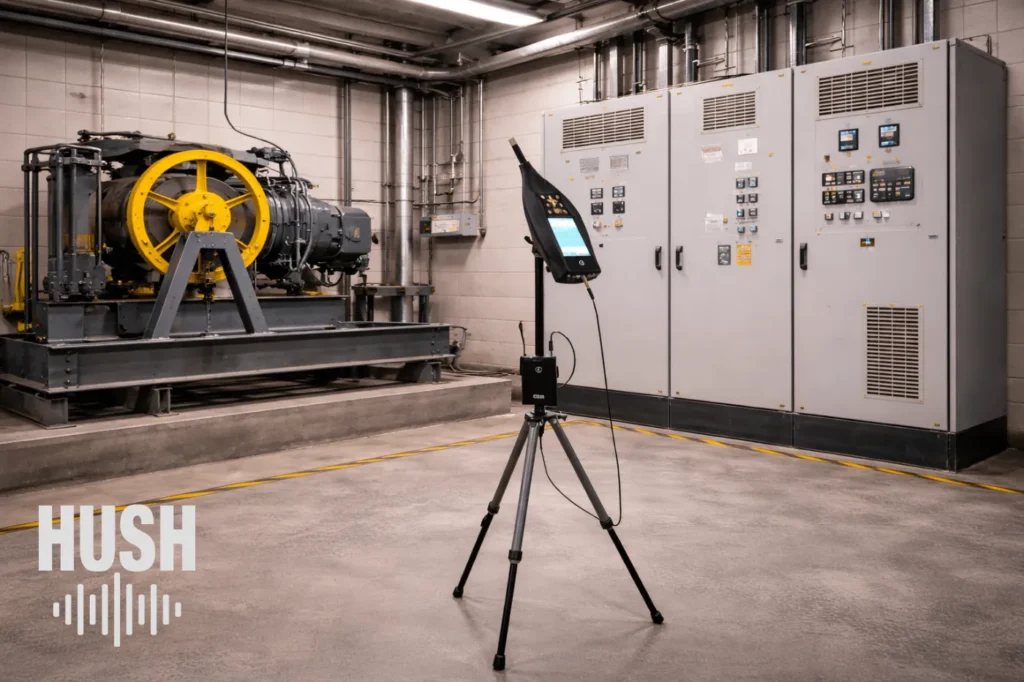
Our work extends to commercial offices and professional environments where speech privacy, echo control, and mechanical noise are critical to performance. This also includes HVAC systems, boiler rooms, and building mechanical infrastructure where vibration and structure borne noise must be properly controlled.
Acoustic Engineering and New York City’s challenge of noise pollution.
New
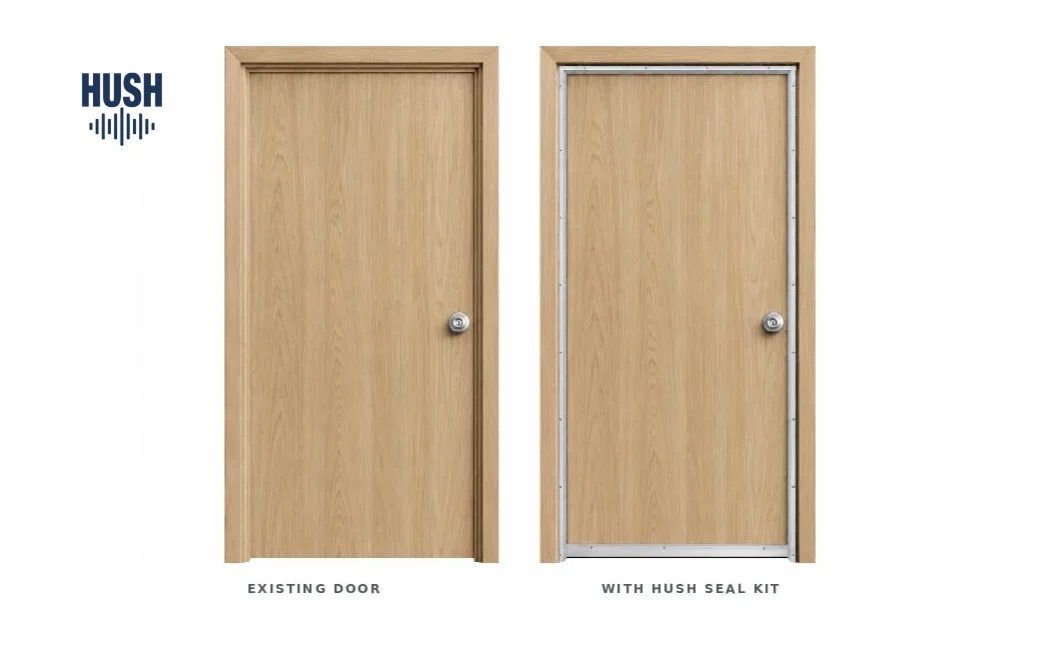
Book door soundproofing online
A door perimeter seal and automatic door bottom, installed by Hush for $1,440 per door. Answer three quick questions, pick your date and pay online.
SPEAK WITH HUSH
917.789.8877
Ceiling Soundproofing
Ceiling soundproofing focuses on noise and vibration transmitted from above, including footfall, impact noise, and structure borne sound. Our ceiling assemblies address flanking through perpendicular rigid connections to the source while also respecting height constraints and existing building conditions.
Wall Soundproofing
Wall soundproofing reduces sound transfer between adjacent spaces. We design and install wall assemblies that limit airborne noise such as voices, music, and television, taking account of parasitic noise paths through connected structural elements.
Floor Soundproofing
Floor soundproofing targets impact noise and vibration traveling through structural elements. Our approach combines isolation, mass, and damping to reduce transmission while remaining compatible with finished flooring systems and building requirements.
Office Soundproofing
Office soundproofing improves speech privacy and acoustic comfort in professional environments. We focus on sound transmission and reverberation to support focus, confidentiality, and intelligibility in active workspaces.


 Trustindex verifies that the original source of the review is Google.
 Trustindex verifies that the original source of the review is Google.
 Trustindex verifies that the original source of the review is Google.
 Trustindex verifies that the original source of the review is Google.
 Trustindex verifies that the original source of the review is Google.
 Trustindex verifies that the original source of the review is Google.
 Trustindex verifies that the original source of the review is Google.
 Trustindex verifies that the original source of the review is Google.
 Trustindex verifies that the original source of the review is Google.
Clients and Projects
Our clients include residential, commercial, and institutional organizations across New York City that rely on precise soundproofing and acoustical execution, from universities and media companies to transit agencies and hospitality brands.

How Our NYC Soundproofing Process Works
Hush uses established soundproofing systems to reduce noise and vibration transmission in residential and professional environments.
Expertise and Experience
Our work is proven by years of focused soundproofing projects in New York City buildings. We approach each project with a deep understanding of how sound behaves in real structures, informed by consulting, testing, and hands on construction.
Local Knowledge
Working extensively in New York City buildings gives us a clear understanding of common construction types and recurring noise paths. That familiarity allows us to anticipate challenges and address them efficiently during installation.
Customized Solutions
Every space presents different constraints. We use established soundproofing systems and adjust them to the conditions of the building, tailoring each solution while relying on methods that have a strong track record.
Exceptional Customer Service
Our process is structured, transparent, and collaborative from start to finish. Clear communication and follow through are central to how we work, and client feedback through our reviews reflects that consistency.
High-Quality Materials
Soundproofing performance depends on the integrity of the assemblies used. We rely on materials and systems that have demonstrated long term reliability, selecting composite components based on data and function rather than marketing claims.
Proven Track Record
Our experience spans a wide range of residential and select commercial projects throughout the city. The results of that work are reflected in repeat clients, referrals, and long standing professional relationships.
Soundproofing That Is Measured, Not Guessed
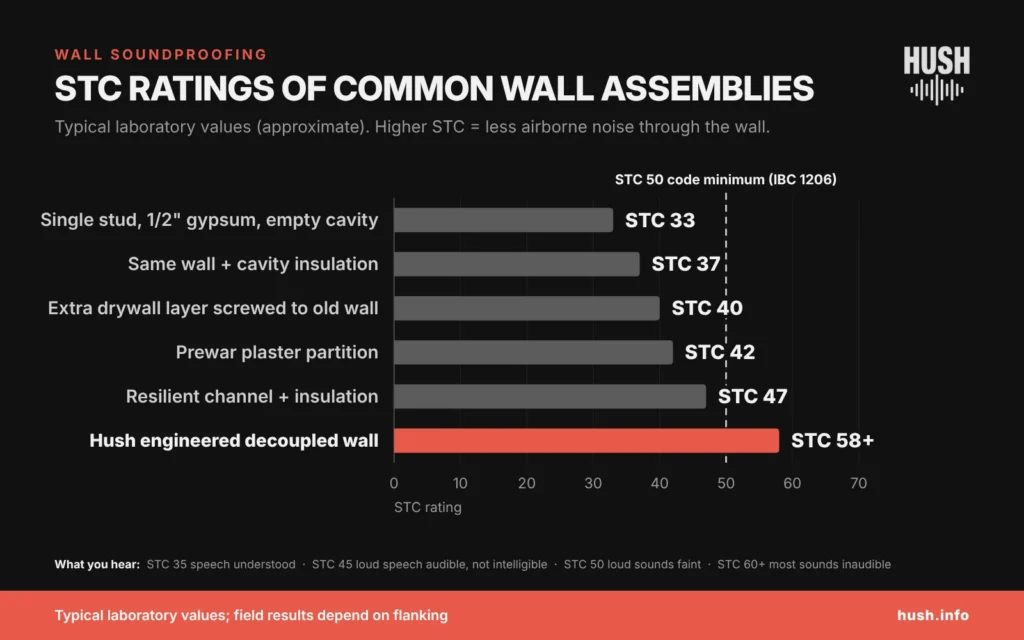
Most soundproofing fails because the wrong problem was solved. Airborne noise through a wall, impact noise through a ceiling, and low-frequency vibration through the structure each need a different assembly. Hush starts with the physics: we identify the noise type, the transmission path, and the flanking paths, then design assemblies using decoupling, mass, damping, absorption, and airtight sealing. Performance is expressed in STC and IIC ratings, and building codes based on IBC Section 1206 set STC 50 / IIC 50 as the minimum between dwelling units. Most Hush assemblies are designed to reach STC 55-60+.
Two physics limits shape every design. First, the mass law. Doubling the weight of a single layer adds only about 5–6 dB of transmission loss, the decibels a barrier removes. Mass alone gives diminishing returns. Second, flanking transmission: sound slips around the treated wall through joists, ducts, outlets and ceiling cavities. So we pair mass with decoupling and airtight sealing. Field ratings measured in your building (ASTC and AIIC) usually land a few points below lab STC and IIC. That gap comes from flanking and workmanship, which is why we track down every connected path.
Noise Reduction in NYC, Measured Before and After
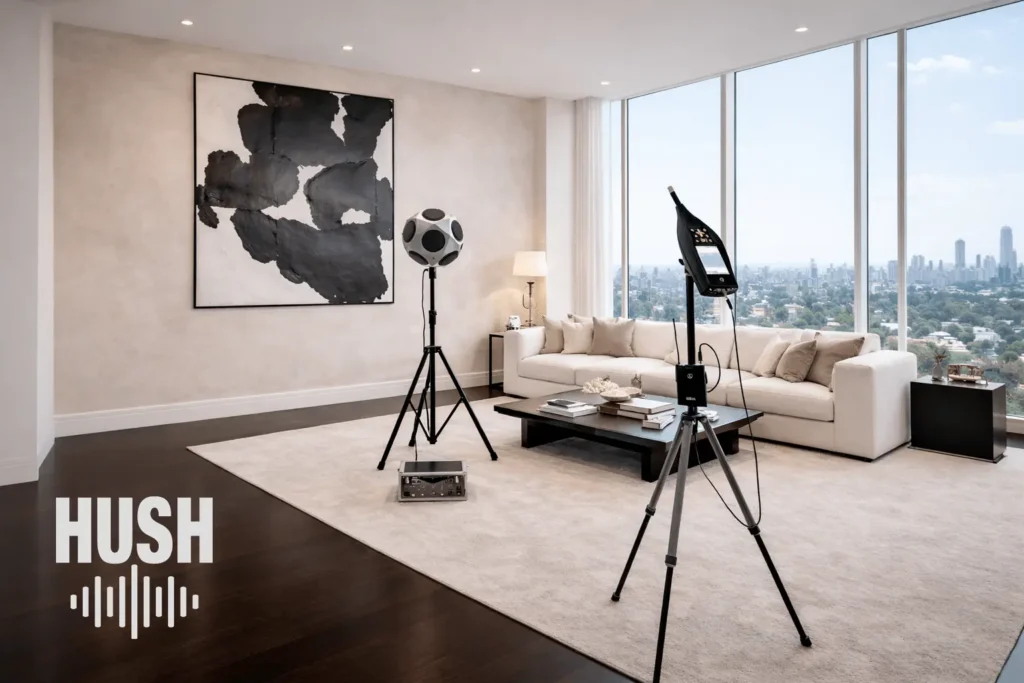
Every Hush project has one goal: noise reduction you can hear and measure. So we take sound level readings before construction and again after it. In our service agreement, we guarantee at least a 50 percent reduction in the noise you hear. Our target is 70 percent or more. That is how we approach noise reduction in NYC apartments, offices and mechanical rooms. See what a measured acoustic report includes.
New to the ratings? Read STC and IIC ratings explained or the Sound Transmission Class reference. For budget planning, see soundproofing cost NYC.



Apartments, Co-ops and Condos
Apartment soundproofing in NYC begins with identifying the dominant transmission path. See our complete apartment soundproofing NYC guide. Voices, television, and music generally travel as airborne noise, while footsteps, dropped objects, and mechanical equipment can excite the building structure. Hush evaluates walls, ceilings, floors, doors, penetrations, and flanking connections before specifying a system. The goal is to restore quiet and privacy between units without giving up usable space.
Depending on the conditions, the solution may combine added mass, structural decoupling, constrained layer damping, cavity absorption, and airtight perimeter sealing, using soundproofing materials chosen for the job. The assembly must also account for ceiling height, usable floor area, existing finishes, and coop or condominium requirements. Acoustic panels may reduce echo inside a room, but they are not a substitute for sound isolation between apartments.
For additional consumer information, the NYC Department of Environmental Protection publishes a Residential Noise Control Guidance Sheet. The World Health Organization’s guidance on environmental noise also explains how persistent noise can affect sleep, concentration, and wellbeing. Hush applies these broader principles through project specific acoustical consulting, system design, and in house installation.
New York Soundproofing Across the Five Boroughs
New York soundproofing changes block by block, because each borough has its own construction. The goal stays the same, but the details do not. Soundproofing New York buildings starts with knowing how each one was built. Hush is based at 298 N 7th St in Williamsburg, Brooklyn, and we handle soundproofing across all five boroughs of New York City with one method: find the noise path, seal it, then add mass, damping and decoupling where they count.
Manhattan Soundproofing
Prewar co-ops, brownstones and high-rise towers stack tightly together. Noise arrives two ways: structural vibration through rigid connections, and corridor noise through doors. Manhattan soundproofing relies on airtight perimeters, upgraded door assemblies and decoupled wall and ceiling systems.
Brooklyn Soundproofing
Brooklyn mixes brownstones, loft conversions and new condos, so no two buildings behave alike. Brick adds mass, but sound still travels through joists, party wall connections and penetrations. That is why Brooklyn soundproofing focuses on flanking control where walls, ceilings and floors meet.
Queens Soundproofing
Queens buildings typically combine wood joists, plaster and details that vary from building to building, so no two scopes are identical. Floors and ceilings carry impact noise, while lightweight walls carry voices. So Queens soundproofing starts by identifying whether the problem is airborne, impact or structure-borne.
Bronx Soundproofing
Heavier prewar construction often gives the Bronx a better baseline. However, sound still leaks through floors, corridors and connection points. In most Bronx soundproofing projects, we keep the existing mass and fix the weak links instead of rebuilding everything.
Staten Island Soundproofing
Staten Island has many semi-attached houses, where direct adjacency drives the noise. Gaps and rigid connections carry sound and vibration between homes, so Staten Island soundproofing needs a clear strategy for separation and airtightness.
New York Soundproofing Rules and Resources
Noise is one of the most common reasons New Yorkers call 311. Even so, many noise problems are not code violations, they come from how the building was built. The NYC Noise Code covers commercial music, construction and building equipment, while the NYC Building Code sets requirements for new construction and renovations.
NYC DEP residential noise guidance recommends consulting a qualified acoustical consultant before spending money. It also lists targets such as STC 50 for interior walls and IIC 50 to 60 for floors, and we build every Hush scope around those targets.
Our Soundproofing Services
Hush is a New York City soundproofing contractor and acoustical consultant. We also design and install engineered sound isolation for apartments, townhouses, offices, and commercial buildings across all five boroughs, from a single party wall to full mechanical noise control.
Not sure which one you need? Compare all our soundproofing services by the noise you hear.
Apartment and home soundproofing
Walls, ceilings, floors, and doors for co-ops, condos, rentals, and brownstones.
Wall soundproofing
Decoupled, damped party walls rated STC 55-60+ to block voices, TV, and music.
Ceiling soundproofing
Isolated ceilings that stop footsteps and impact noise from the apartment above.
Floor and door soundproofing
Acoustic underlayments, floating floors, perimeter seals, automatic door bottoms, and STC-rated doors.
Commercial and mechanical noise control
Offices, restaurants, hotels, gyms, schools, and building systems including elevators, boilers, chillers, and HVAC.
Acoustical consulting and testing
Field STC and IIC measurements, noise diagnosis, and acoustic reports for boards, landlords, and design teams.
Acoustic panels
Felt, fabric, wood slat, and wood wool acoustic panels to control echo and reverberation.
Our Process
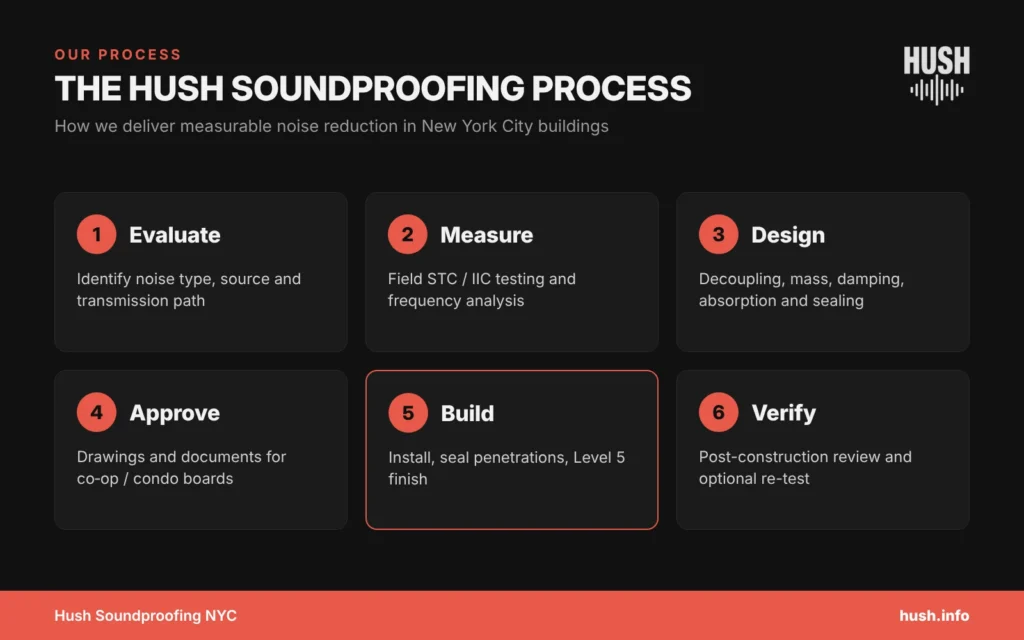
Evaluate, measure, design, approve, build, verify. Every project follows the same disciplined process, documented for co-op and condo boards and scheduled within the work hours set by the NYC Noise Code.
Soundproofing NYC FAQ
How much does soundproofing cost in NYC?
Hush wall soundproofing typically costs $12,000 to $25,000 per room and ceiling soundproofing $18,000 to $36,000 per room. A door seal package is $1,440 per door installed. See our soundproofing cost NYC guide for details.
What is the best way to soundproof an apartment in NYC?
Identify the noise type first. Airborne noise through walls needs a decoupled, damped wall assembly. Footsteps from above need an isolated ceiling or a floor upgrade upstairs. Hallway noise needs door seals or a soundproof door.
Can you soundproof a rental apartment?
Yes, with landlord approval. Many renters start with door seals and acoustic sealing, and some landlords approve wall or ceiling assemblies as permanent improvements.
Do you work in co-ops and condos?
Yes. Hush prepares assembly details, product data, and insurance certificates for alteration agreements and schedules work within building rules.
What is the difference between soundproofing and acoustic panels?
Soundproofing blocks sound passing between spaces (STC, IIC). Acoustic panels absorb sound inside a room to reduce echo (NRC). Many projects use both.
Which NYC boroughs do you serve?
Manhattan, Brooklyn, Queens, the Bronx, and Staten Island, for both residential and commercial projects.
Can you measure how loud my neighbor is?
Yes. Our acoustic reports use calibrated Class 1 instrumentation to measure field STC and IIC, noise levels, and frequency content.
Is everyday neighbor noise against the law in NYC?
Usually not. Normal living sounds like footsteps and conversation are not typically violations. However, loud music, construction outside permitted hours and noisy equipment can be.
Why do older New York buildings have so much noise?
Many were built before modern sound rules. Decades of renovations have created gaps and flanking paths that carry sound.
Schedule an NYC Soundproofing Consultation
Contact us to discuss your noise conditions and objectives.