
Wall Soundproofing NYC
Soundproof Walls framed by Hush Soundproofing
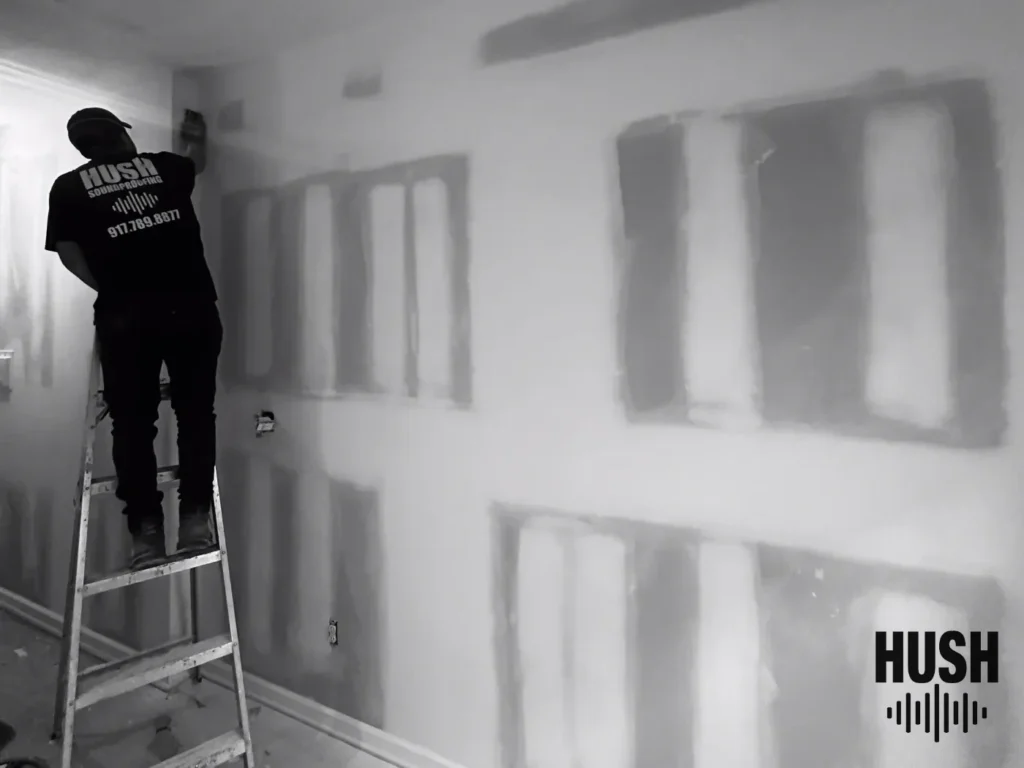
Wall Soundproofing for NYC Apartments and Offices
A typical New York apartment party wall is a single row of studs with a layer of drywall on each side and, often, nothing in between. As a result, it rates around STC 33, which means you can follow your neighbour’s phone call. Wall soundproofing, therefore, rebuilds that wall from your side into a decoupled, insulated, damped, sealed assembly that reaches STC 55-60+, where a raised voice next door is a murmur and normal conversation is gone. To date, Hush has built these walls in co-ops, condos, brownstones and offices across the five boroughs.
Average cost: $12,000 to $25,000 per room for walls of 100 sq ft and up. Details below.
How Soundproof Walls Work
Voices, TV and music are airborne noise. It crosses a wall two ways: through the air in any gap, and through the structure when the drywall on one side vibrates the studs, which vibrate the drywall on the other side. A wall stops both only when it has four things, plus airtightness.
- Mass: heavy layers that resist vibration. Examples include drywall, soundproof drywall and mass loaded vinyl.
- Decoupling: no rigid path from one face to the other. For example, isolation clips, resilient channel, or independent framing.
- Damping: the rigid layers stop ringing. Damping compound (green glue) between drywall sheets.
- Absorption: the cavity does not resonate. Mineral wool soundproof wall insulation.
- Sealing: every edge, outlet and penetration closed with acoustical sealant and putty pads.
Remove any one, and the wall then underperforms. Similarly, add mass alone, as most DIY attempts do, and the wall barely improves. Our soundproofing materials guide covers each product; this page is about the assembly.
Mass alone fails because of the mass law. Doubling the weight of a single layer adds only about 5–6 dB of transmission loss, the decibels a wall removes. Weight here means a layer’s mass per unit area (lb/ft² or kg/m²), what acousticians call surface density. So extra weight gives diminishing returns, and decoupling does the heavy lifting.
Inside a Hush Soundproof Wall
Step 1: Inspection and sealing
First, we find the leaks: gaps at the floor and ceiling, cracks behind trim, the outlet boxes that share a stud bay with the neighbour’s. Then everything gets acoustical sealant.
Step 2: Electrical and penetration treatment
Next, we offset outlet boxes so they no longer sit back to back and wrap them in acoustic putty pads. We also gasket pipes and ducts.
Step 3: Decoupling
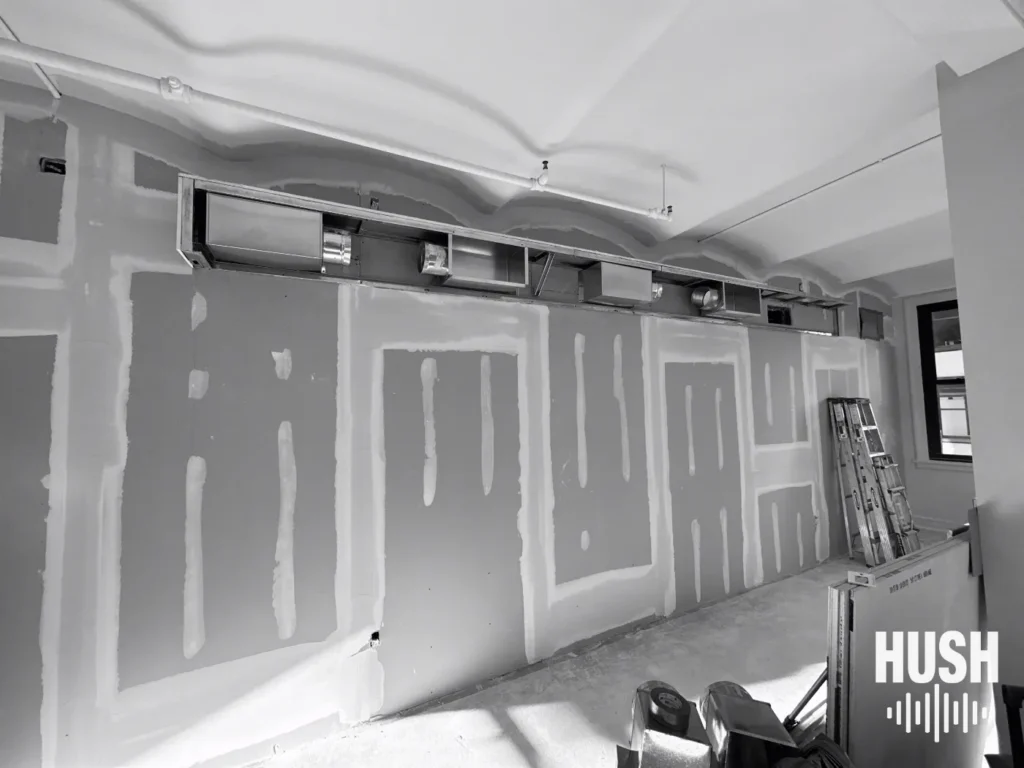
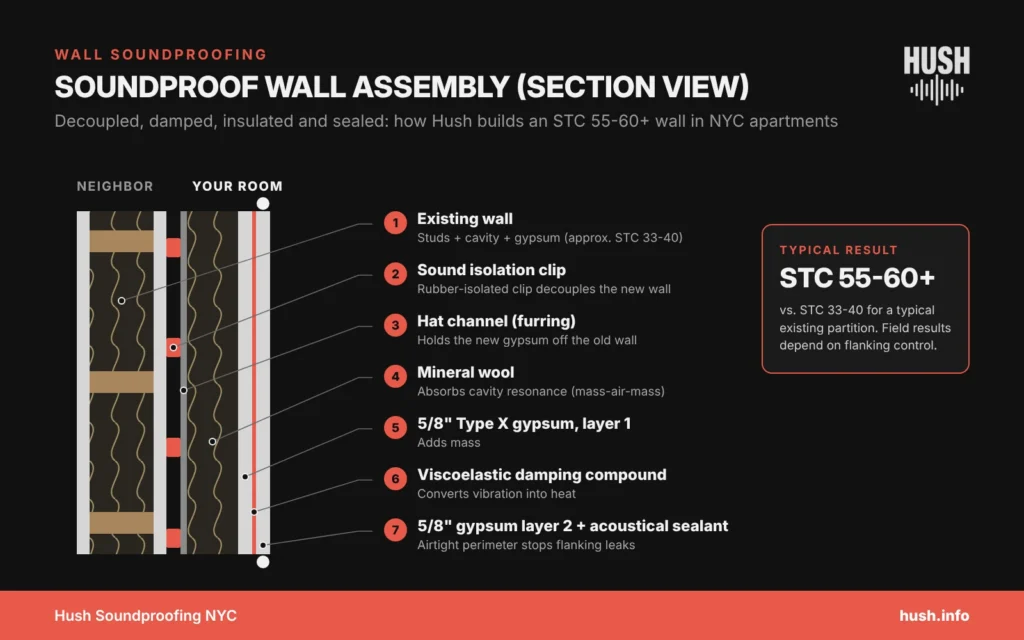
Then we fasten sound isolation clips, sometimes sold as soundproofing clips, to the existing wall or studs and snap hat channel into the clips. Here, line and point connections matter: a stud touches the board along a line, a clip only at points. As B.H. Sharp’s work on double walls showed, point connections pass less vibration. Alternatively, on a wall with room to spare, an independent second stud row gives the same result.
Step 4: Insulation
After that, mineral wool goes in with full contact and no voids.
Step 5: Mass and damping
Two layers of five-eighths Type X drywall with damping compound between them, hung from the channel. However, where depth is limited, laminated soundproof drywall replaces the two-layer sandwich.
Damping also targets the coincidence dip. At that frequency, bending waves in the board line up with sound in the air, so isolation sags. For five-eighths-inch gypsum, it falls around 2,500–3,000 Hz. The board’s radiation efficiency, how well its motion turns into sound, also peaks there. Constrained-layer damping, a viscoelastic layer sandwiched between two rigid sheets, makes that dip shallower.

Step 6: Airtight finish
Finally, we seal the perimeter with acoustical caulk before trim goes on, apply a Level 5 finish, and reinstall outlets and switches in sealed boxes.
In most cases, a single wall takes two to five working days and adds roughly two to four and a half inches to the wall.
Wall Soundproofing Performance: STC Ratings
| Wall assembly | Typical STC |
|---|---|
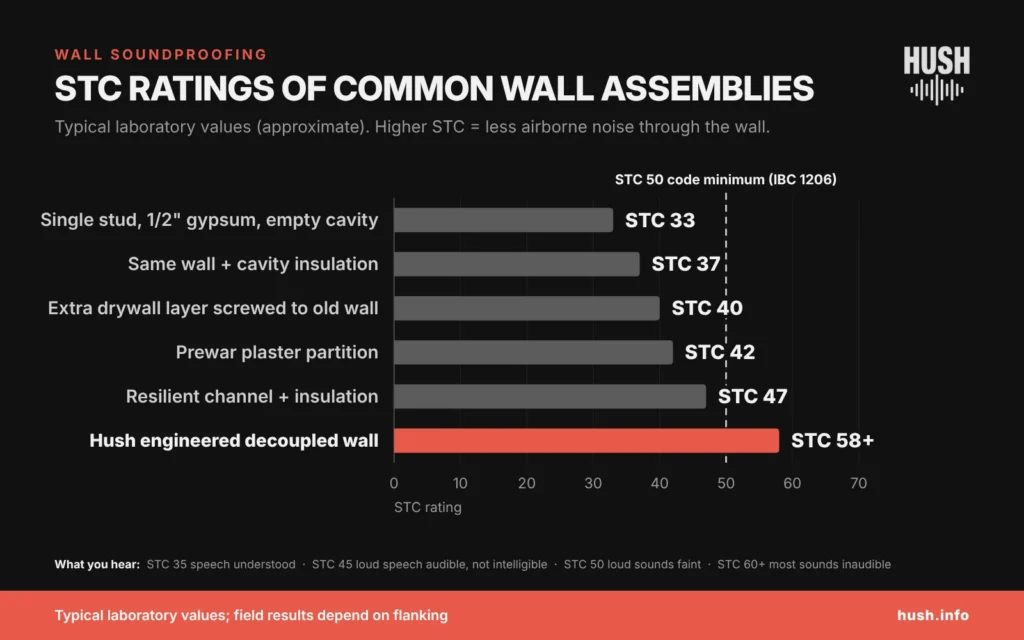
| Single stud wall, drywall each side, empty cavity | 33 |
| Same wall with insulation | 36-39 |
| Extra layer of drywall screwed to the existing wall | 40-43 |
| Resilient channel, insulation, single drywall | 45-50 |
| Hush decoupled assembly: clips, mineral wool, two layers damped drywall, sealed | 55-60+ |
For reference, IBC Section 1206 requires STC 50 between dwelling units in new construction; NYC DEP recommends STC 50 for interior walls between apartments. However, most existing NYC walls fall well short of it. Our STC and IIC ratings guide also explains what the numbers sound like.
Those are lab-style figures. Field ratings measured in a finished room (ASTC, ASTM E336) usually come in several points lower because of flanking and workmanship. Flanking transmission is sound that bypasses the wall through floor joists, ceiling cavities, ducts or outlets. That is also why the IBC accepts STC 45 when the wall is field-tested.
Soundproof Drywall, Green Glue and Resilient Channel: What Each One Does
In fact, these three come up in every consultation, often as if any one of them were the whole answer.
Soundproof drywall (QuietRock, SilentFX and similar) is two gypsum layers laminated around a damping core, and soundproofing drywall is the step people most often try first. In other words, it is mass and damping in one sheet. For this reason, it is the right choice where the wall cannot grow by the extra five-eighths inch a second layer would add. However, it does nothing useful screwed directly to the existing wall without decoupling.
Green glue and other damping compounds go between two sheets of ordinary drywall and turn panel vibration into heat. Two layers of standard Type X with compound between them performs like soundproof drywall at lower material cost and slightly more labour. Still, it needs full coverage and a few weeks of cure time.
Resilient channel is the budget decoupler: a springy metal strip across the studs that the drywall hangs from. It works, although a single screw through the channel into a stud short-circuits it, and heavy double-layer drywall can bottom it out. Sound isolation clips with hat channel are the version that carries the weight, and a misplaced screw cannot short-circuit them, and they are what we install.
The honest answer to “which is best” is: a wall with all three jobs covered (mass, damping, decoupling), by whichever products fit the depth you have.
Best Insulation for Soundproofing Walls
Mineral wool is the best soundproofing for walls at the insulation layer, and the best sound insulation for walls by weight and fire rating. For example, Rockwool and Roxul Safe’n’Sound are the common brands; dense fibreglass works nearly as well where it is already present and well fitted. Also, the cavity must be full with no voids. Insulation alone moves a bare wall from STC 33 to the high 30s; it is necessary and nowhere near sufficient. In contrast, closed-cell spray foam makes a wall worse by rigidly bridging the two faces. See the insulation section of our materials guide.
How to Soundproof a Wall: Existing Wall vs. New Wall
How to soundproof walls depends on whether the wall exists yet.
Soundproof existing wall: we build the new assembly over the current wall, from your side, without opening the neighbour’s. In short, this is how to soundproof a wall in an apartment, and it is the normal case.
How to build a soundproof wall from scratch (a partition inside your own space, a home office wall, a temporary soundproof wall between roommates) lets us use staggered or double studs with a full air gap, which reaches high STC in less depth. A “soundproof temporary wall” that is not sealed at floor, ceiling and sides is a room divider, not a soundproof wall; pressurised partitions and freestanding panels leak around every edge.
How to soundproof interior walls between your own rooms (a soundproof bedroom wall next to a living room, a nursery) follows the same assembly. We usually soundproof interior walls like these to a lower performance target since the noise is yours and you control it.
Soundproof Apartment Walls and Co-op Boards
When you soundproof walls, apartment building rules come into play too. We build party wall work entirely from your side, so nothing happens next door. Co-op and condo boards generally approve it as an interior alteration with a licensed, insured contractor; we provide the drawings, the assembly specification, and the schedule that respects NYC Noise Code work hours. As a result, you do not need the neighbour’s consent. Our guide to soundproofing a wall between apartments goes deeper on party walls, and apartment soundproofing covers the approval process.
Wall Soundproofing for Every NYC Building Type
- Party walls between units in co-ops and condos: the core case, STC 55-60+ from one side.
- Prewar plaster walls, especially those with hidden flanking through continuous lath, chases and old chimney breasts; the inspection step matters most here.
- Brownstones and converted multi-unit homes, where the party wall is shared masonry and the flanking runs through joists pocketed into it.
- Offices, HR rooms and medical rooms needing speech privacy; often a lower STC target but a strict one.
- Walls shared with elevator shafts and mechanical rooms, where low-frequency hum needs mass and decoupling together; see mechanical noise.
Wall Soundproofing vs. Acoustic Wall Panels
First, soundproofing blocks sound between rooms, and STC rates it. Acoustic wall panels and acoustic wall tiles, however, absorb echo inside a room and NRC rates them. Panels on a shared wall will not stop your neighbour; instead, they will make your room sound softer. For this reason, many projects use both: a soundproofed wall plus a little acoustic wall treatment for the room. See acoustic panels.
Outlets, Switches and Other Small Leaks
Back-to-back outlet boxes in the same stud bay are the commonest leak in a NYC party wall; sound passes straight through the two plastic boxes. So we offset them, wrap them in putty pads, and seal with acoustical sealant rather than spray foam. In addition, baseboard gaps, cable penetrations and the joint where the wall meets a hung ceiling are the others. As a result, a wall with every material above and an unsealed outlet underperforms a sealed wall with half of them.
Wall Soundproofing Cost in NYC
- Decoupled soundproof wall: $12,000 to $25,000 per room, 100 sq ft and up, including decoupling, insulation, mass and damping layers, sealing and finish.
- Variables: wall length and height, number of outlets and penetrations, plaster vs. drywall substrate, board requirements, and whether adjacent surfaces need tying in to stop flanking.
- Consultation: $250 virtual or $500 on-site, credited toward the project.
Full context on our soundproofing cost guide.
Wall Soundproofing FAQ
How do I soundproof a wall between apartments?
First decouple and insulate, then add damped mass and seal, all from your side. See the assembly above and our party wall guide.
Does adding a layer of drywall soundproof a wall?
If it is screwed directly to the existing wall, it adds a few points and leaves the leaks. Hung on isolation clips with damping compound and sealing, it is the finish layer of a real soundproof wall.
Does green glue work?
Yes, as long as it sits between two rigid layers at full coverage and has time to cure.
Resilient channel or isolation clips?
Clips. Channel works when installed perfectly, but it fails from a single misplaced screw.
What is the best insulation for soundproofing walls?
Mineral wool, because it is dense and fire-resistant, fitted full with no voids.
Can I soundproof a bedroom wall in a rental?
The full assembly is construction, so it needs landlord approval first. Sealing outlets and the perimeter, and a filled bookcase against the wall, are the reversible options.
Will a soundproof wall stop bass?
It will reduce it, though. Low frequencies are the hardest to block, and if bass is the main problem we set expectations at the consultation before you spend.
How long does it take?
Typically two to five working days for a single wall, depending on outlets and finish.
Why Hush
Hush specializes exclusively in soundproofing and building acoustics. We measure performance, design assemblies, and execute construction with consistency. Our work is built for long-term results, not temporary relief.
If you are looking for a soundproofing company that understands how walls behave inside real buildings, you are in the right place.
Expertise and Experience
With extensive experience in soundproofing, Hush Soundproofing provides highly specialized and knowledgeable services, ensuring top-quality results for residential and commercial projects.
Local Knowledge
Based in Brooklyn, Hush Soundproofing has a deep understanding of the local architecture and common soundproofing challenges, allowing for more effective and relevant solutions.
Customized Solutions
Hush Soundproofing offers tailored soundproofing solutions to meet the unique needs of each client, ensuring maximum effectiveness and satisfaction.
Exceptional Customer Service
Committed to providing an outstanding customer experience, Hush Soundproofing offers responsive, friendly, and professional service throughout the entire process.
High-Quality Materials:
Using only the best materials and latest technology, Hush Soundproofing guarantees durable and efficient soundproofing that stands the test of time.
Proven Track Record
Hush Soundproofing has a history of successful projects and satisfied clients, demonstrating reliability and consistent delivery of high-quality soundproofing services.
Our Clients
Client partners include residential, commercial, and institutional organizations that rely on precise soundproofing and acoustical execution.

IN-PERSON CONSULTATION
Contact Hush Soundproofing today! Our expert team is ready to assess your space and provide customized solutions to create a peaceful and quiet environment.
Schedule a Wall Soundproofing Consultation
Hush is a licensed New York City contractor with an in-house acoustic team. We are based in Brooklyn and serve Manhattan, Queens, the Bronx and Staten Island. We find the leaks, build the assembly, and measure the result.
Related: Soundproof a Wall Between Apartments · Apartment Soundproofing · Ceiling Soundproofing · Door and Window Soundproofing · Soundproofing Materials · Acoustic Panels · STC and IIC Ratings · Soundproofing Cost NYC