
Floor Soundproofing NYC
Done right: floor soundproofing in NYC with acoustic underlayment
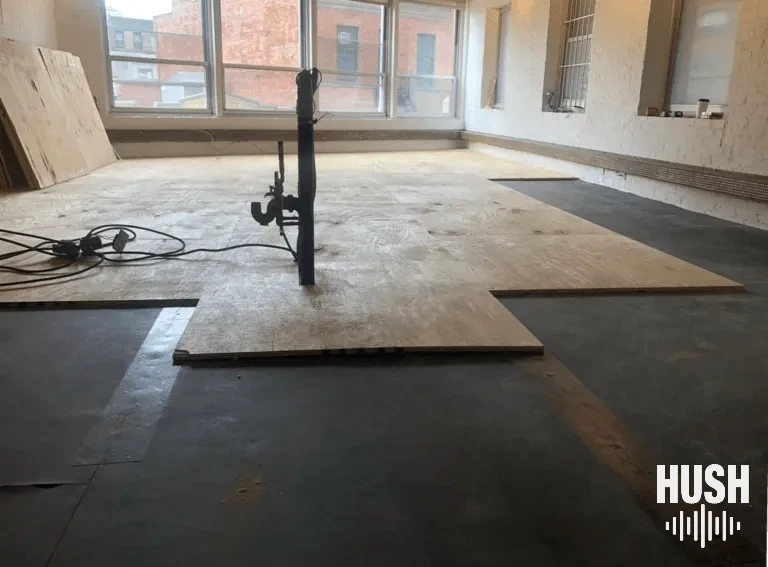
Floor Soundproofing for NYC Apartments and Houses
Floor soundproofing solves a problem that is usually somebody else’s: your footsteps, your chairs, your children, your treadmill, arriving in the apartment below. In New York it is also the problem co-op and condo boards care about most, which is why so many alteration agreements specify an IIC rating or an 80% carpet rule. Hush designs and installs soundproof flooring assemblies that stop impact noise at the source, meet board requirements, and let you keep the hardwood or tile you actually want.
Impact Noise vs. Airborne Noise Through a Floor
In general, a floor transmits two things.
Impact noise is footsteps, dropped objects, furniture, exercise equipment. It is energy delivered directly into the structure, and it is what the neighbour below complains about. IIC (Impact Insulation Class) rates impact performance.
Airborne noise is voices, television and music passing through the floor-ceiling assembly. STC rates it instead.
Floor soundproofing is mostly about impact, because the floor is where the impact starts. Stopping the energy before it enters the joists or slab is far more effective than trying to catch it in the ceiling below. Airborne noise, on the other hand, we usually address from whichever side you are renovating. Our STC and IIC ratings guide explains both numbers.
How to Soundproof a Floor: The Assembly
Step 1: Assess the noise
A Hush soundproof floor is built as a floated system: the finished floor and its subfloor sit on a resilient layer and never touch the structure or the walls rigidly.
Impact, airborne or both, and what the building is: wood joists, concrete slab, or a slab with a dropped ceiling below.
Step 2: Prepare the substrate
Remove the existing flooring to the subfloor or slab, or, where height allows, work over the existing floor.
Step 3: First acoustic underlayment layer
A resilient mat (rubber, cork-rubber, or a dense foam engineered for impact) laid over the whole area. How springy the mat is shows in its dynamic stiffness (s′), measured to ISO 9052-1 in MN/m³. A lower s′ gives a lower floating-floor resonance and, as a result, better impact isolation.
Step 4: Floating subfloor
A new layer of plywood or cement board that adds mass and distributes load across the resilient layer, not fastened through to the structure.
Step 5: Second underlayment layer
A thinner acoustic underlay matched to the finish floor.
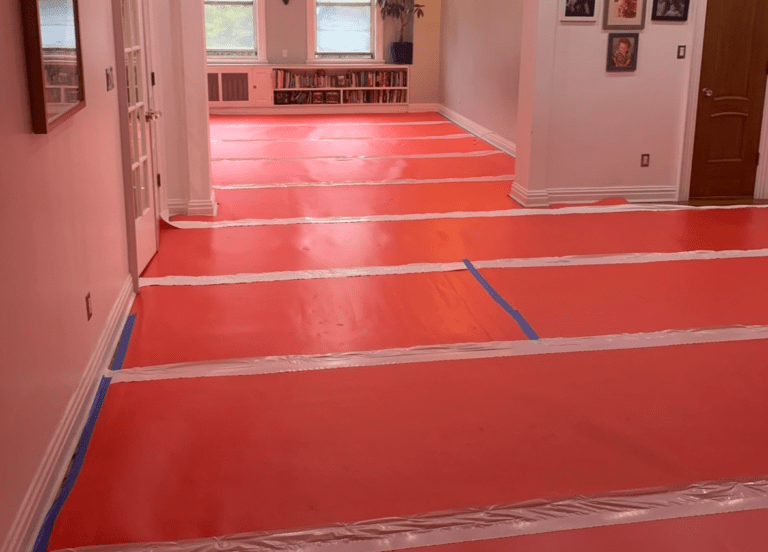
Step 6: Finished floor
Hardwood, engineered wood, laminate, LVT or tile installed so it is isolated from walls and any rigid connection.
Step 7: Perimeter isolation and sealing
Perimeter isolation strip at every wall, acoustical caulk at the edges, and base trim installed so it does not bridge floor to wall.
The result is a floor that moves very slightly as a unit on its resilient layer instead of hammering the structure beneath it.
Acoustic Underlayment: Choosing the Right One
Acoustic underlayment is the heart of the system, and “best underlayment to reduce noise” depends entirely on the finish floor and the structure.
| Finish floor | Underlayment approach |
|---|---|
| Hardwood (nail-down) | Soundproof underlayment for hardwood floors means a floated plywood subfloor on a rubber mat; nail into the floating subfloor, never through to joists |
| Engineered wood or laminate | Dense rubber or cork-rubber underlay; the best underlayment for laminate flooring to reduce noise is the heaviest one the click-lock manufacturer allows |
| Luxury vinyl tile (LVT) | Thin, firm acoustic underlay, since LVT cannot sit on anything soft without telegraphing |
| Tile and stone | Crack-isolation acoustic underlayment for tile under a cement board, so the rigid tile layer floats as a whole |
| Carpet | A dense carpet pad over a resilient mat; soundproofing under carpet is the easiest case and the reason boards love carpet |
Thickness and density matter more than brand, whatever the product calls itself (acoustic underlayment, soundproofing floor underlay, sound deadening underlayment). A thin foam pad sold as “sound deadening underlayment” at a flooring store will meet the manufacturer’s warranty requirement and do very little for the neighbour below. A rubber underlayment at a quarter inch or more, under a floated subfloor, is what moves an IIC rating. We specify underlayment with lab test data for the actual assembly, not a marketing number for the mat alone.
When you compare floor soundproofing products or noise reduction flooring, ask for ΔIIC (delta IIC, ASTM E2179). It measures the improvement an underlayment and floor covering add over a bare concrete slab. So it compares the best soundproof underlayment candidates on equal terms. A plain IIC number, by contrast, describes the whole floor-ceiling assembly.
Soundproof Flooring for Apartments: Boards, the 80% Rule and IIC
Most NYC co-op and condo alteration agreements require one of two things when you change your floors: carpet over 80% of the floor area (the “80% rule”) or a floor assembly that meets a stated IIC, commonly IIC 50 or higher. Therefore, the second route is how you keep hardwood.
Boards usually ask for a lab test report for the proposed assembly before approval, and sometimes for a field test after installation. We supply the assembly specification, the IIC documentation from the underlayment manufacturer, and, where required, a post-installation acoustic report. In practice a floated assembly on a quarter-inch rubber mat over a wood-joist floor reaches IIC 50-55; on a concrete slab, higher. New construction in New York targets IIC 50, and NYC DEP guidance points to IIC 50 for living areas and IIC 60 for bedrooms.
Lab and field numbers are not the same. A lab rates IIC under ASTM E492, while a test in your building gives AIIC (ASTM E1007). Both use a standard tapping machine, a row of steel hammers that strike the floor at a steady rate. Field results usually come in several points below lab results because of flanking and workmanship.
The whole assembly is built from your apartment and needs no access to the neighbour below.
How to Soundproof Between Existing Floors in a House or Duplex
When you own both levels, you can intervene from above or below. For impact noise, the floor is the better place, because the energy is stopped before it enters the structure. For airborne noise, the ceiling is often less disruptive. Our ceiling soundproofing page covers the view from below; the best floor sound insulation between floors in a brownstone or duplex is usually a floated floor above and, where the budget allows, a decoupled ceiling below.
How to soundproof a floor cheaply when you cannot lift the finish floor: a dense rubber-backed rug pad under large area rugs covers most of the impact area, and perimeter sealing stops the airborne leak at the baseboards. It is a real improvement for the neighbour below, not a solution.
Soundproof Floor Mats, Acoustic Mats and Rugs
Interlocking rubber gym mats, “soundproof floor mats” and acoustic mats under equipment all do the same thing: put a resilient layer between a point load and the floor. Under a treadmill, a Peloton or a drum throne they help a great deal, because the load is in one place. Spread across a whole room they are a floating floor without the mass layer, and they help less than a proper assembly, though a thick rubber mat under a rug is the most effective no-construction option there is. A soundproof or sound absorbing rug by itself is a thick rug on a dense pad; it reduces footfall noticeably and does nothing for airborne sound.
One caution for home gyms. IIC under-weights low-frequency thuds such as heel strikes and dropped weights. So a floor with a high IIC can still pass a deep thump, which is why a sound dampening mat under the weights still matters.
Floor Soundproofing in Prewar and Postwar Buildings
Prewar buildings have wood-joist floors with little mass and often no insulation in the cavity. As a result, they transmit impact badly and benefit the most from a floated floor. Postwar buildings have concrete slabs, which handle airborne sound well but carry impact and low-frequency noise across the whole slab, so a resilient layer directly under the finish floor is what matters. Mid-century slab buildings get their own section below. Brownstones are prewar joists with the added complication of flanking through continuous party walls; see brownstone soundproofing.
Floor Soundproofing in Mid-Century Apartments
Mid-century buildings, roughly the 1950s to the 1970s, look calm. However, hard finishes, open layouts and thin floor build-ups carry every footstep. So soundproofing condo floors and co-op floors in these buildings is about a system that controls impact energy, resonance and flanking, not a miracle mat. If you are working out how to soundproof a floor in an apartment from that era, start with what you hear.
- Sharp heel clicks are higher in frequency, so a good underlayment and a softer finish usually handle them.
- Heavy thumps carry low-frequency energy, so they need isolation plus added mass.
- Creaks and squeaks come from parts rubbing together. In wood framing, joist tape between the joists and subfloor can quiet them, but it is a detail, not isolation.
Protect the Isolation Everywhere
Spring isolators and resilient layers work like shock absorbers, but only if the system stays continuous. For example, a single rigid bridge at a fastener, threshold or baseboard can wipe out most of the gain. Also plan for height: a floated floor adds thickness, so doors may need trimming. Finally, resilient layers must keep their spring for years. Under long loading, an elastomer can keep a permanent squash, called compression set (ASTM D395), which stiffens pads and underlays.
When You Cannot Rebuild the Floor
If the board or landlord won’t allow construction, rugs over dense pads soak up higher-frequency impacts, and felt glides stop chairs from scraping. These steps won’t replace a floated floor. Still, they make day-to-day life noticeably calmer. If the noise comes from the unit above you instead, see our guide to upstairs neighbor noise.
Floor Soundproofing Cost in NYC
We quote floor assemblies per project rather than per room, because the finish floor, the substrate and the board requirements drive the cost more than the square footage. Variables: whether the existing floor comes up, slab or joist construction, the finish floor you choose, height constraints at doors and thresholds, and whether a post-installation acoustic test is required. Consultations are $250 virtual or $500 on-site, and we credit the fee toward the project. Our soundproofing cost guide has the context.
Floor Soundproofing FAQ
How do I soundproof my floor so my downstairs neighbour stops complaining?
A floated floor on acoustic underlayment with a perimeter isolation strip. It stops the impact energy before it enters the structure, which is the only thing that works for footsteps.
What is the best underlayment for soundproofing?
A dense rubber or cork-rubber mat with lab IIC data for the assembly you are building, under a floating subfloor. Thin foam pads satisfy flooring warranties and little else.
Can I keep hardwood in a co-op with an 80% carpet rule?
Usually, if the alteration agreement allows an IIC-rated assembly as an alternative and you submit test documentation. We also handle the specification and paperwork.
What IIC rating do I need?
IIC 50 is the common board requirement and the new-construction target. Over bedrooms, NYC DEP guidance suggests 60.
Does soundproof underlayment work under laminate?
Yes, within the limits of what the laminate manufacturer allows under click-lock flooring. Then choose the densest option on their approved list.
Will a soundproof floor stop sound coming up from below?
It helps with airborne noise from below but it is designed for impact going down. For noise coming up, see ceiling soundproofing and apartment soundproofing.
How long does it take?
A single room typically takes one to two weeks including flooring, depending on the finish.
Schedule a Floor Soundproofing Consultation
Hush is a licensed New York City contractor with an in-house acoustic team. We specify floors that meet your board’s IIC requirement, install them, and test them when required. Based in Brooklyn, serving all five boroughs.
Related: Ceiling Soundproofing · Upstairs Neighbor Noise · Apartment Soundproofing · Brownstone Soundproofing · Soundproofing Materials · STC and IIC Ratings · Soundproofing Cost NYC · Acoustic Report
Why Choose Us
With years of experience in New York buildings, Hush Soundproofing NYC can turn a noisy apartment into a calm, comfortable home.
Expertise and Experience
Over the years, Hush Soundproofing has built deep, specialized experience, so you get top-quality results on both residential and commercial projects.
Local Knowledge
Because we are based in Brooklyn, we know local buildings and their usual noise problems well. As a result, our solutions fit the way NYC apartments are actually built.
Customized Solutions
Every client's situation is different. For that reason, we tailor each soundproofing solution to your space, your noise and your goals.
Exceptional Customer Service
Above all, we want working with us to be easy. That means responsive, friendly and professional service from the first call to the final walkthrough.
High-Quality Materials:
We use proven materials and current techniques. In other words, you get a durable result that keeps performing for years.
Proven Track Record
Over the years, Hush Soundproofing has completed many successful projects across the city. Today, that record shows in our reviews, repeat clients and referrals.
Why Hush Soundproofing

Our Clients
Client partners include residential, commercial, and institutional organizations that rely on precise soundproofing and acoustical execution.

IN-PERSON CONSULTATION
Contact Hush Soundproofing today! Our expert team is ready to assess your space and provide customized solutions to create a peaceful and quiet environment.