
Ceiling Soundproofing NYC
Soundproof your ceiling with the best soundproofing materials
Ceiling Soundproofing for NYC Apartments and Offices
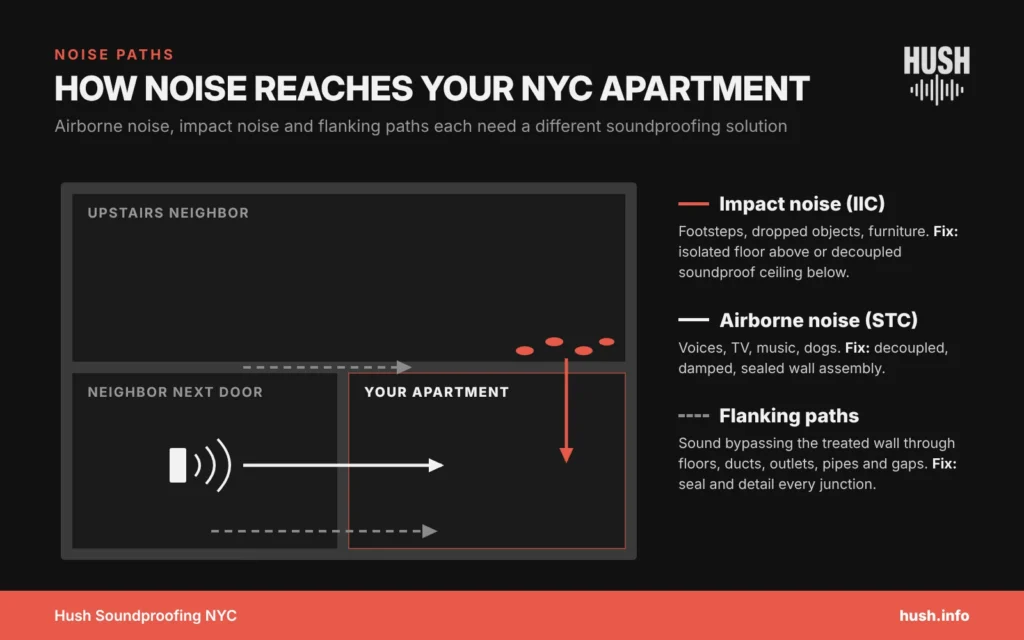
Footsteps from the apartment above are one of the most common noise complaints in New York City, and the ceiling is the hardest surface to get right. A soundproof ceiling has to stop two different kinds of sound at once: airborne noise like voices and television, and impact noise like footsteps, dropped objects and chairs scraping, which travels through the structure itself. However, most ceiling “soundproofing” products address the first and ignore the second. Hush builds decoupled ceilings that handle both, in apartments, brownstones and offices across the five boroughs.
Average cost: $18,000 to $36,000 per room (150 sq ft and up). Details below.
Why You Hear the Apartment Above
In other words, your ceiling is their floor. When they walk, the joists or slab vibrate, and anything rigidly attached to that structure (your ceiling drywall, your light fixtures, the top of your walls) vibrates with it and radiates sound into your room. Low-mass wood-joist floors in prewar buildings and brownstones transmit the most; concrete slabs transmit less airborne sound but carry impact and low-frequency noise a long way.
That is why adding material to the face of the existing ceiling rarely works. After all, the material is still bolted to the thing that is shaking. Instead, the fix is to build a new ceiling that is not.
How to Soundproof a Ceiling: The Assembly
Step 1: Site evaluation and transmission mapping
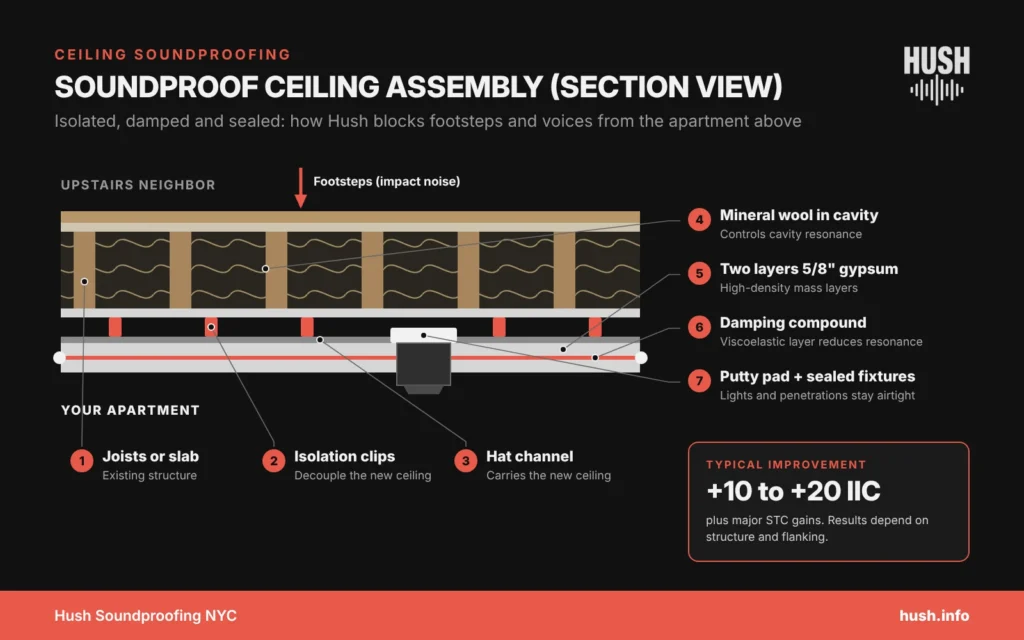
A Hush soundproof ceiling is built in seven steps, and the order matters.
We identify whether the problem is impact, airborne or low-frequency, and trace the paths: joists, slab, beams, ducts, and the walls that connect your ceiling to theirs.
Step 2: Sealing
First, we seal every perimeter joint, penetration and transition with acoustical caulk, putty pads and gaskets. Recessed lights and ducts get treated or relocated; each one is a hole in the ceiling.
Step 3: Decoupling
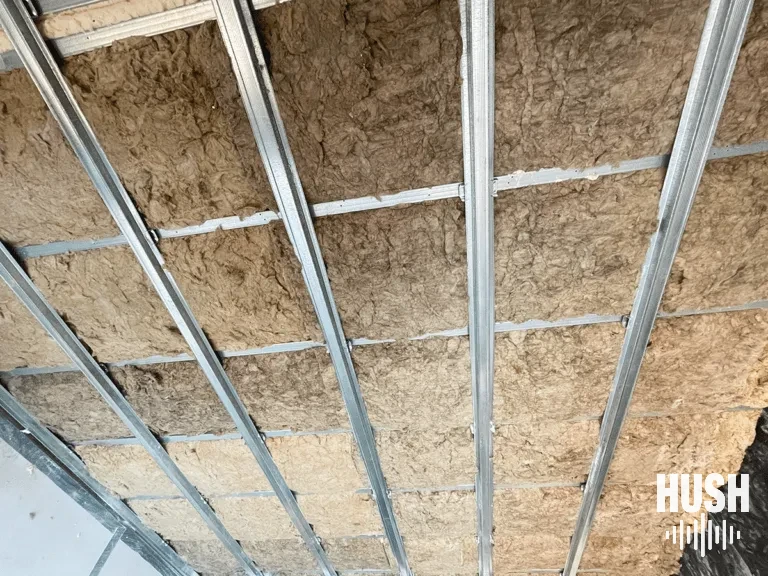
Sound isolation clips fastened to the existing structure, with hat channel snapped into the clips. The new ceiling hangs from the channel and never touches the joists directly. This is the step that addresses footsteps.
Step 4: Cavity absorption
Mineral wool soundproof ceiling insulation sized to the cavity depth, so the air space between old and new ceiling does not resonate.
Acousticians call this mass–spring–mass resonance. The old ceiling, the air gap and the new ceiling behave like two weights on a spring, so isolation dips near one low frequency. A deeper, insulated cavity and heavier layers push that dip below the range that matters.
Step 5: Damping
Then, viscoelastic damping compound goes between the drywall layers so the finished panels do not ring.
Step 6: Mass
Next come two layers of high-density Type X drywall. Where ceiling height is tight, mass loaded vinyl adds weight without adding thickness.
Step 7: Finishing and review
Level 5 skim coat, and a final check of joints and penetrations for flanking paths. For studios and home theatres, we also coordinate room acoustics (absorbers, diffusers, clouds) with the new ceiling.
Decoupling, damping and mass together are what move a ceiling from “I hear every step” to “I know someone is home.” However, any one of them alone does not. Our guide to soundproof ceiling materials compares clips, damping compound and MLV in more detail.
How Much Ceiling Height You Lose
A clip-and-channel assembly with two layers of drywall typically takes three to five inches. In a prewar apartment with ten-foot ceilings that is invisible; in a postwar apartment with eight-foot ceilings it is a design decision we make together. Where every inch counts, MLV and soundproof drywall (a laminated damped board) let us reach the same performance in slightly less depth.
Acoustic Ceiling Tiles vs. a Soundproof Ceiling
This is the most important distinction on this page. Acoustic ceiling tiles do not soundproof a ceiling. So if you want a noise reduction ceiling for footsteps, tiles are the wrong product.
Acoustic ceiling tiles (the mineral-fibre or felt tiles in a drop ceiling grid) are absorbers. They reduce echo inside the room they face, which is why offices use them. They are also light, porous and hang from a grid that is rigidly wired to the structure above. As a result, sound from upstairs passes through them almost unchanged. “Soundproof ceiling tiles” and “soundproof drop ceiling tiles” are marketing terms for tiles with a slightly higher STC; a heavy tile might reach the high 30s in a lab, and the grid, the gaps and the light fixtures give most of that back.
If you compare sound absorbing ceiling tiles, check two ratings. NRC tells you how much echo a tile absorbs. CAC (Ceiling Attenuation Class, ASTM E1414) tells you how well a suspended ceiling blocks sound traveling over a wall through the shared plenum. Neither one measures footsteps from the floor above.
A soundproof drop ceiling is possible, but only when the grid itself is hung on isolation hangers, the plenum is filled with insulation, and a mass layer is added above the tiles. At that point it is a decoupled ceiling with a drop ceiling finish, and we price it as one.
Where acoustic ceiling tiles and acoustic ceiling clouds belong: offices, restaurants and conference rooms that need to control echo, usually underneath a ceiling that is already isolated or where the floor above is not occupied. See our acoustic panels page.
Soundproof Basement Ceiling
A soundproof basement ceiling is the one case where the soundproofing works in the other direction: it protects the apartment above from the basement (a home theatre, a music room, a gym, a laundry) or protects a basement bedroom from the house above. Basement ceilings are usually open wood joists with ducts and pipes running through them, which makes the sealing step more involved and makes a clip-and-channel ceiling the practical choice.
The cheapest way to soundproof a basement ceiling that actually works is to fill the joist cavities with mineral wool, seal every penetration, and hang a single layer of drywall on resilient channel. It will not match a full assembly, but it is the minimum that changes what you hear. Stuffing insulation into open joists and leaving them open does very little; absorption without a mass layer is not isolation.
Soundproofing Between Floors in a House or Duplex
When you own both levels, you have a choice, though. Working from below (the ceiling) is what this page describes. Working from above (the floor) means a floated subfloor on acoustic underlayment, which our floor soundproofing page covers. For impact noise, the floor is the more effective place to intervene, because it stops the energy before it enters the structure. For airborne noise, either side works, and the ceiling is usually less disruptive. The best sound insulation between floors is both, and in a duplex or brownstone we often do both.
Soundproof Ceiling Apartment Rules: Boards, Neighbours and Reality
Soundproofing an apartment ceiling in a co-op or condo happens entirely from your side, and the work never touches the neighbour’s apartment. As a result, boards generally approve it as an interior alteration with a licensed, insured contractor, and we handle the paperwork and the NYC Noise Code work hours. You do not need the neighbour’s cooperation, which is the main reason ceiling work is more common than persuading them to add underlayment upstairs.
How to drown out noise from upstairs neighbors without construction, and how to reduce noise between floors when you do not own both: rugs and pads upstairs (if they will), masking with a fan or sound machine downstairs, and realistic expectations. Panels, foam, paint and mass loaded vinyl stapled to your ceiling will not stop footsteps. Our upstairs neighbor noise guide covers the non-construction options and the co-op rules on carpeting.
What Results to Expect
A well-built decoupled ceiling under a wood-joist floor moves impact performance from the low 30s to the IIC 50s and airborne performance into the STC 50s. NYC DEP guidance points to IIC 50 for living areas and IIC 60 for bedrooms, and new construction targets IIC 50. In practice: heavy footsteps become a soft, distant thud; voices and television disappear; bass and dropped weights are reduced but not eliminated. Our STC and IIC ratings guide explains the numbers.
One caveat about the numbers. IIC under-weights low-frequency thuds such as heel strikes and dropped weights, so a high-IIC ceiling can still pass a deep thump. Also, field results measured in your building (AIIC) usually come in a few points below lab IIC because of flanking.
Ceiling Soundproofing Cost in NYC
- Decoupled soundproof ceiling: $18,000 to $36,000 per room, 150 sq ft and up, including decoupling, insulation, damping, two layers of drywall, sealing and Level 5 finish.
- Variables: ceiling height, number of recessed lights and penetrations, ducts in the cavity, building logistics, and whether walls need to be tied in to stop flanking.
- Consultation: $250 virtual or $500 on-site, credited toward the project.
See our soundproofing cost guide for the full picture.
Ceiling Soundproofing FAQ
Can you soundproof a ceiling from footsteps?
Yes, with a decoupled ceiling on isolation clips. However, nothing applied to the surface of the existing ceiling will do it.
Do acoustic ceiling tiles block sound from upstairs?
No. Instead, they absorb echo in your room. They are not a soundproofing product.
How much height will I lose?
Typically three to five inches for a full assembly; less with soundproof drywall and MLV where height is critical.
Can I soundproof my ceiling without my upstairs neighbour’s involvement?
Yes. That is because the entire assembly is built from your apartment.
What is the cheapest way to soundproof a basement ceiling?
Mineral wool in the joist cavities, every penetration sealed, and drywall on resilient channel. Anything less, however, changes very little.
Will a soundproof ceiling stop bass from the apartment above?
It will reduce it significantly. Low frequencies are the hardest to block; if bass is the main problem we will say so at the assessment and set expectations before you spend.
How long does it take?
In most cases, single-room ceilings take one to two weeks on site, depending on penetrations and finish.
Ceiling Soundproofing
Our Clients
Client partners include residential, commercial, and institutional organizations that rely on precise soundproofing and acoustical execution.

IN-PERSON CONSULTATION
Contact Hush Soundproofing today! Our expert team is ready to assess your space and provide customized solutions to create a peaceful and quiet environment.
Schedule a Ceiling Soundproofing Consultation
Hush is a licensed New York City contractor with an in-house acoustic team, based in Brooklyn and working in Manhattan, Queens, the Bronx and Staten Island. We measure first, build the assembly your ceiling needs, and verify the result.
Related: Upstairs Neighbor Noise · Floor Soundproofing · Wall Soundproofing · Apartment Soundproofing · Soundproofing Materials · STC and IIC Ratings · Soundproofing Cost NYC · Acoustic Report