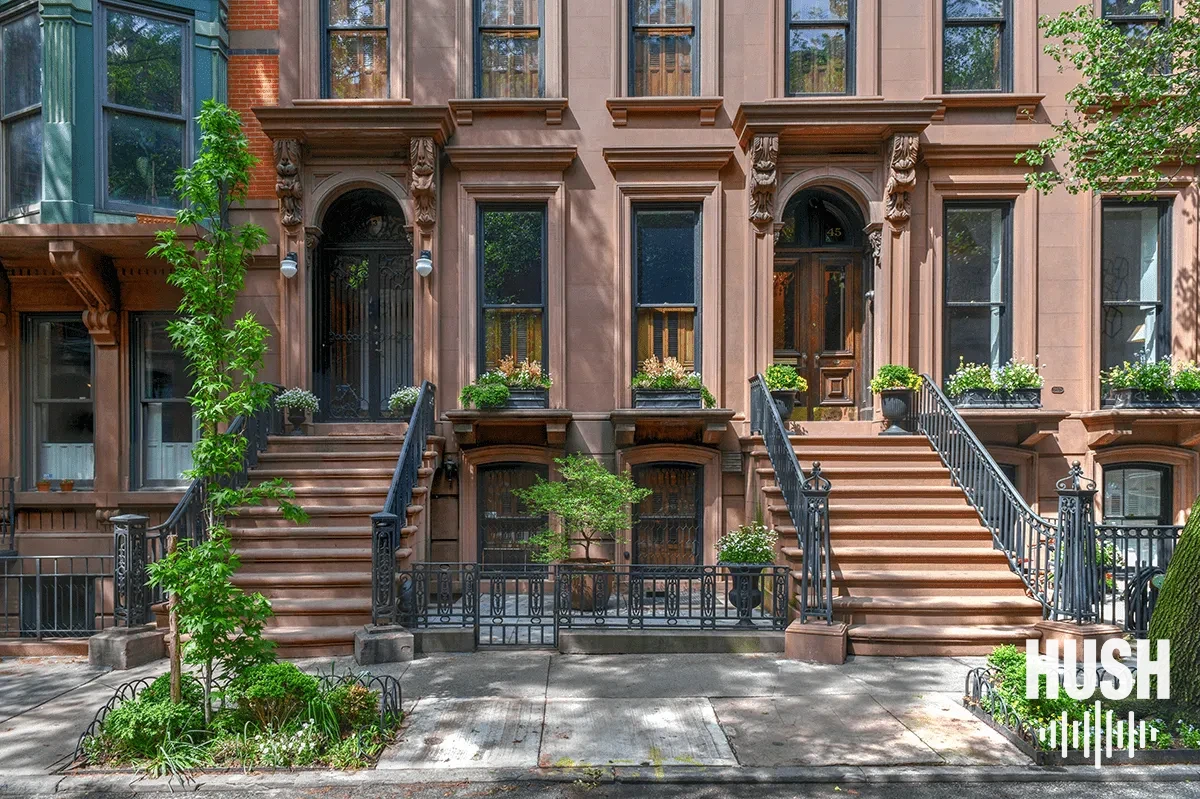
Row of historic Brooklyn townhouses

Brownstone and Townhouse Soundproofing NYC

New York’s brownstones and townhouses are beautiful, but they were not built for privacy between units. Most were converted from single-family homes into two to five apartments, with wood joist floors, lath-and-plaster ceilings, and party walls that were never designed to separate households. Brownstone soundproofing requires a different approach than a concrete high-rise. Hush designs soundproofing for these buildings across Brooklyn, Harlem, the Upper West Side, and the West Village.

Why Brownstones Are Noisy

Wood joist floors

Floors are typically 2×10 or 3×10 joists with plank subfloor and a plaster ceiling below. The assembly is light and stiff, so footsteps and low-frequency impact noise travel freely. IIC also under-weights these low thuds, so a floor can test well and still pass heel strikes. This is why upstairs neighbor noise is the number one complaint in converted brownstones.

Masonry party walls and joist pockets

The brick party wall between two brownstones is usually massive and performs well, but joists pocket directly into it, so footfall in the neighbor’s house can transmit along the structure. Acousticians rate how much vibration drops as it crosses a junction like this with the vibration reduction index (Kij). EN ISO 12354 uses it to predict flanking, and it is especially relevant to heavy masonry like brownstones. Also, interior partitions added during conversions are often a single stud wall with plaster or drywall on each side.

Stairwells, shafts and old openings

Open stair halls, abandoned dumbwaiters, old chimney flues, and radiator risers create flanking paths that carry sound between floors. In other words, sound bypasses the treated surfaces through connected structure.

Renovations that removed mass

In addition, gut renovations often replace thick plaster with a single layer of drywall and recessed lights, which can make a brownstone noisier than it was before.

Brownstone Soundproofing Solutions

Ceilings

Isolated ceilings below wood joists

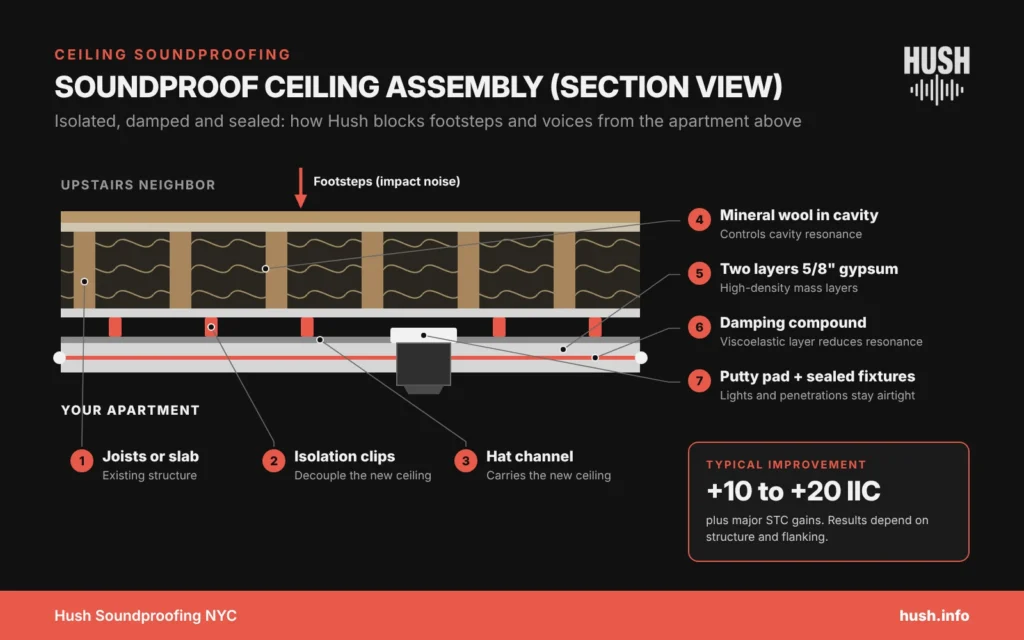
Isolation clips or spring hangers, mineral wool between the joists, and two layers of damped 5/8″ gypsum. In practice, this is the core solution for owner’s units below rental floors. Ceiling soundproofing.

Floors

Floating floors and acoustic underlayments

When you control the upper floor, an acoustic underlayment or floating floor system stops impact noise at the source. Floor soundproofing.

Walls

Decoupled interior partitions

So we decouple, damp, and seal new or upgraded partitions between units to reach STC 55-60+. Wall soundproofing and walls between apartments.

Doors and stairs

Sealing the stair hall

Unit entry doors on a shared stair are a major leak. Perimeter seals and automatic door bottoms, or solid-core soundproof wooden doors, preserve the brownstone look while blocking sound. Door soundproofing.

Ceiling assembly diagram with isolation clips, hat channel, mineral wool and two layers of drywall

Landmarks and Historic Details

Many brownstones are in NYC historic districts. Interior soundproofing generally does not affect the facade, but we plan assemblies to preserve crown moldings, ceiling medallions, window casings, and pocket doors wherever possible, and we coordinate with your architect when work is part of a larger renovation filed with the NYC Department of Buildings.

Brownstone Soundproofing in Brooklyn and Manhattan

Hush is based in Williamsburg and works in brownstone neighborhoods throughout Brooklyn (Park Slope, Prospect Heights, Fort Greene, Clinton Hill, Bed-Stuy, Carroll Gardens, Cobble Hill, Brooklyn Heights) and Manhattan (Harlem, Upper West Side, West Village, Chelsea). See typical pricing in soundproofing cost NYC, or start with an acoustic report.

FAQ

Brownstone Soundproofing FAQ

How do you soundproof a brownstone floor?

From above, use an acoustic underlayment or floating floor to stop impact noise at the source. From below, build an isolated ceiling on isolation clips with mineral wool and damped double gypsum.

Are brownstone party walls soundproof?

The masonry party wall between two brownstones is usually massive and blocks airborne noise well. Problems usually come from joists pocketed into the wall, chimney flues, and interior partitions added during conversions.

Can you soundproof a brownstone without removing original plaster?

Often yes. A decoupled ceiling or wall plane can be built over existing plaster, preserving its mass, while we work around moldings and historic details.

Do I need landmarks approval for interior soundproofing?

Interior soundproofing that does not affect the exterior generally does not require Landmarks Preservation Commission approval, but larger renovations may require DOB filings. We coordinate with your architect.

Brownstone Soundproofing: Working With 19th-Century Construction

Brownstones are some of the most beautiful homes in Brooklyn and Manhattan. Acoustically, though, they can be tricky. Thick masonry party walls block a lot of airborne sound, yet the wood joist floors, open stairwells and shared chimney flues often carry footsteps and voices between floors and units. In addition, many brownstones have been split into rentals or condos over the years, which leaves thin partitions where a single family once lived. Good brownstone soundproofing respects the original fabric of the building while fixing those weak links.

So our approach usually focuses on the floor-ceiling assemblies between units, which is where most complaints start. For example, decoupled ceilings, resilient underlayment under new floors and careful sealing around beams and pipes all help. For street noise, the NYC DEP Residential Noise Control Guidance Sheet recommends at least STC 60 for exterior walls and at least STC 50 for windows, and HUD’s Noise Guidebook explains how exterior noise affects homes. If your brownstone sits in a historic district, front windows may need approval from the Landmarks Preservation Commission, so interior window inserts are often the easiest route.

Brownstone Soundproofing FAQs

Why can I hear my neighbors through a brick party wall?

Usually the sound isn’t coming straight through the brick. Instead, it travels through floor joists that sit in the shared wall, through old chimney flues, or through gaps where pipes pass between units. So to soundproof brownstone party walls, start with those paths, not the brick itself.

Can you soundproof a brownstone without losing original details?

Yes. For example, we can often work from below, through the ceiling, and keep moldings, parquet and plaster intact. Where we do open surfaces, we plan the work to restore the finishes afterward.

What’s the best fix for street noise in a brownstone?

In practice, windows are almost always the weak point. Interior acoustic window inserts add a second, well-sealed pane without changing the facade. Also, compare windows by OITC (Outdoor–Indoor Transmission Class), which weights the low frequencies of traffic better than STC.

Do brownstone floors need special soundproofing?

Often, yes. In fact, wood joist floors pass a lot of impact noise. A resilient underlayment under the new floor, or a decoupled ceiling below, makes the biggest difference.

Learn more about Brooklyn soundproofing and ceiling soundproofing, or book a consultation.

High Ceilings, Hard Floors and Echo

Brownstone wall soundproofing by Hush Soundproofing in Brooklyn

Brownstones have tall ceilings, plaster walls and original hardwood floors. Those features look great, but they also make rooms lively. Sound bounces between hard surfaces, so voices and footsteps seem louder and linger longer. Acousticians measure this as reverberation time (RT60), the time sound takes to fade by 60 dB. That is a room acoustics problem, separate from noise coming through the walls.

Good brownstone soundproofing handles both. First, we isolate the walls, floors and ceilings that let noise in. Next, we tame the echo inside the room with rugs and pads, upholstered furniture, heavy curtains and acoustic panels. The Whole Building Design Guide notes that both sound isolation and reverberation control shape acoustic comfort.

Testing before and after brownstone soundproofing

Old row houses vary a lot, even on the same block. For that reason, we measure noise levels before work starts and again when it is done. As a result, you see the change in numbers, not just a promise.

Our Clients

Client partners include residential, commercial, and institutional organizations that rely on precise soundproofing and acoustical execution.

Hush Soundproofing NYC clients: Columbia University, Verizon, MTA New York City Transit, The Wall Street Journal, Sony Music, American Express, NYU, Revlon, NY DMV, HelloFresh, NYRA, Four Seasons, J.Crew and Dow Jones

SCHEDULE A CONSULTATION

Contact Hush Soundproofing today! Our expert team is ready to assess your space and provide customized solutions to create a peaceful and quiet environment.