
Church Soundproofing
Church Soundproofing
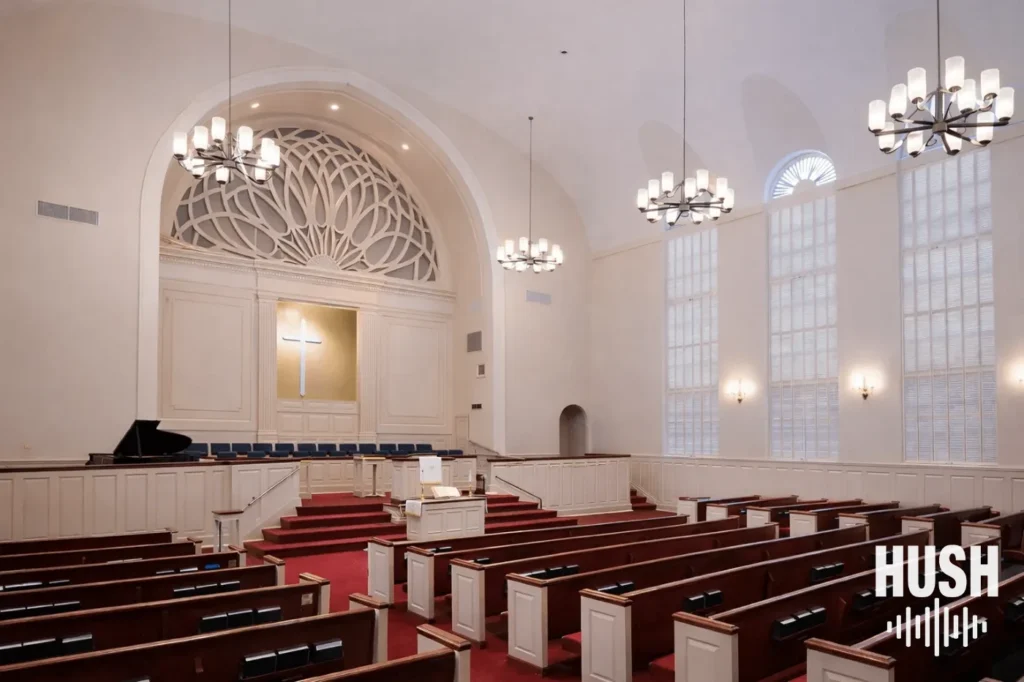
Church soundproofing is a balancing act. For example, singing and music need some liveliness, while spoken word needs clarity and controlled decay. We build for noise reduction from outside and adjacent spaces, and we tune the room for echo reduction where it improves speech intelligibility without stripping the space of warmth.
Typical church soundproofing and acoustic problems
- Too much reverberation: words smear, so congregants strain to understand.
- Uneven coverage: front rows are loud, back rows are unintelligible.
- Mechanical noise: HVAC rumble or hiss masks quiet speech.
- Exterior intrusion: traffic, sirens, neighborhood activity.
Keep the room musical, make speech clear
Specifically, we target the reflections that harm speech and leave the reflections that support music. In practice, that often means ceiling and upper-wall control, diffusion in strategic fields, and discreet absorption where it won’t change the visual character.
- Speech clarity: reduce late reflections and harsh flutter echo (rapid repeats between parallel hard walls).
- Musical presence: preserve energy with diffusion and balanced decay.
- Discreet integration: finishes that read like architecture, not “treatment.”
To get there, we first measure reverberation time, or RT60: how long a sound takes to fade by 60 dB after it stops. A large plaster or stone sanctuary can ring for a long time. That suits an organ, but it smears speech. So we also check speech scores such as STI (Speech Transmission Index), because a long RT60 lowers them. Music, however, has its own yardstick: early sound energy, in the first 80 ms, versus late energy. That ratio, in dB, is clarity C80. Spaciousness, meanwhile, relates to how different the sound is at a listener’s two ears. Acousticians measure it as interaural cross-correlation (IACC), and lower values feel more spacious.
Soundproofing for churches
However, when the goal is sound reduction to neighboring spaces (or vice versa), we treat walls, ceilings, doors, and penetrations as a system.
- Wall Soundproofing for adjacent occupancies and classrooms
- Ceiling Soundproofing when roof or upper mechanical is involved
- Soundproof Door for entry seals, vestibules, and leakage control
For sanctuaries on busy avenues, we also look at OITC, not just STC. OITC weights the low frequencies of traffic and trains, so it rates windows against street noise more honestly. As a result, church soundproofing keeps the street out of the service and the choir out of the neighbors’ homes.
Frequently Asked Questions
Do we need soundproofing or acoustic treatment? In fact, many churches need both: soundproofing for intrusion and acoustic treatment for clarity.
Further reading:
Church Soundproofing and Worship Acoustics
Houses of worship have unusual acoustic needs. On one hand, congregational singing, organs and choirs sound best in a reverberant room. On the other hand, everyone in the pews needs to understand sermons and readings clearly. In addition, many NYC churches and synagogues share walls with apartments or sit on busy streets, so the building has to keep sound in and traffic out. Church soundproofing balances all of these goals.
Inside the sanctuary, we tune the reverberation time with discreet absorption and diffusion. For example, we often hide treatment in ceilings, wall finishes or behind fabric, so speech becomes clearer without losing the warmth that music needs. Acousticians gauge that warmth with Beranek’s bass ratio. Specifically, it divides the reverberation at 125 and 250 Hz by the reverberation at 500 and 1,000 Hz. Meanwhile, the standard ISO 3382-1 describes how acousticians measure acoustics in performance spaces. To improve isolation, we focus on windows, doors and any shared walls or fellowship halls near neighbors. Finally, because many sanctuaries are historic, we design changes that respect original details, and we coordinate with the Landmarks Preservation Commission when your building is a landmark.
Church Soundproofing FAQs
Will acoustic treatment make our sanctuary sound dead?
Not if we design it well. Instead of covering everything, we target specific problem reflections and keep enough reverberation for singing and organ music.
Why is it hard to understand the sermon from the back?
Usually the room is too reverberant for speech, or nobody has aimed and tuned the sound system for the space. Therefore, treatment and system adjustments together fix it.
Can you hide acoustic panels in a historic sanctuary?
Yes. We can finish church acoustic panels to match plaster or wood, or we can also place them out of sight in ceilings and alcoves.
How do we stop our services from disturbing neighbors?
In most cases, upgrading windows and doors and isolating shared walls makes the biggest difference. So that is usually where church soundproofing starts.
See auditorium soundproofing, acoustic panels and acoustical consulting.
Our Clients
Client partners include residential, commercial, and institutional organizations that rely on precise soundproofing and acoustical execution.

SCHEDULE A CONSULTATION
Contact Hush Soundproofing today! Our expert team is ready to assess your space and provide customized solutions to create a peaceful and quiet environment.