
Auditorium Soundproofing
Auditorium Soundproofing
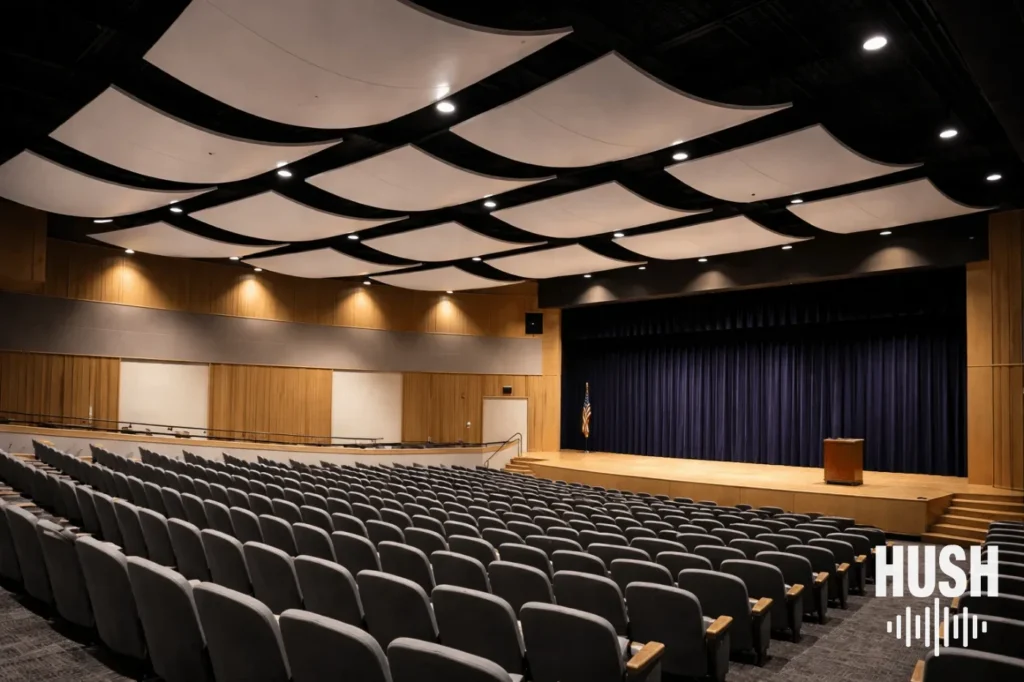
Auditorium soundproofing has two jobs. First, it keeps outside noise out and the hall’s own sound in. Second, it shapes the acoustics inside the room. A great auditorium feels lively during a performance, yet every word from the stage is still easy to understand. To get there, we control noise intrusion and mechanical vibration, and then we shape reflections for speech clarity and musical energy.
Explore our commercial soundproofing services, schedule a consultation, or see our acoustic panels for echo reduction.
Where Auditorium Noise Comes From
Every hall is different. Still, the same noise paths come up again and again:
- Neighboring spaces: corridors, classrooms, restaurants, lobbies and back-of-house areas.
- The roof and mechanical systems: rooftop units, noise carried through ducts, and vibration traveling into the building shell.
- The stage and support rooms: backstage activity, loading zones and leaky doors.
- The facade: street noise and low-frequency traffic rumble.
If HVAC is part of the problem, our guides to HVAC unit soundproofing and HVAC duct soundproofing are a good place to start.
Keeping the Room Lively Without Losing Control
Auditoriums usually go wrong in one of two ways. Either the room is over-treated and sounds dead, or reflections are left unchecked and it sounds harsh and muddy. For that reason, we take a balanced approach:
- Diffusion spreads reflections so the room keeps its energy and feels natural.
- Targeted absorption shortens excessive decay and flutter where they hurt clarity.
- Hidden low-frequency control, such as tuned resonators, can sit behind finishes when needed.
- Lower background noise keeps speech and quiet passages easy to hear.
Timing and direction matter too. The time between the direct sound and the first reflection is the initial time delay gap (ITDG). Leo Beranek linked it to a hall’s intimacy. Likewise, early sound arriving from the sides makes the source seem wider. Acousticians measure that share of early sound as the lateral energy fraction.
Auditorium Soundproofing: Walls, Ceilings and Doors
Isolation is assembly work. In practice, that means sealing perimeter gaps, breaking rigid connections and closing off flanking routes through slabs and chases. Flanking is sound that sneaks around a wall through connected structure, ducts or ceiling space. Doors and vestibules matter just as much as the walls, because one leaky opening can undo an otherwise excellent build.
- Wall soundproofing for neighboring spaces and back-of-house areas
- Ceiling soundproofing for rooftop noise and overhead impact
- Soundproof doors for entries, service doors and perimeter sealing
Auditorium Soundproofing FAQs
Do acoustic panels soundproof an auditorium? No. Instead, panels reduce echo and improve clarity. Soundproofing, on the other hand, needs isolation assemblies and airtight detailing.
Can the acoustic treatment be hidden? Yes. In fact, it can sit behind architectural features, ceiling forms and wall systems, as long as it’s planned early.
What about mechanical noise? Equipment noise is often the biggest complaint in a hall. Our mechanical noise page explains how we treat it.
Standards We Design To
For readers who want the technical background, we design with reference to ISO 3382-1 for performance-space acoustics, the Whole Building Design Guide on acoustic comfort, and ASTM C423 for absorption testing.
Planning an Auditorium Soundproofing Project
Every auditorium soundproofing project starts with the same question: what is the room for? A lecture hall, for example, needs short reverberation and very clear speech. A concert or theater space, on the other hand, needs more liveliness and careful control of echoes. Meanwhile, school and community auditoriums often have to do both. Because of that, we define the uses first, and then we design the treatment and isolation around them.
Here, reverberation time (RT60) is how long a sound takes to fade by 60 dB after it stops. Sabine’s equation ties it to the hall’s volume and its total absorption, so we can estimate it before construction. A related measure, early decay time (EDT), judges reverberation from just the first 10 dB of decay. In practice, it tracks how reverberant a hall actually sounds. For speech, we also check STI (Speech Transmission Index) and C50 clarity. Both drop as RT60 grows, so a lecture hall aims lower than a concert hall.
In addition, background noise is often the hidden problem. Rooftop units, air handlers and duct noise can raise the noise floor enough to swallow quiet passages and soft speakers. So we set a target as an NC (Noise Criteria) or RC (Room Criteria) rating, which limits background noise in each octave band. That’s why we measure HVAC noise early and follow the methods in the ASHRAE Handbook chapter on noise and vibration control. For finishes, we select materials by their tested Noise Reduction Coefficient and by how they spread sound, rather than by appearance alone.
More Auditorium Soundproofing Questions
How long does an auditorium soundproofing project take?
Typically, smaller treatment projects take a few weeks, while full isolation upgrades follow the building’s construction schedule. We phase the work around events where possible.
Do we need an acoustical consultant for an auditorium?
For new halls or major renovations, yes. In fact, early acoustic input on room shape, finishes and mechanical design saves money and avoids costly fixes later.
Can seating affect auditorium acoustics?
It can. For instance, well-upholstered seats absorb sound in a similar way whether or not they are occupied, which keeps rehearsals and full performances sounding alike.
What’s the first step?
Usually, an on-site assessment with measurements, so we can see exactly what the room needs.
Learn about our acoustical consultant services or acoustic reports.
Our Clients
Client partners include residential, commercial, and institutional organizations that rely on precise soundproofing and acoustical execution.

SCHEDULE A CONSULTATION
Contact Hush Soundproofing today! Our expert team is ready to assess your space and provide customized solutions to create a peaceful and quiet environment.