
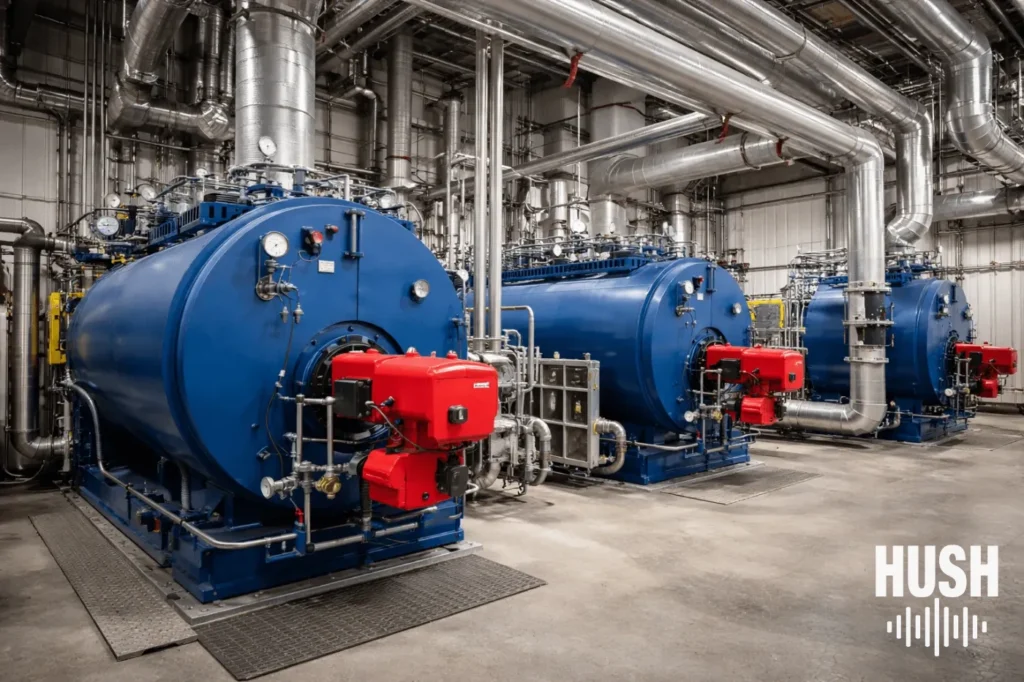
Boiler Soundproofing
Boiler Soundproofing
Boiler rooms create a particular kind of complaint: low-frequency rumble, cycling noise, and vibration that moves into occupied spaces through slabs, pipe supports, and structural connections. This is why boiler soundproofing is not a single material—it’s isolation, damping, and assembly control built to survive heat and service conditions.
Common boiler room noise problems
- Burner and combustion noise: cycling, roar, tonal components.
- Pump and motor vibration: structure-borne noise through slabs and pipe hangers.
- Steam and hot water piping breakout: noise radiating from un-treated or rigidly-supported pipes.
- Mechanical room flanking: sound escaping through doors, louvers, and penetrations.
High-temperature acoustic lagging: foil-faced insulation + damping
Above all, boiler soundproofing needs materials and detailing that remain stable under heat. Therefore, we often design pipe and equipment treatments using:
- Foil-faced insulation systems: for high-temperature pipes and equipment where durability and thermal performance are non-negotiable.
- Damping layers: added where vibration is exciting panels, jacketing, or nearby enclosures.
- Mass barriers with sealed seams: used where airborne breakout is driving complaints.
- Isolation at supports: because rigid clamps and hangers can transmit vibration into the building frame.
Flexible connectors on the pipes also matter. They stop pump and burner vibration from traveling down the lines into risers and slabs. In other words, we cut structure-borne noise, the vibration the building carries, before it re-radiates as airborne sound upstairs.
If cavity resonance is part of the issue in adjacent assemblies, see soundproofing insulation.
Floor, wall, and door upgrades around boiler rooms
In addition, when boiler noise reaches apartments, offices, or hotel rooms, the receiving-side assemblies often need targeted upgrades. For example, common add-ons include:
- Floor soundproofing strategies: managing vibration transmission through slabs and structural contact points. See floor soundproofing.
- Wall soundproofing at adjacencies: decoupling and damping where the boiler room wall acts like a speaker. See wall soundproofing.
- Door leakage control: in practice, mechanical rooms often fail at the door. See soundproof door systems.
Frequently Asked Questions
Will adding insulation to the boiler room fix the noise? Not by itself. Insulation helps resonance; however, boiler complaints usually require isolation and airtightness.
Why does the noise show up upstairs? Because vibration moves through structure and pipe paths, then re-radiates as sound in quiet rooms.
Related mechanical systems:
Further reading:
Boiler Soundproofing for Apartments Above the Boiler Room
In many older NYC buildings, ground-floor and basement apartments sit right above or beside the boiler room. When the burner fires, residents hear a low roar, and when it cycles off, pipes tick and bang. In addition, burner fans, circulator pumps and flue draft can all add their own sounds. Boiler soundproofing starts by separating these sources, since each one needs a different fix.
For the room itself, we build heavier, sealed walls and ceilings and treat doors and openings, while making sure combustion air and ventilation stay code-compliant. For vibration, we also isolate burners, pumps and pipe supports. The NYC DEP Residential Noise Control Guidance Sheet notes that HVAC noise can be difficult to control unless you identify its true cause, so we always measure first. For engineering detail, the ASHRAE Handbook covers equipment isolation, and the NYC Noise Code applies to building equipment noise.
Boiler Soundproofing FAQs
Why do my radiator pipes bang?
Usually, it’s steam meeting trapped water, or pipes expanding against tight hangers. Consequently, the fix is often a heating adjustment rather than soundproofing, and we’ll tell you which applies.
Can a boiler room be soundproofed safely?
Yes, as long as the design preserves combustion air, ventilation and fire ratings. That is why we coordinate with the building’s heating contractor.
What causes the low roar when the boiler fires?
Mainly the burner and its fan. In many cases, a burner silencer, an isolated mount or a sealed room solves it.
That roar is mostly low-frequency, so we measure it in dBC and in octave bands such as 63 Hz and 125 Hz. A-weighted dBA readings follow human hearing and under-read bass. As a result, they can make a real rumble look minor.
Who pays for boiler soundproofing in a rental or co-op?
It depends on your lease and building rules. Often, though, an acoustic report helps management see the problem and plan the fix.
See pump soundproofing, mechanical noise and acoustic reports.
Our Clients
Client partners include residential, commercial, and institutional organizations that rely on precise soundproofing and acoustical execution.

SCHEDULE A CONSULTATION
Contact Hush Soundproofing today! Our expert team is ready to assess your space and provide customized solutions to create a peaceful and quiet environment.