
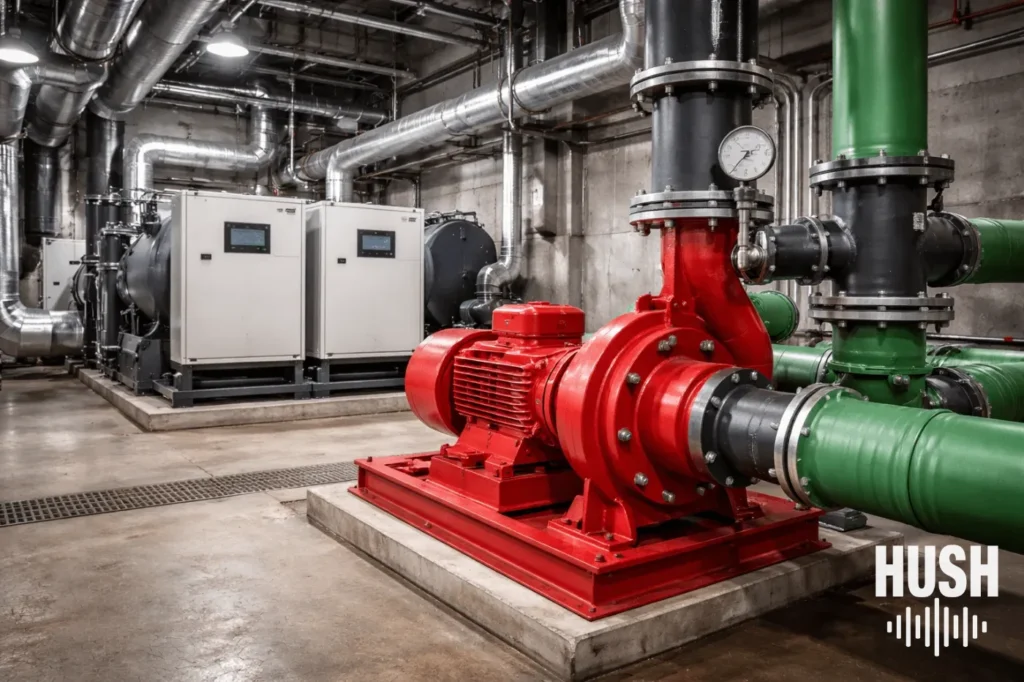
Pump Soundproofing
Pump Soundproofing
Pumps are small machines that create outsized complaints. Booster pumps, circulation pumps, sump pumps, and mechanical room pumps generate tonal noise, vibration, and pipe-borne transmission. Pump soundproofing works when we isolate the pump correctly, control connections, and stop the building from re-radiating vibration into occupied rooms.
Why pumps are loud in “quiet” buildings
- Rigid piping acts like a transmission bar: vibration runs through pipes and hangers into walls and slabs. Water hammer, the bang from a pressure surge when a valve closes quickly, travels the same route into the structure.
- Misalignment and worn components: creates tonal noise and cyclic vibration.
- Cavitation and flow issues: adds broadband noise and harshness.
- Small rooms amplify sound: pump closets and tight mechanical rooms build up resonance quickly.
What we do in pump soundproofing: isolation + connection control
In practice, pump soundproofing is straightforward when the scope is complete. We typically address:
- Correct isolators: selected by load and vibration behavior, not guesswork. For neoprene, that includes hardness on the Shore A durometer scale: a softer compound deflects more under the same load.
- Flexible connectors: so vibration doesn’t jump directly into hard piping.
- Pipe support isolation: hangers and clamps that don’t transmit vibration into structure.
- Penetration detailing: sleeves and gaps that can become sound leaks if left untreated.
For example, we select isolators by static deflection, that is, how far a spring or pad compresses under the pump’s weight. More deflection gives a lower natural frequency. When that frequency sits well below the pump’s running speed, transmissibility (the share of vibration passing through) drops sharply. In other words, isolation efficiency is (1 − transmissibility) × 100. That’s the percentage of vibration force the isolator keeps out of the building. An inertia base, a heavy concrete base under the pump, also lowers the center of gravity.
If the noise is showing up as “wall vibration” or audible hum in a bedroom, it often becomes a wall soundproofing problem on the receiving side.
Hot water loops and piping: foil-faced insulation + damping
Many pump systems include hot water piping where standard acoustic materials fail over time. Therefore, pump soundproofing on hot loops calls for heat-appropriate systems:
- Foil-faced insulation wraps: for durability and temperature stability.
- Damping layers and mass jacketing: where pipe breakout noise is driving the complaint.
- Continuous seams and serviceable detailing: because maintenance access is non-negotiable in pump rooms.
Frequently Asked Questions
Do I need to build a room around the pump? Not always. In fact, once isolation and connections are corrected, the noise can drop dramatically without a full enclosure.
Why does pump noise show up in another unit? Because pipes and structure are connected. As a result, the receiving room re-radiates the vibration as sound.
Related mechanical systems:
Further reading:
Pump Soundproofing: Stopping Hum Through Pipes and Slabs
Booster pumps, circulator pumps and fire pumps keep New York buildings running, yet they’re also a classic source of a steady hum that residents can’t escape. Pump noise rarely travels through the air for long. Instead, it moves through rigid pipe connections, pipe hangers and the concrete pad, then radiates from walls and ceilings far from the pump room. That’s why pump soundproofing focuses on breaking those structural paths.
Typically, we combine three measures. First, we put the pump on a properly selected inertia base or isolators. Second, we install flexible connectors on the suction and discharge piping. Third, we replace rigid pipe hangers with resilient ones near the pump. The NYC DEP Residential Noise Control Guidance Sheet warns that you have to select vibration isolators correctly, because the wrong choice can make resonance worse. The ASHRAE Handbook chapter on noise and vibration control covers that selection in detail.
Pump Soundproofing FAQs
Why do I hear a hum when the water pump turns on?
Most likely, the pump or its piping is rigidly connected to the building. As a result, vibration travels through the structure and comes out as sound in your apartment.
That hum is often tonal, a single steady pitch, which annoys people more than broadband noise at the same level. So we measure it in dBC and in octave bands such as 63 Hz and 125 Hz. A-weighted dBA readings under-read bass and can hide it.
Does pump soundproofing require shutting down water service?
Often, we can do much of the work with only a short, planned shutdown. We also coordinate the timing with building management.
Do variable speed pumps make more noise?
Not necessarily. However, at certain speeds they can excite resonances in the building, so we check the full speed range during testing.
Is pump noise covered by the NYC Noise Code?
Pumps count as circulation devices, so equipment noise rules can apply. An acoustic report documents the levels clearly.
See boiler soundproofing, mechanical noise and acoustic reports.
Our Clients
Client partners include residential, commercial, and institutional organizations that rely on precise soundproofing and acoustical execution.

SCHEDULE A CONSULTATION
Contact Hush Soundproofing today! Our expert team is ready to assess your space and provide customized solutions to create a peaceful and quiet environment.