
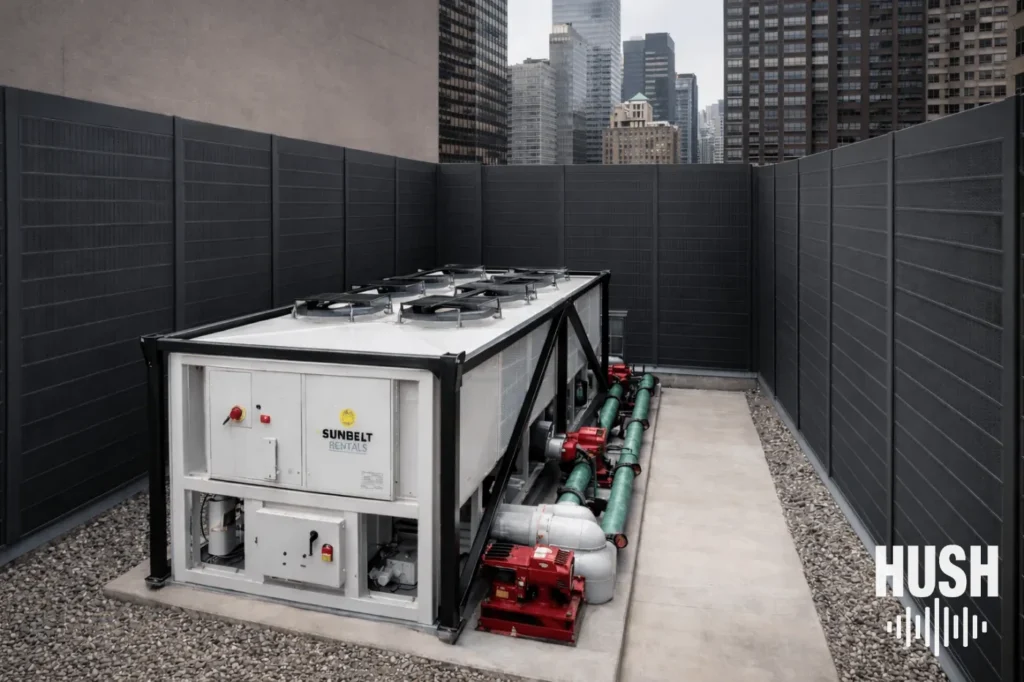
Chiller Soundproofing
Chiller Soundproofing
Chillers create both vibration and airborne noise—compressor behavior, fan noise, and tonal components that travel through structure and into neighboring spaces. In NYC, chiller soundproofing has to account for tight roof conditions, slab transmission, and how sound moves through penthouses, setbacks, and adjacent buildings.
Common chiller noise issues
- Compressor vibration: structure-borne transmission into roof slabs and supporting steel.
- Fan noise and tonal components: especially noticeable in quiet hours.
- Pipe-borne vibration: chilled water and condenser loops carrying vibration into the building.
- Exterior propagation: sound traveling to neighboring properties and terraces.
What works in chiller soundproofing: isolation, stiffness, and containment
In practice, chiller noise control is a balancing act between mechanical requirements and acoustical performance. Typical measures include:
- Vibration isolators and inertia strategy: correct selection and detailing to prevent rigid bridging.
- Connection control: flex connectors and isolated supports so piping does not short-circuit isolation.
- Targeted barriers/screens: when exterior noise is the driver, designed so airflow and service access remain clean.
- Receiving-side upgrades: when noise transmits into occupied rooms below.
For example, an inertia base is a heavy concrete base under the chiller or its pumps. It lowers the center of gravity and steadies the machine on its springs. We also select springs by static deflection, that is, how far they compress under load. When the resulting natural frequency sits well below the compressor’s speed, transmissibility (the share of vibration passing through) drops. The key number is the frequency ratio: forcing frequency ÷ the isolator’s natural frequency. In fact, isolation only begins above √2 (about 1.41); below that, an isolator can amplify vibration.
If rooftop equipment is driving noise into rooms below, the receiving condition often becomes a ceiling soundproofing project.
When the building needs help: ceilings, walls, and penetrations
Even well-isolated equipment can still cause complaints if the building has open penetrations, weak ceiling planes, or flanking routes. In those cases, chiller soundproofing extends to the building around the noise path:
- Ceiling assemblies: decoupling and damping where structure re-radiates. See ceiling soundproofing.
- Wall assemblies: mass + damping near sensitive rooms. See wall soundproofing.
- Air leaks and penetrations: sealed transitions so sound can’t bypass the assembly.
Frequently Asked Questions
Will an acoustic screen solve the problem? Sometimes, but only if vibration and transmission paths are controlled. In other words, screens manage airborne noise; they don’t stop structure-borne energy.
Why does it sound worse in certain rooms? Because vibration finds stiff paths, and certain rooms amplify low frequencies based on geometry and construction.
Related mechanical systems:
Further reading:
Chiller Soundproofing for Rooftop and Plant Rooms
Chillers and cooling towers are among the largest pieces of mechanical equipment in a building, and they run for long hours through the summer. As a result, chiller soundproofing often comes up when a new tower goes up next door or when residents move into a building with rooftop plant. Chiller noise is usually a mix of low-frequency compressor tones, fan noise and vibration that travels into the structure.
To control it, we first measure the sound and identify which components dominate. Then we combine the right tools: acoustic barriers or enclosures with properly sized louvers, discharge and intake silencers, spring isolators and inertia bases, and flexible pipe connections. The ASHRAE Handbook chapter on noise and vibration control sets out the engineering methods, while the NYC Noise Code governs equipment noise at neighboring properties. For homes affected by outdoor plant, HUD’s Noise Guidebook also explains how exterior noise exposure is evaluated.
Chiller Soundproofing FAQs
Why is chiller noise so low and droning?
Compressors and large fans produce strong low-frequency tones. Moreover, low frequencies travel far and pass through windows and walls more easily than higher sounds.
That is also why we report dBC and octave-band levels, not just dBA. A-weighting follows human hearing and under-reads bass, so a 63 Hz or 125 Hz drone can look minor in dBA. Tonal noise also annoys people more than broadband noise at the same level.
Can chiller soundproofing reduce noise without affecting performance?
Yes. In fact, we design barriers and silencers with the airflow and service access the equipment needs, and we coordinate with your mechanical engineer.
Who is responsible for noise from a neighbor’s chiller?
Generally, the equipment owner. An acoustic report with measurements gives you solid evidence for a conversation with the owner or the city.
Do chillers need vibration isolation?
Almost always. Without it, vibration travels into the roof slab and columns and causes hum in spaces below.
See HVAC unit soundproofing, pump soundproofing and acoustic reports.
Our Clients
Client partners include residential, commercial, and institutional organizations that rely on precise soundproofing and acoustical execution.

SCHEDULE A CONSULTATION
Contact Hush Soundproofing today! Our expert team is ready to assess your space and provide customized solutions to create a peaceful and quiet environment.