
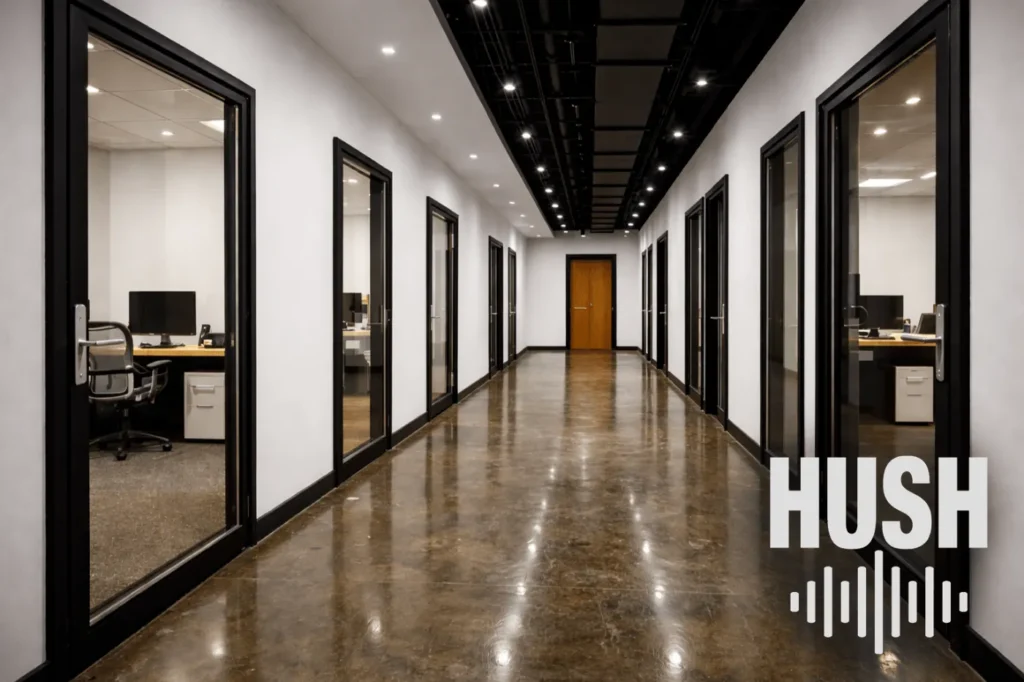
Soundproof Glass Doors NYC
Soundproof Glass Doors
Acoustic Glass doors can deliver real privacy when they’re treated as engineered openings, not decorative panels. In other words, the frame, seals, and closing behavior matter as much as the glass. Therefore, we focus on airtight compression lines first, then select the glass construction that fits the space and the noise profile.
Best-fit rooms
- Conference rooms: improved speech privacy and reduced distraction.
- Offices: quieter calls and better focus without closing the space visually.
- Luxury interiors: modern glass detailing with controlled leakage.
What makes Acoustic glass doors “soundproof”
First, the door must close into a consistent seal line. Next, the frame must stay rigid so gaps don’t open with time. Then, we select the glass build (often laminated or layered) based on the frequency range that’s driving the complaint. For example, speech privacy is different from low-frequency music, so the approach changes.
- Perimeter gasketing: continuous compression at jamb and head.
- Bottom interface: controlled undercut or a sealing strategy appropriate for the opening.
- Hardware behavior: latch pull-in and closure force that stays repeatable.
Common issues we correct
Most glass-door failures are simple: the door looks premium, but it leaks like a vent. Therefore, we prioritize the interfaces.
- Visible daylight at edges: perimeter gaps that leak sound immediately.
- Door bounce: seals are too aggressive and the latch never fully engages.
- Frame flex: the opening moves and the seal line breaks over time.
Why do small gaps matter so much? Because leak area caps performance. Even a thin unsealed edge can hold a glass door far below its rated STC. So we close the leaks first, with continuous gaskets and acoustical sealant at the frame.
Fire-rated and code considerations
Some openings must maintain a fire rating. In that case, we coordinate the door and hardware so the opening remains appropriate for its use while improving acoustic performance. We keep the scope practical and aligned with the building conditions.
Authority links
If you need sight lines with limited swing clearance, see Soundproof Sliding Glass Doors.



How Soundproof Glass Doors Keep Spaces Open and Quiet
Soundproof glass doors let you keep light and sightlines while still controlling noise. They’re popular for private offices, conference rooms, home offices and studios, where a solid door would make the space feel closed in. The challenge is that ordinary glass is thin and rigid, so it passes a lot of sound, and frameless glass doors often leave large gaps at the edges.
Acoustic glass doors solve both problems. First, they use laminated glass, often in thicker or double-glazed builds, because the inner interlayer damps vibration. Second, they sit in a sealed frame with gaskets on every edge. The NYC DEP Residential Noise Control Guidance Sheet suggests around STC 50 for doors and windows in homes, and lab ratings are measured under ASTM E90. For offices, the Whole Building Design Guide’s acoustic comfort guidance explains why speech privacy depends on doors as much as walls.
However, a lab rating describes the whole tested assembly, with glass, frame and seals tested together (for example, ASTM E1408). On site, field ratings such as NIC (ASTM E336) usually come in several points lower. Workmanship and flanking cause that gap. Flanking is sound that bypasses the door through ceilings, ducts or wall joints. For a plain-English breakdown, see our guide to STC and IIC ratings.
Soundproof Glass Doors FAQs
Can a glass door really be soundproof?
A well-built acoustic glass door can block a lot of sound. With laminated glazing and a fully sealed frame, it can perform close to a good solid door. A standard frameless glass door, by contrast, leaks heavily at its gaps.
What kind of glass is best for sound?
In general, laminated glass is the key ingredient. Two panes of different thicknesses with an air space between them perform even better, since they don’t vibrate at the same frequency.
That frequency has a name: the coincidence (or critical) frequency. At that point, bending waves in the glass line up with sound in the air, so isolation dips. Laminated glass adds a PVB interlayer, a soft plastic film that damps the pane and shrinks that dip. In other words, the glass rings less, so less sound passes through.
Can you upgrade an existing glass office door?
Sometimes. For example, adding perimeter seals and a drop seal helps. However, if the door is a single sheet of tempered glass with open gaps, replacing it with an acoustic unit gives a much bigger improvement.
Do soundproof glass doors work for conference rooms?
Yes, and they’re one of the most common upgrades we install. Also, pairing the door with sealed wall joints and ceiling treatment gives the best speech privacy.
See soundproof sliding glass doors, conference room soundproofing, or book a consultation.
Our Clients
Client partners include residential, commercial, and institutional organizations that rely on precise soundproofing and acoustical execution.

SCHEDULE A CONSULTATION
Contact Hush Soundproofing today! Our expert team is ready to assess your space and provide customized solutions to create a peaceful and quiet environment.