
Hospital Soundproofing
Hospital Soundproofing
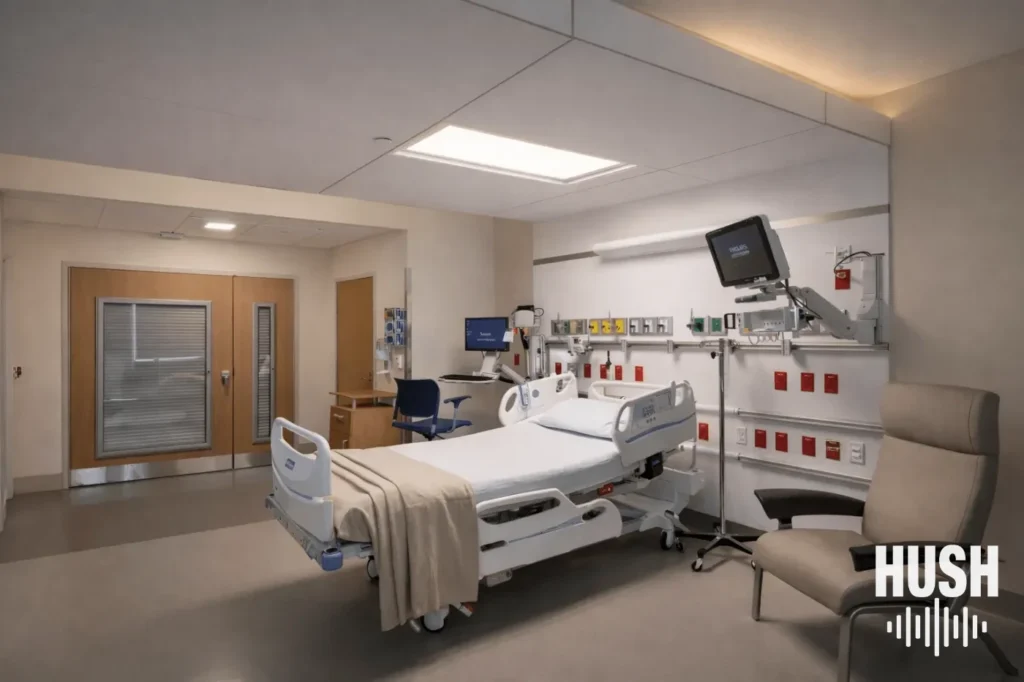
Hospital soundproofing is about patient care, staff performance, and privacy. Post-op recovery, children’s centers, consult rooms, and nurse stations all need different balances of sound reduction, noise reduction, and speech privacy. We treat the building as a system—assemblies, doors, ceilings, and mechanical noise—so the space supports calm and communication.
Healthcare spaces we address
- Post-op + patient rooms: privacy, rest, and low noise floor.
- Consult + intake rooms: speech privacy and confidentiality.
- Children’s centers: echo reduction + calm sound environment.
- Nurse stations + corridors: controlled reflections and reduced spill.
- Mechanical adjacency: vibration and duct-borne noise control.
Speech privacy and intelligibility
Healthcare needs both:
- Privacy: keep conversations in the intended room, so patient details stay private.
- Intelligibility: make speech clear at normal levels, so nobody has to strain.
If the issue is reflections and harshness in open areas, see Acoustic Panels for echo reduction.
In hospital soundproofing, privacy often fails over the wall rather than through it. That happens when a wall stops at the suspended ceiling and speech crosses through the shared plenum. So we run the wall to the deck or specify a ceiling with a high CAC (Ceiling Attenuation Class). In open intake areas, we also check Articulation Class (AC), which rates how well the ceiling stops speech bouncing between stations.
Isolation systems: walls, ceilings, doors, and flanking
- Wall Soundproofing for consult rooms and patient room boundaries
- Ceiling Soundproofing for overhead noise and mechanical adjacency
- Soundproof Door for leakage control and privacy performance
Hospital soundproofing for mechanical noise
Hospitals are also equipment-dense. When the problem is structure-borne vibration or duct noise, treat the source and the path.
We also set background-noise targets with NC or RC curves. Specifically, these Noise Criteria and Room Criteria curves rate HVAC noise band by band. So the spec can state exactly how quiet a patient room must be.
Authority links
Hospital Soundproofing for Rest, Recovery and Privacy
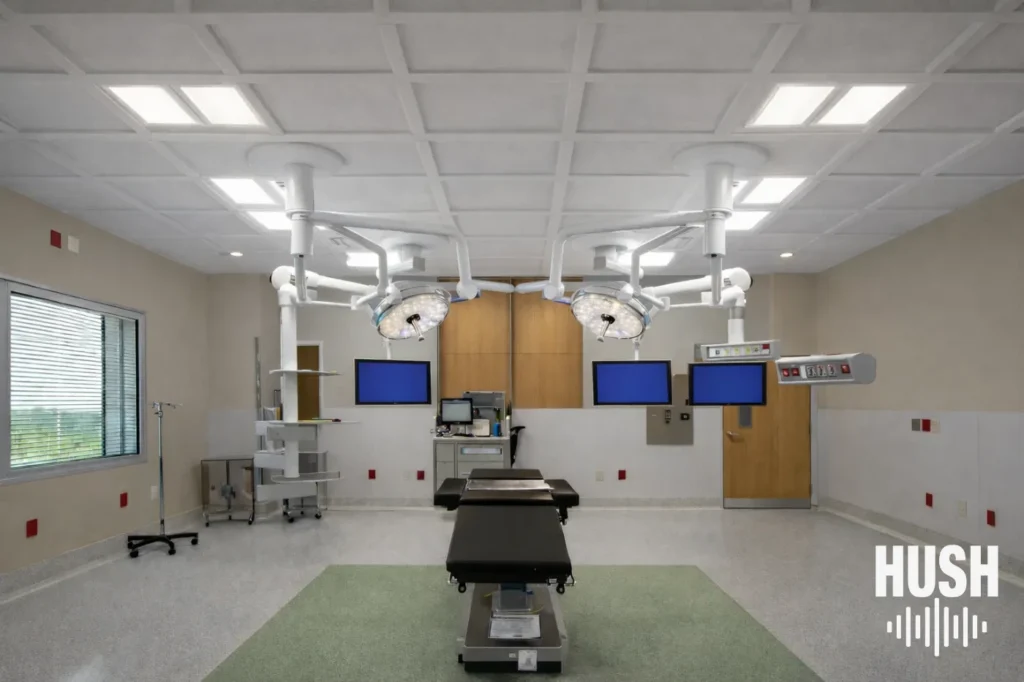
Hospitals and clinics are some of the noisiest buildings people try to rest in. Alarms, carts, HVAC, conversations at nursing stations and adjacent patient rooms all add up, and the hard, cleanable finishes that infection control requires make sound linger. So hospital soundproofing aims to protect two things: patient rest and speech privacy for sensitive conversations.
Our work in healthcare spaces generally includes higher-performance walls between exam and patient rooms, sealed acoustic doors, quieter HVAC with properly selected silencers and diffusers, and cleanable acoustic ceilings and wall panels. The WHO environmental noise guidelines summarize the health effects of noise, and the Whole Building Design Guide’s acoustic comfort resource covers design strategies for privacy and comfort. For equipment noise, the ASHRAE Handbook chapter on noise and vibration control is the industry reference.
Hospital Soundproofing FAQs
How do you improve speech privacy in exam rooms?
Seal the walls to the deck above, upgrade or seal the doors, and treat shared ductwork. In addition, a little background sound in corridors can help mask conversations.
This is sound masking: it raises the background sound slightly, so distant speech is harder to understand.
Are acoustic panels safe for clinical spaces?
Yes, if you choose the right products. So we specify cleanable, moisture-resistant and fire-rated acoustic finishes suitable for healthcare. For example, a sheet with sub-millimeter holes can absorb sound without any fibrous fill. Staff can wipe this micro-perforated panel clean, which suits infection control.
Can hospital soundproofing happen in an occupied building?
It can, with careful phasing, dust control and after-hours scheduling coordinated with your facilities team.
What causes the constant hum in patient rooms?
Most often, HVAC: fans, terminal units or high air velocity at the diffusers. So we measure the noise and fix it at the source where possible.
A hum is often tonal, that is, a steady tone at one pitch. Because tonal noise annoys more than broadband noise at the same level, it matters even when the dBA reading looks low.
See soundproof doors, HVAC duct soundproofing and commercial soundproofing.
Our Clients
Client partners include residential, commercial, and institutional organizations that rely on precise soundproofing and acoustical execution.

SCHEDULE A CONSULTATION
Contact Hush Soundproofing today! Our expert team is ready to assess your space and provide customized solutions to create a peaceful and quiet environment.