
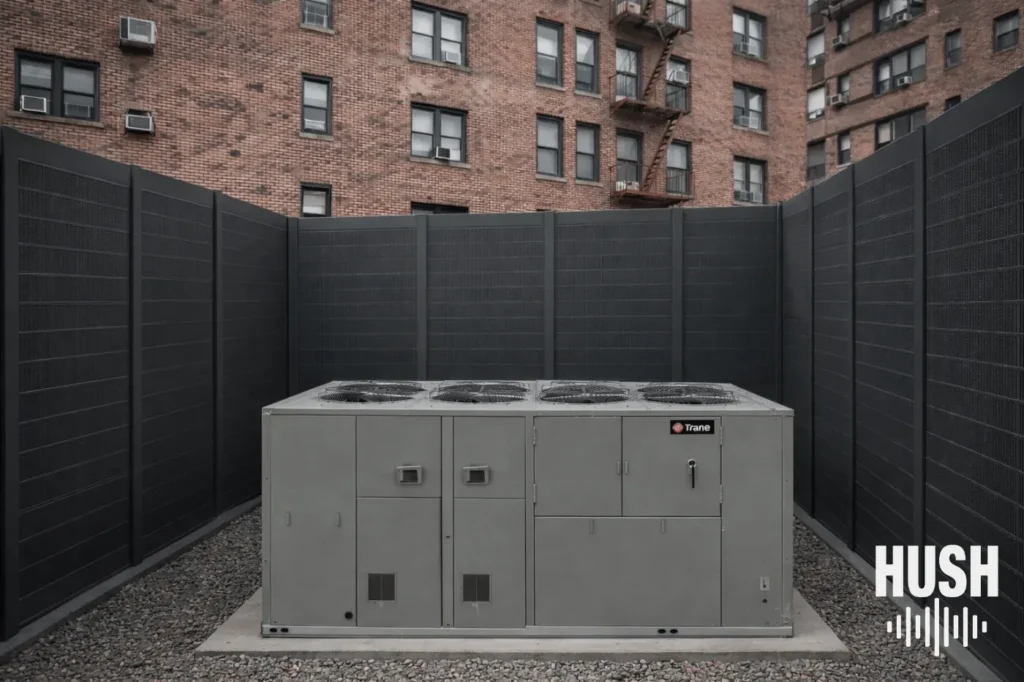
HVAC Unit Soundproofing
HVAC Unit Soundproofing
HVAC unit noise is one of the fastest ways to ruin a high-end space. Fan noise, vibration, cycling tones, and rooftop transmission all show up as sleep disruption and “room buzz.” HVAC unit soundproofing works when we isolate the equipment correctly, control duct and pipe connections, and reinforce the receiving-side ceiling or wall where the building is acting like a speaker.
Common HVAC unit noise complaints
- Fan rumble and tonal noise: especially noticeable in bedrooms and offices. A steady tone annoys people more than broadband noise at the same level. A fan produces a tone at its blade pass frequency: RPM × number of blades ÷ 60, in hertz. So matching it to a measured tone helps pin down which fan is the source.
- Rooftop unit vibration: transmitted into slab/steel and re-radiated below.
- Mechanical closet noise: small enclosures amplify and leak.
- Short cycling and “thumps”: start/stop impulses, contact points, and rigid connections.
What we control: vibration, airflow noise, and transmission paths
In practice, HVAC units are predictable when treated as systems. Typical scope items include:
- Correct isolators: selected for load and vibration behavior, installed without rigid bridges.
- Flexible connectors at ducts and piping: to stop mechanical energy from “jumping” into the building.
- Duct-borne sound control: silencers, lining, or plenum strategies where fan noise is transmitted.
- Airtight detailing: because leaks bypass your assembly and make the room feel “thin.”
For example, we size isolators by static deflection, that is, how far the spring compresses under the unit’s weight. More deflection lowers the isolator’s natural frequency. Once that frequency sits well below the fan or compressor speed, transmissibility (the share of vibration passing through) drops sharply. So HVAC unit soundproofing starts with the right isolator.
With neoprene mounts, deflection depends on the shear modulus: rubber’s stiffness in shear, far lower than its bulk modulus. That’s why neoprene-in-shear mounts load the rubber in shear, not pure compression, for more deflection from the same compound.
Rooftop HVAC units: ceiling soundproofing below
When rooftop HVAC units are above apartments, hotel rooms, or offices, you often need receiving-side control in addition to mechanical isolation. So that usually means a ceiling assembly designed to reduce structure-borne and airborne transmission.
- Decoupled ceiling systems: isolation clips and channel to limit structure-borne vibration transfer.
- Damping layers: to reduce panel resonance and buzz.
- Cavity absorption + sealing: to stabilize performance across frequencies.
See ceiling soundproofing for how we build systems that actually perform.
Frequently Asked Questions
Can I just “box in” the unit? Only if the box accounts for airflow, service access, and vibration isolation. In fact, a rigid enclosure can make vibration worse if it creates new contact points.
Why is the noise worse in one corner of the room? In practice, that’s usually a flanking path or a stiff structural connection re-radiating vibration.
Related mechanical systems:
Further reading:
HVAC Unit Soundproofing for Rooftops, Terraces and Mechanical Rooms
Condensers on rooftops and terraces, air handlers in closets and packaged units in mechanical rooms are some of the most common sources of noise complaints in New York. HVAC unit soundproofing deals with the two ways that equipment noise spreads. On one hand, airborne sound radiates from fans and compressors to nearby windows and terraces. On the other hand, vibration travels through mounts, pipes and ducts into the structure, where it reappears as hum in rooms below. So effective HVAC noise reduction has to treat both paths.
For airborne noise, we use acoustic enclosures, barrier walls and louvers sized to keep airflow healthy. For vibration, we also install spring or neoprene isolators and flexible connections, as recommended in the NYC DEP Residential Noise Control Guidance Sheet and the ASHRAE Handbook. Because the NYC Noise Code covers HVAC equipment, controlling unit noise also helps building owners avoid violations and neighbor disputes.
We also measure in dBC and octave bands, not just dBA. A-weighting follows human hearing and under-reads bass. However, low-frequency hum shows up much better in dBC and in octave bands such as 63 Hz and 125 Hz.
HVAC Unit Soundproofing FAQs
Can you build an enclosure around a rooftop condenser?
Yes. However, the enclosure has to let enough air through, so we design acoustic louvers and openings that keep the unit cool while blocking noise.
Why do I hear a hum from the unit upstairs?
In many cases, the unit sits directly on the slab without proper isolation. As a result, vibration passes straight into the structure. So isolators usually fix it.
Is a noisy HVAC unit a code violation in NYC?
It can be. The NYC Noise Code includes rules for HVAC equipment, and DEP publishes guidance on both interior and exterior HVAC noise.
Will soundproofing affect my HVAC warranty?
Not when HVAC unit soundproofing follows the manufacturer’s clearance and airflow requirements, which we always check first.
See HVAC duct soundproofing, chiller soundproofing and mechanical noise.
Our Clients
Client partners include residential, commercial, and institutional organizations that rely on precise soundproofing and acoustical execution.

SCHEDULE A CONSULTATION
Contact Hush Soundproofing today! Our expert team is ready to assess your space and provide customized solutions to create a peaceful and quiet environment.