
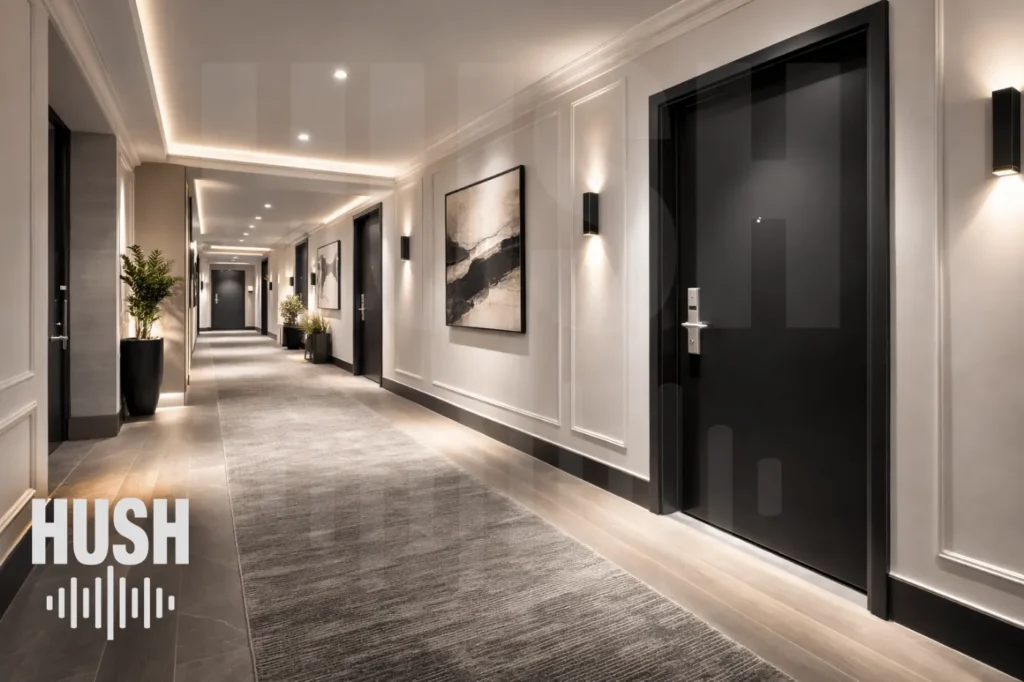
Soundproof Metal Doors NYC
Soundproof Metal Doors
Metal doors are common in NYC commercial spaces, corridors, and back-of-house areas. However, “metal” doesn’t automatically mean quiet. Sound performance depends on the door core, frame stiffness, and sealing discipline. Therefore, we treat metal doors as complete opening systems—leaf, frame, gasketing, and under-door control.
Where metal soundproof doors make sense
- Commercial entries: tenant spaces that need privacy and control.
- Mechanical adjacency: rooms where tonal noise (a steady hum at one frequency) and equipment activity are present.
- High-traffic openings: durability without sacrificing sealing.
What we build around
First, we verify the opening condition: alignment, hinge behavior, and latch pull-in. Next, we select the fire rated soundproof door construction appropriate for the objective (including core type and stability). Then, we install perimeter gasketing and an under-door strategy so the door closes into a continuous seal line. In addition, we avoid “over-sealing” that prevents proper latch engagement for the acoustic metal door.
Seals are foundational: Door Perimeter Seal.
Common field problems we correct
Metal doors often “sound loud” because the opening is leaky or unstable. Therefore, we fix the basics before recommending replacement with an Acoustic Metal Door.
- Edge gaps: inconsistent clearances that leak corridor noise.
- Door bounce: the closer fights the seals and the latch never seats fully.
- Undercut leakage: the bottom gap behaves like an open vent.
- Rattle: hardware or frame vibration that becomes audible at higher levels which require heavier Soundproof Metal Doors.
Fire rated Soundproof Doors
Many metal doors are part of a fire-rated opening, especially in corridors and commercial buildings. For that reason, sound upgrades must be coordinated so the opening remains appropriate for its rating and hardware configuration. We keep the process straightforward and aligned with real site conditions.
Authority links
For glass and visibility, see Soundproof Glass Doors.

Choosing Soundproof Metal Doors for NYC Buildings
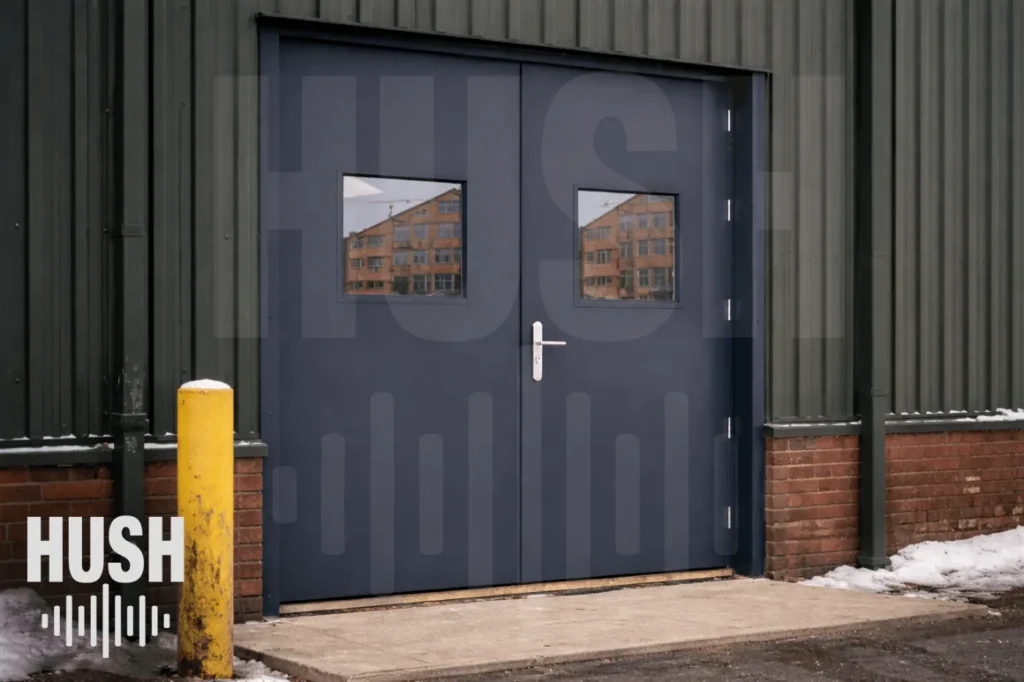
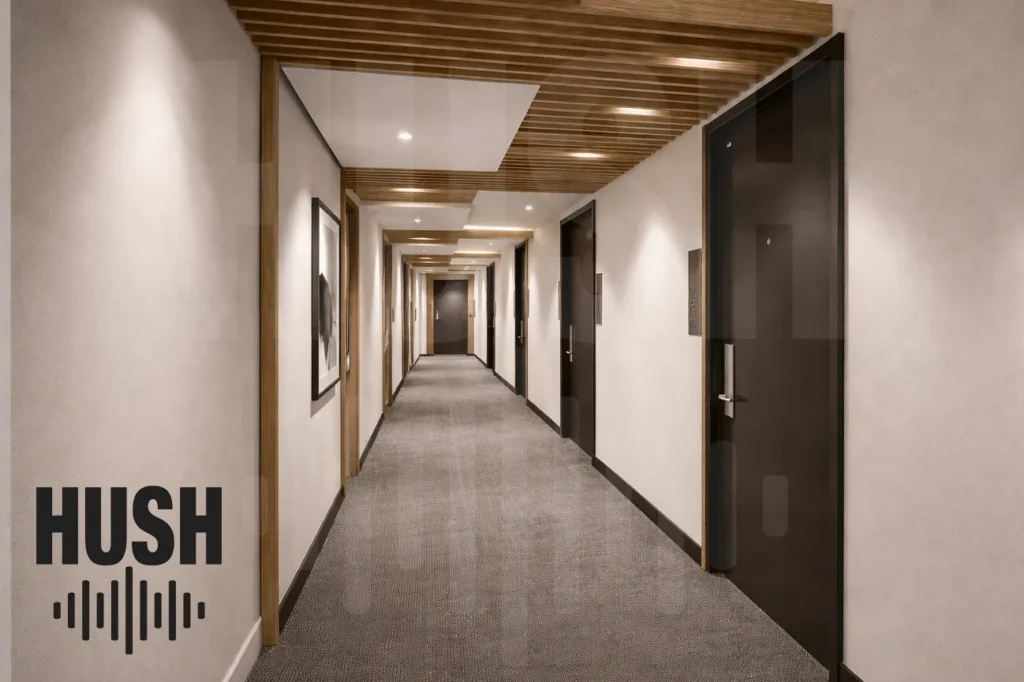
Soundproof metal doors are the go-to choice wherever a door has to block serious noise and meet fire and security requirements at the same time. Typical uses include mechanical rooms, stairwells, recording studios, back-of-house corridors and apartment entry doors in buildings that require rated steel doors. Unlike a standard hollow metal door, an acoustic metal door has a damped, filled core, a heavy-gauge frame and a complete gasket system around the head, jambs and bottom.
Why does the core matter? A bare steel skin follows the mass law. Doubling its weight adds only about 5–6 dB of transmission loss, that is, the decibels a door removes at each frequency. So soundproof hollow metal doors rely on a filled core with constrained-layer damping instead. In other words, a viscoelastic layer sandwiched between rigid layers turns vibration into a little heat. As a result, the slab rings less and blocks more sound.
Lab Ratings vs. Field Results
Door ratings come from laboratory tests based on ASTM E90, and the NYC DEP Residential Noise Control Guidance Sheet suggests at least STC 50 for doors and windows in homes. In practice, though, the seals matter as much as the slab. A gap of even a few millimeters under a door can undo much of its rating. That’s why we treat soundproof metal doors as a complete assembly: slab, frame, seals, automatic bottom and an airtight frame-to-wall joint. For broader design guidance, the Whole Building Design Guide’s acoustic comfort resource covers the basics of acoustic comfort, from sound isolation to absorption and masking.
Also keep in mind that a door’s STC is a lab number for the complete assembly. Labs test door systems as slab, frame and seals together, for example under ASTM E1408. Once installed, field ratings such as NIC (ASTM E336) usually land several points lower. That gap comes from workmanship and flanking paths, meaning sound that slips around the door through a hollow wall, ducts or a shared ceiling. For more on how the numbers work, see our guide to STC and IIC ratings.
Soundproof Metal Doors FAQs
Can a soundproof metal door also be fire-rated?
Yes. Many acoustic steel door assemblies carry both a sound rating and a fire rating. We confirm the labels and hardware so the door meets code and your building’s requirements.
What STC rating should a metal door have?
For apartment entries and offices, STC 45 to 50 is a solid target. For studios, mechanical rooms and music spaces, we often specify STC 50 to 55 or higher, sometimes as a double-door sound lock.
A sound lock is simply two doors with a small vestibule between them. For recording rooms, see our soundproof studio doors.
Can you upgrade my existing metal door instead of replacing it?
Sometimes. If the frame is sound, adding perimeter gaskets and an automatic door bottom can make a big difference. However, a hollow slab has limits, so a full replacement gives the best result.
Do soundproof metal doors need special frames?
Yes. The frame has to be rigid, grouted or filled, and sealed to the wall. Otherwise, sound simply goes around the door.
Compare our soundproof doors, see the automatic door bottom and door perimeter seal, or book a consultation.
Our Clients
Client partners include residential, commercial, and institutional organizations that rely on precise soundproofing and acoustical execution.

SCHEDULE A CONSULTATION
Contact Hush Soundproofing today! Our expert team is ready to assess your space and provide customized solutions to create a peaceful and quiet environment.