
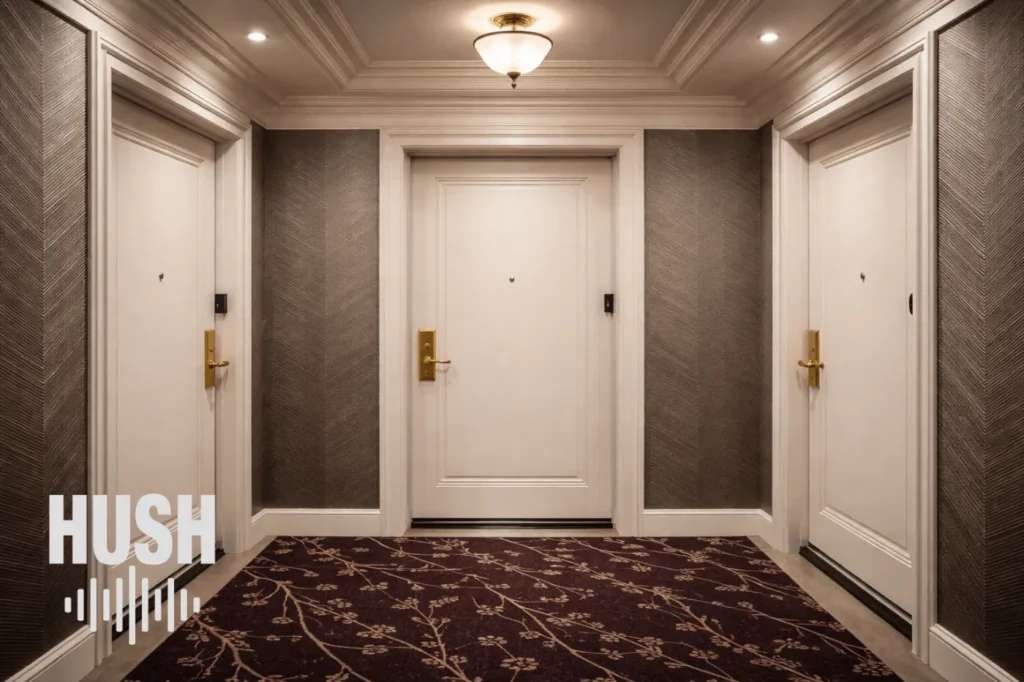
Door and Window Soundproofing NYC
Most of the noise that gets into an apartment through a door is not coming through the door. Instead, it comes around it: the gap under the leaf, the crack along the jambs, the latch that never quite pulls the door tight. A soundproof door is an opening system, not a slab of wood, and the same is true of a window. Hush seals, upgrades and replaces doors and windows across New York City, and we start by finding the leak path before we recommend anything.
How to Soundproof a Door: Where the Sound Actually Gets In
Stand inside a quiet room with the lights off and look at a closed hallway door. In practice, any light you see is a sound leak. In most NYC apartments and offices the ranking is the same:
- The undercut. A standard door clears the floor by half an inch to an inch. As a result, that gap is acoustically a hole the width of the door.
- The perimeter. Jambs and head rarely seal. Also, weatherstripping meant for drafts compresses unevenly or not at all.
- The latch. If the latch does not pull the door firmly into its stop, the seals never compress and nothing else matters.
- The leaf itself. Hollow-core interior doors weigh very little, so they transmit voices easily. This is the last item on the list because it is the most expensive to fix and, in most cases, the smallest leak.
Fixing items one through three is door soundproofing. Fixing item four is a soundproof door. In fact, many clients only need the first. Acousticians call this leak area: a small unsealed gap can cap a door far below its rated STC. So soundproofing a door always starts with the gaps.
Soundproof Door Seals and Automatic Door Bottoms
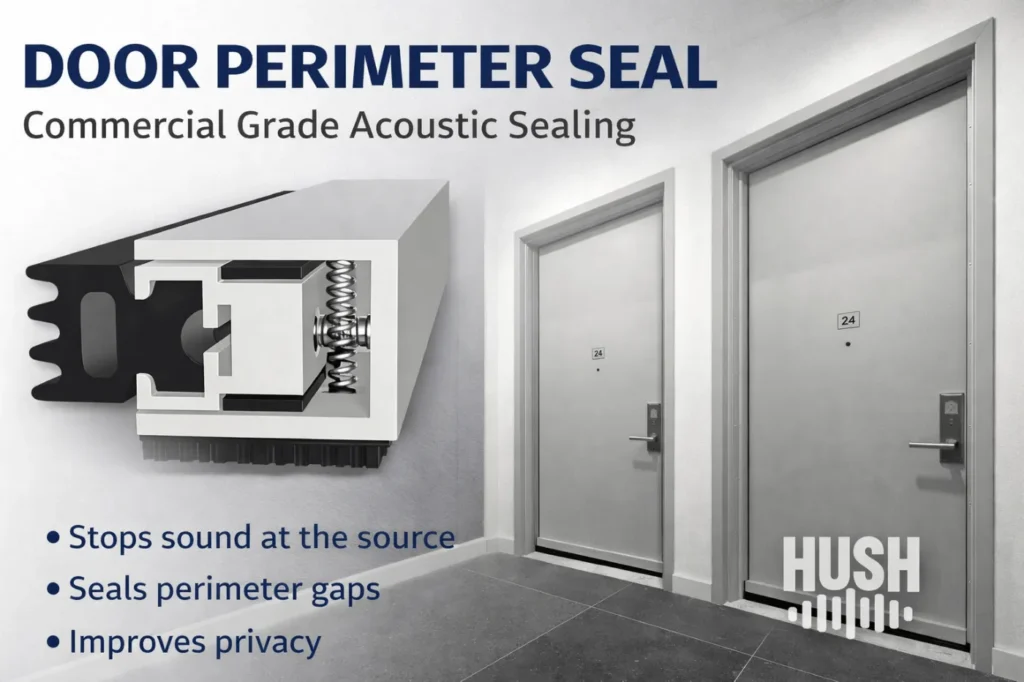
Our installed seal package treats the whole perimeter of an existing door and costs $1,440 per door, installed. It includes:
- Perimeter seals at both jambs and the head: continuous compression gasketing set so the latch pulls the door into full contact.
- An automatic door bottom (the engineered version of a soundproof door sweep). A plunger strikes the opposite jamb as the door closes and drops a seal to the floor, then lifts it when the door opens so it does not drag.
- Latch and closer tuning so the seals actually compress, and adjustment of the strike if the door is not pulling tight.
- Acoustic sealant at the frame-to-wall joint, where many frames leak behind the trim.
Every component is an acoustic door seal rated for compression rather than a hardware-store draft strip.
Two automatic door bottom styles are available. Recessed units mortise into the bottom of the leaf for a clean look where the door has enough thickness. Surface-mounted units, on the other hand, screw to the face of the door for faster retrofits, metal doors, or where the leaf is too thin to mortise.
A seal package is the right first step for hallway voices, lobby noise, a neighbour’s television and most office speech-privacy problems. It is also a renter-friendly fix; nothing structural changes.
Soundproof Interior Doors and When to Replace the Leaf
Sealing a light door makes it as good as that door can be. However, sometimes that is not good enough. Signs you need a full soundproof door rather than seals:
- The door sounds hollow when you knock on it, or you can feel it flex.
- It is visibly warped, so seals cannot make continuous contact.
- The latch does not pull it tight even after adjustment.
- The source is loud: music, a studio, a bar below, a mechanical room.
- You have already sealed it and the exposure has not changed meaningfully.
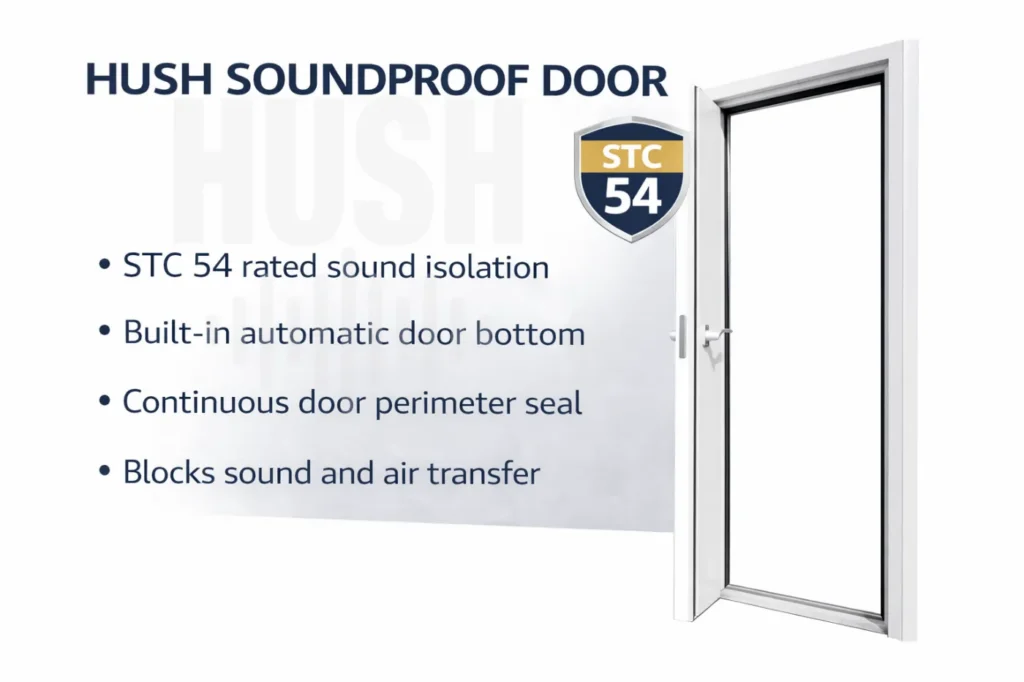
An acoustic door is rated by STC (Sound Transmission Class). The NYC Department of Environmental Protection recommends at least STC 50 for windows and doors in homes. In our experience, a purpose-built STC 55 door is about three inches thick. We supply and install solid wooden, metal, glass, studio and sliding glass soundproof doors, and the right one depends on the noise profile and the opening:
| Door type | Best for |
|---|---|
| Solid wood acoustic door | Bedroom and apartment entry doors where speech privacy matters and the look should stay residential |
| Metal acoustic door | Mechanical rooms, commercial corridors, fire-rated openings that also need isolation |
| Glass acoustic door | Offices and conference rooms that need sight lines; laminated or multi-layer glazing, never standard glass |
| Studio door | Recording and rehearsal spaces; often paired as a double door or sound lock |
| Sliding glass acoustic door | Terrace and courtyard openings; the track and bottom seal do most of the work |
Frames, Thresholds and Sound Locks
The frame is also part of the system. Hollow metal frames get filled with grout or mineral wool, the frame-to-wall gap is sealed with acoustical sealant, and the threshold is levelled so the bottom seal lands evenly. Otherwise, a twisted or unanchored frame will defeat any door hung in it.
Also, check what a door rating actually covers. Labs test a door as a complete assembly, meaning slab, frame and seals together (for example, under ASTM E1408). So a sound blocking door slab hung in an old frame without its seals will not reach its listed STC. Field results also run a few points below lab numbers because of flanking and workmanship. Finally, a wall with a door in it gets one combined rating, the composite STC. It comes from area-weighted transmission, so the weakest element dominates and a weak door drags down a strong wall.
For the loudest sources, two doors with a vestibule between them (a sound lock) can push a doorway into the STC 60s and is the most effective door solution for bass.
Soundproof Bedroom Doors and Apartment Entry Doors
The two most common residential requests are different problems.
A soundproof apartment door faces the hallway. The noise is voices, elevators, deliveries and lobby spill. The leak is almost always the undercut and perimeter, so a seal package solves most cases. In addition, co-op and condo boards usually treat seals as a non-structural alteration, which keeps approvals simple.
A soundproof bedroom door faces the rest of your own apartment. The problem is usually a hollow-core leaf plus a large undercut left for HVAC return air. Therefore, you often need both: a solid-core replacement leaf and a seal package, and a return-air path that does not run under the door.
Soundproof barn doors are a frequent question and an honest answer is that a barn door cannot be sealed. It hangs proud of the wall on a track, so there is an open gap on every side. If the room needs isolation, it needs a hinged door.
Soundproof Door Curtains, Blankets and Other Door Sound Blockers
Heavy curtains, a soundproof blanket for a door hung from hooks, and under-door foam “noise blockers” come up in nearly every consultation. They add a small amount of absorption and a little mass. However, they do not seal, and they do not stop a door from leaking at the perimeter. A soundproof door curtain can take the edge off hallway echo; it will not stop a conversation from being intelligible on the other side. If you want a reversible, no-tools fix, a properly fitted door sweep and adhesive perimeter gasket will do more than any curtain, and the installed seal package will do more still.
You may also see a “noise cancelling door” advertised. In practice, that is simply a heavy, well-sealed door; nothing in it cancels sound electronically. So judge it by its tested assembly STC, not the label.
Soundproofing Windows in NYC
Windows are the other opening in the room, and in Manhattan and Brooklyn they are often the dominant noise path: traffic, sirens, construction, the subway grate across the street. The options, in order of cost and effectiveness:
Sealing. Sash locks tightened so the sashes compress their weatherstripping, gaps at the frame caulked with acoustical sealant, and worn glazing putty replaced. It is cheap, and it is also the first step for any window.
Interior window inserts. A secondary laminated-glass panel mounted inside the existing window with a sealed air gap of several inches. Inserts are renter-friendly, usually need no board approval, keep the original window intact (important in landmarked buildings), and are the most effective single upgrade for street noise short of replacement.
Replacement acoustic windows. Laminated, dissimilar-thickness glass in a sealed frame. The right answer when the existing window is at the end of its life or the building is already replacing windows. Many suppliers sell these as noise reduction windows, so compare tested ratings, not names.
For street noise, also ask for OITC (Outdoor–Indoor Transmission Class). It weights traffic and train rumble, so it rates windows better than STC. Laminated glass adds a PVB interlayer, a plastic film that damps the pane. Also, unequal panes avoid sharing one coincidence dip, the frequency where isolation sags.
For studios and the loudest street exposures, we angle and separate panes the way a control-room window is built, which is covered on our studio soundproofing page.
DIY soundproofing windows (removable plugs, heavy curtains, weatherstripping) helps at the margins. Searches for soundproof windows NYC usually end at inserts for exactly this reason: they are the step between DIY and replacement. Still, the honest limit is that a window with a leaking frame or single glazing cannot be made quiet with fabric.
What We Check Before We Scope the Work
- Identify the dominant leak path: undercut, perimeter, leaf, or window.
- Check latch engagement and closing force; a door that will not pull tight gets a strike adjustment before anything else.
- Look for flanking: sound arriving through the ceiling plenum, a shared return duct or the wall beside the door. If the door is not the weakest point, sealing it will not change what you hear, and we will tell you so.
- Confirm whether the opening is fire-rated. Many NYC corridor doors are. Sound upgrades must keep the opening compliant, so we coordinate seals and replacement doors with the fire rating rather than around it.
For disputes, recurring complaints, or any case where the source is unclear, an acoustic report measures airborne leakage, structure-borne vibration and flanking separately so you fix the right thing once.
Door and Window Soundproofing Cost in NYC
- Installed seal package (perimeter seals + automatic door bottom): $1,440 per door
- STC-rated soundproof door, supplied and installed: quoted per opening, dependent on door type, frame condition and fire rating
- Soundproof window inserts and acoustic windows: quoted per opening
- Consultation: $250 virtual or $500 on-site, credited toward the project if you proceed
Full pricing context is on our soundproofing cost guide.
Door and Window Soundproofing FAQ
How do I soundproof a door without replacing it?
Seal it. Perimeter gasketing at the jambs and head plus an automatic door bottom closes the gaps that carry most of the sound. Our installed seal package does exactly this for $1,440 per door.
Does a soundproof door sweep work?
A brush or rubber sweep helps a little. However, an automatic door bottom, which drops a seal to the floor when the door closes, works much better because it seals under compression and does not drag. That is the version we install.
What STC rating should a soundproof door have?
NYC DEP guidance points to around STC 50 for residential noise control. Standard hollow-core doors are in the 20s; a sealed solid-core door reaches the mid-30s; purpose-built acoustic doors reach 50 to 55, and sound locks go higher. See our STC and IIC guide for what the numbers sound like.
Can I soundproof a rental apartment door?
Yes. Seals and automatic door bottoms are reversible, so they need no structural work. Window inserts are also removable.
Do soundproof curtains or blankets on a door work?
They reduce echo slightly and do nothing for the gaps. So seal the door first.
What is the best way to soundproof windows in an NYC apartment?
For most apartments, interior window inserts over a sealed existing window. They are the biggest improvement that does not require replacing the window or going to the board. So inserts are usually the first step when soundproofing windows in NYC. When the window itself is failing, replacement noise reducing windows with laminated glass are the next step.
Will sealing my door stop bass from the bar downstairs?
No. Low frequencies travel through the structure. That is a ceiling or floor problem, not a door problem, and we will say so at the consultation rather than sell you seals.
Schedule a Door or Window Consultation
Hush is a licensed New York City contractor with an in-house acoustic team. We serve Manhattan, Brooklyn, Queens, the Bronx and Staten Island. Book an on-site or virtual consultation and we will tell you whether your opening needs seals, a new door, window inserts, or something else entirely.
Related: Wall Soundproofing · Ceiling Soundproofing · Apartment Soundproofing · Soundproofing Materials · STC and IIC Ratings · Soundproofing Cost NYC · Acoustic Report
Our Clients
Client partners include residential, commercial, and institutional organizations that rely on precise soundproofing and acoustical execution.

SCHEDULE A CONSULTATION
Contact Hush Soundproofing today! Our expert team is ready to assess your space and provide customized solutions to create a peaceful and quiet environment.