
How to Soundproof a Wall Between Apartments
If you can hear your neighbor’s conversations, TV, music, or phone calls through the wall, you have an airborne noise problem at the party wall (also called the demising wall) between apartments. The good news: airborne noise through a shared wall is one of the most predictable problems in building acoustics, and a properly engineered soundproof wall between apartments can reduce it dramatically. The bad news: the common fixes, like foam, decorative panels, bookshelves, or one more layer of drywall screwed to the wall, rarely make a meaningful difference.
This guide explains how Hush soundproofs a wall between apartments in New York City, why each layer matters, and what results you can expect. For the full service overview, see wall soundproofing NYC.
Why Apartment Walls Leak Sound
To reduce noise from neighbors, first find out why the wall leaks. These are the usual causes we check before soundproofing apartment walls.
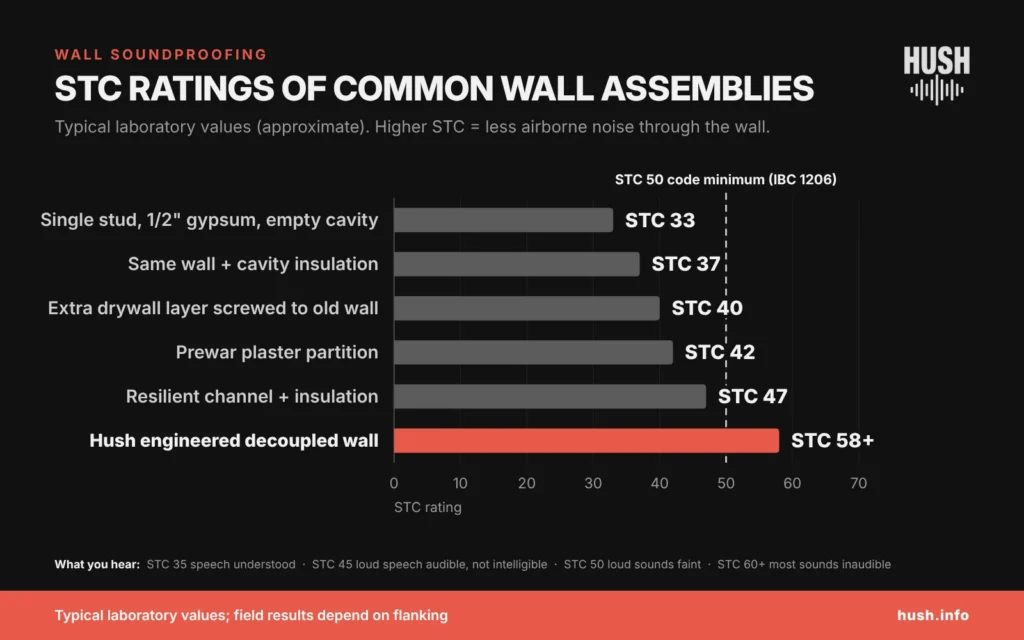
- Low mass: a single layer of 1/2″ gypsum on each side of steel or wood studs is light and transmits speech easily (roughly STC 33-40).
- Rigid coupling: when both sides of a wall share the same studs, vibration passes straight through. In fact, this is the main limit on performance. B.H. Sharp’s 1978 method for predicting double walls accounts for exactly this. Known as Sharp’s double-wall method, it also covers how studs and screws carry vibration between the two sides.
- Cavity resonance: an empty cavity acts like a drum (the mass-air-mass resonance), weakening low and mid frequencies.
- Air leaks: back-to-back outlets, gaps at the floor and ceiling, and pipe penetrations let sound through as easily as an open crack under a door.
- Flanking: sound bypasses the wall through the floor, ceiling, ductwork, or a continuous slab and enters your room from another surface.
How Hush Soundproofs a Wall Between Apartments
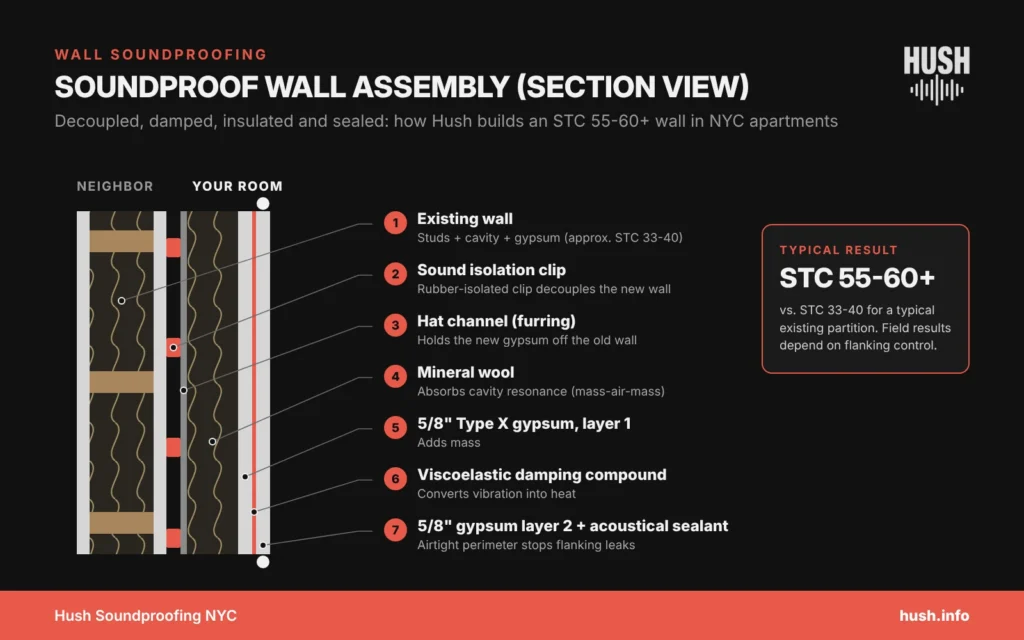
We build a new, independent wall plane on your side, using all four principles of sound isolation at once: decoupling, mass, damping, and absorption, finished with airtight sealing.
- Inspection and leak control. First, we locate gaps, outlets, switch boxes, and penetrations, and seal them with acoustical sealant, putty pads, and gaskets.
- Decoupling. Then we mechanically separate the new wall plane from the existing wall, so vibration cannot pass straight through. Hush uses its own decoupling method, engineered for each building.
- Absorption. Next, mineral wool fills the new cavity to control cavity resonance and improve low-frequency transmission loss.
- Mass and damping. Two layers of 5/8″ Type X gypsum go up with a viscoelastic damping compound between them, which converts vibration into heat.
- Perimeter isolation. We also fill a small gap at the floor, ceiling, and side walls with non-hardening acoustical sealant, so the new wall stays isolated and airtight.
- Finishing. Finally, we extend outlets with sealed boxes, then tape and finish the wall to a Level 5 paint-ready surface.
A soundproof wall between apartments built this way typically adds a few inches of depth. Typical results are STC 55-60+ in lab terms, compared with STC 33-40 for a typical existing partition. Real-world (field) results depend on flanking, which is why our acoustical consultant evaluates adjoining floors, ceilings, and ducts before construction.
In practice, field ratings have their own names. ASTC (Apparent STC, ASTM E336) rates a wall measured in your building. It usually comes in several points below lab STC (ASTM E90) because of flanking and workmanship. So we design with that margin in mind.
Common Mistakes When Soundproofing a Shared Wall
Using acoustic panels or foam
Acoustic panels are excellent for echo control, but they are absorbers, not barriers. In other words, they do not stop sound passing through the wall.
Screwing extra drywall directly to the wall
Added mass helps, but when it is rigidly attached it typically gains only 3 to 5 STC points. That is the mass law at work: doubling the weight of a single layer adds only about 5–6 dB of transmission loss. Instead, decoupling is what unlocks large improvements.
Short-circuiting the decoupling
A single screw that reaches a stud through resilient channel bypasses the isolation. In other words, it becomes a rigid link across the cavity, a sound bridge that caps the wall’s performance. So decoupling only works when the new wall plane stays fully separated from the structure at every point.
Ignoring outlets and the perimeter
An unsealed outlet box or a gap under the baseboard can cost 5 to 10 STC points. Sealing is not optional. Leak area matters, because soundproof apartment walls are only as good as their weakest seal.
Hearing footsteps too? Read upstairs neighbor noise. For hallway noise, see door soundproofing. For a full-apartment plan, see apartment soundproofing NYC. Typical pricing is in our soundproofing cost guide, and the Sound Transmission Class article explains how STC is measured.
Party Wall Soundproofing FAQ
What is the best way to soundproof a wall between apartments?
Build a new wall plane that is decoupled from the existing structure, add mass and damping, control cavity resonance with absorption, and seal every perimeter and penetration airtight.
How thick is a soundproof wall?
A Hush party wall assembly typically adds a few inches to the existing wall, depending on the performance target.
Can I soundproof a shared wall without touching my neighbor’s side?
Yes. All Hush party wall assemblies are built entirely from your side of the wall.
How much does it cost to soundproof a wall in NYC?
Hush wall soundproofing projects typically cost $12,000 to $25,000 per room for walls of 100 square feet and up.
Does mass loaded vinyl work?
MLV adds mass, but on its own and fastened directly to a wall it adds only a few STC points. It can be useful inside a decoupled assembly, but decoupling and damping usually deliver more performance per dollar.
Will I still hear bass through the wall?
Low frequencies are the hardest to block. Deeper cavities, absorption, damping, and careful decoupling all improve low-frequency performance, and we design for it when bass is the main complaint.
How to Soundproof a Wall Between Apartments in NYC
Party walls in New York come in every form: plaster on clay tile or brick in pre-war buildings, single steel studs in many newer condos, and patched-together assemblies after decades of renovations. Because of that, there’s no single product that works everywhere. To soundproof a wall between apartments properly, we first identify how the sound is getting through, then build an assembly that fixes that path.
So if you are wondering how to soundproof a wall in a condo, the method is the same. However, steel-stud condo walls often need extra attention to flanking at the slab edge and window mullions.
The NYC Department of Environmental Protection’s Residential Noise Control Guidance Sheet recommends a rating of at least STC 50 for interior walls. Lab ratings come from tests such as ASTM E90, but real walls usually perform lower in the field, because sound also leaks through outlets, baseboards, ceiling cavities and side walls. That’s why our soundproof wall systems combine three things: an independent or resiliently mounted new layer, extra mass with damping, and airtight sealing at every edge and penetration. Research such as NIST’s NBS Report 10316 on STC and IIC in housing still explains why these details matter.
Soundproof Wall Between Apartments: FAQs
How much room does a soundproof wall take up?
Most soundproof walls we build between apartments add about 2 to 4.5 inches, depending on how much isolation you need. In tight rooms, we can use slimmer clip-and-channel systems.
Can I soundproof a shared wall without my neighbor’s involvement?
Yes. We build the entire assembly on your side of the wall, so your neighbor’s unit isn’t touched. Your co-op or condo board may still need to approve the work.
Does adding a layer of drywall help?
A little, since mass helps. However, drywall screwed straight onto the old wall stays rigidly connected, so the gain is usually small. Decoupling, damping and sealing make a far bigger difference.
Do outlets and light switches leak sound?
They do. Back-to-back electrical boxes are one of the most common leaks in NYC party walls. So we seal or relocate them as part of every wall project.
See our wall soundproofing service, or book a consultation to have your wall assessed.
Our Clients
Client partners include residential, commercial, and institutional organizations that rely on precise soundproofing and acoustical execution.

SCHEDULE A CONSULTATION
Contact Hush Soundproofing today! Our expert team is ready to assess your space and provide customized solutions to create a peaceful and quiet environment.