

Soundproofing Cost in NYC
What does soundproofing cost in New York City? The honest answer is that price follows performance. A sealed door, a decoupled wall, and an isolated ceiling solve different problems at very different price points. This guide explains soundproofing costs in NYC using real Hush project ranges, what drives the number up or down, and how to avoid paying for materials that will not solve your noise problem.
| Scope | Typical cost | Solves |
|---|---|---|
| Wall soundproofing | $12,000 to $25,000 per room (100 sf and up) | Airborne noise through a shared wall: voices, TV, music |
| Ceiling soundproofing | $18,000 to $36,000 per room (150 sf and up) | Footsteps and impact noise, plus airborne noise from above |
| Door seal package | $1,440 per door installed | Hallway noise through door gaps (perimeter seal + automatic door bottom) |
| STC-rated soundproof door | Quoted per opening | Corridor, studio, and office privacy beyond what seals can achieve |
| Floor soundproofing | Quoted per assembly | Impact noise to the unit below; board IIC requirements |
| Acoustic report | Quoted per site | Measured STC/IIC, noise source diagnosis, code and lease disputes |
Ranges reflect completed Hush projects in Manhattan, Brooklyn, and Queens and include materials, labor, sealing, and Level 5 finishing. However, final pricing follows a site evaluation. When you compare home soundproofing contractors, ask what each quote includes.
What Drives Soundproofing Cost in NYC
1. The noise type
Airborne noise (voices, TV) is controlled with mass, decoupling, damping, and sealing. Impact noise (footsteps) and low-frequency structure-borne vibration (bass, mechanical equipment) require isolation hardware and deeper assemblies, which cost more. Misdiagnosing the noise type is the most expensive mistake in soundproofing. See STC and IIC ratings explained.
Why do deeper assemblies cost more? In a two-layer wall or ceiling, the two leaves and the air cavity act like a spring. So they resonate at a low frequency, and isolation is poor near it. A deeper, insulated cavity with heavier leaves pushes that resonance below the range that matters. As a result, bass and footstep problems need more depth, more hardware and more labor.
2. The performance target
For example, moving an existing partition from STC 40 to STC 50 is relatively affordable. However, pushing to STC 60+ requires full decoupling, damped mass layers, and meticulous flanking control. Each additional point of performance costs more than the last.
Physics explains that curve. Under the mass law, doubling the weight of a single layer adds only about 5–6 dB. So past a point, extra drywall buys very little. Instead, decoupling does the heavy lifting. It breaks the rigid connection between the two sides, for example with isolation clips and hat channel.
3. Flanking paths
Sound that bypasses the treated surface through ductwork, outlets, pipes, floor joists, or continuous slabs limits real-world results. Treating flanking is part of every Hush scope, and it is why low-bid “add a layer of drywall” quotes often disappoint.
4. Building conditions
Prewar plaster, brownstone joists, steel-stud high-rise partitions, and hung ceilings each require different details. In addition, electrical relocation, sprinkler heads, HVAC diffusers, and radiator piping add scope.
5. Building logistics
Co-op and condo alteration agreements, insurance certificates, elevator reservations, restricted work hours under the NYC Noise Code, and debris removal all affect soundproofing labor cost in New York.
6. Room size and lost space
Pricing scales with square footage. Thinner high-performance assemblies preserve floor area and ceiling height but use more expensive components.
So why not quote a simple soundproofing cost per square foot? Because square footage is only one input. A small room still needs full perimeter sealing, flanking control and finishing. As a result, per-room ranges and a site visit give a truer number than a per-foot rate.
DIY vs Professional Soundproofing
Foam tiles, egg-crate panels, and decorative acoustic panels absorb echo inside a room. However, they do not block sound from passing through a wall or ceiling. Mass loaded vinyl stapled to studs, or a single layer of drywall screwed directly to the existing wall, adds a few STC points at best because the new layer is rigidly coupled to the structure. Instead, real sound isolation depends on decoupling, damping, mass, and airtight construction working together. DIY products cost less up front, but most Hush clients come to us after spending money on solutions that did not work. By contrast, professional soundproofing in NYC starts by finding the noise path, including flanking.
How to Get an Accurate Soundproofing Cost Estimate in NYC
- Describe the noise: what you hear, when, and from where.
- Share photos of the wall or ceiling, outlets, lights, and any vents.
- Tell us your building type and whether board approval is required.
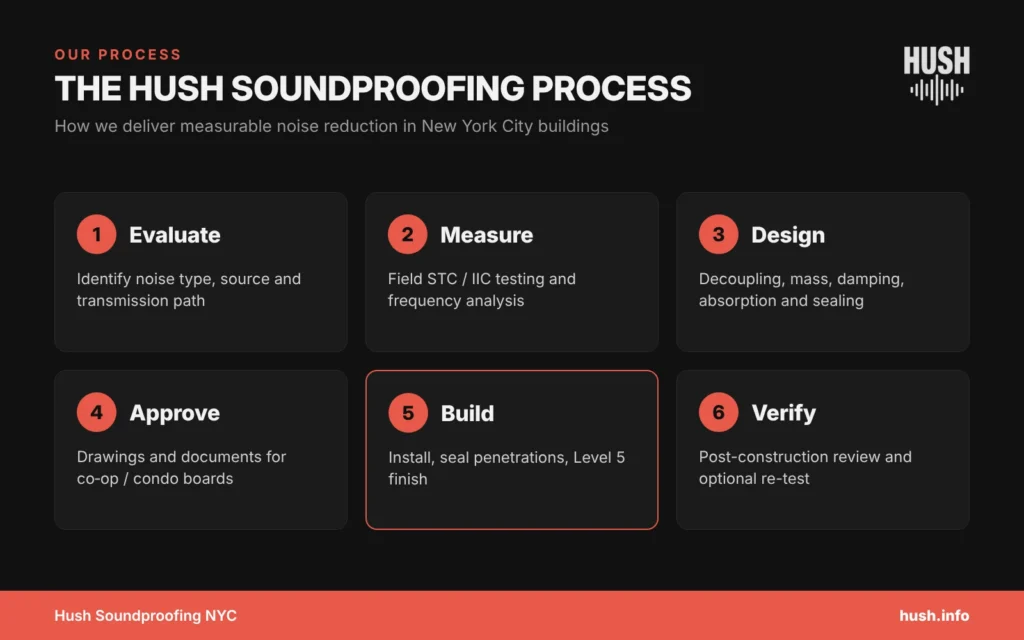
- Book a site consultation. We evaluate the assembly, identify flanking paths, and provide a written scope and price.
NYC Soundproofing Cost FAQ
How much does it cost to soundproof a room in NYC?
Most Hush wall soundproofing projects cost $12,000 to $25,000 per room (100 sf and up), and ceiling soundproofing costs $18,000 to $36,000 per room (150 sf and up). Door seal packages are $1,440 per door installed.
Why is ceiling soundproofing more expensive than wall soundproofing?
Ceilings must control impact noise as well as airborne noise. That requires isolation clips or spring hangers, a managed cavity, damped multi-layer gypsum overhead, and treatment of lights, sprinklers, and HVAC penetrations, all installed overhead.
Is soundproofing worth the cost?
When it is designed around the actual noise type and flanking paths, yes. A decoupled and damped assembly can reduce transmitted noise by 15 to 20 dBA, a difference you will clearly notice.
Can I soundproof one wall instead of the whole room?
Yes. Most apartment projects treat only the shared party wall or the ceiling below a noisy neighbor. Flanking at adjacent walls, floors, and penetrations is evaluated so the treated surface performs as intended.
Do you offer free estimates?
Contact Hush to schedule a consultation. We review your noise problem, building conditions, and goals, and provide a written scope and price.
What Drives Soundproofing Cost in NYC?
Soundproofing cost in NYC depends far more on the building than on the materials. For example, a wall in a pre-war co-op with plaster, radiators and back-to-back outlets takes more labor than a wall in a newer condo. Likewise, a ceiling that has to work around sprinklers, recessed lights or HVAC adds time. In general, five things set the price: the type of noise, the surface being treated, the performance target, the building’s construction and the board’s requirements for insurance, hours and protection.
As a reference point, our published pricing runs about $12,000 to $25,000 per room for wall soundproofing, $18,000 to $36,000 per room for ceiling soundproofing, and $1,440 per door for a sealed door package. Consultations start at $250 for virtual and $500 for on-site residential visits, and the fee is credited toward construction if you move forward. Performance targets in the NYC DEP Residential Noise Control Guidance Sheet (such as STC 50 for interior walls) are a useful way to compare quotes on equal terms.
Also check whether a quote promises a lab rating or a field result. Field ratings such as ASTC (ASTM E336) usually land several points below lab STC, because of flanking and workmanship. So when you compare soundproofing cost in NYC, compare the tested outcome too. A measured acoustic report can confirm it before and after the work.
Soundproofing Cost NYC FAQs
Why does soundproofing cost more in NYC?
Labor rates, building access rules, insurance requirements and limited work hours all add cost. In addition, older NYC buildings often hide surprises behind the walls, so careful scoping protects your budget.
Is it cheaper to soundproof during a renovation?
Yes. When walls or ceilings are already open, the extra cost of isolation, insulation and sealing is much lower. If you’re planning a renovation, bring us in early.
Do I need permits for soundproofing work?
Some projects do. Work has to follow the NYC Building Code and Department of Buildings rules, and most co-op and condo boards require an alteration agreement. We’ll tell you what applies to your scope.
What’s the least expensive fix that actually works?
Sealing doors and gaps is usually the best value. For example, a sealed door package often makes a bigger difference than people expect, especially in hallways and bedrooms.
See our consultation options or the apartment soundproofing guide for more detail.
Our Clients
Client partners include residential, commercial, and institutional organizations that rely on precise soundproofing and acoustical execution.

SCHEDULE A CONSULTATION
Contact Hush Soundproofing today! Our expert team is ready to assess your space and provide customized solutions to create a peaceful and quiet environment.