
Apartment Soundproofing NYC
Apartment soundproofing in NYC is a building acoustics problem, not a decorating problem. In New York’s prewar co-ops, postwar high-rises, brownstone rentals, and new-construction condos, noise from neighbors travels through shared walls, concrete slabs, wood joists, plumbing chases, HVAC ducts, and the gaps around doors. Hush designs and builds engineered sound isolation assemblies for walls, ceilings, floors, and doors so your apartment performs like a private home, with measurable gains in STC (Sound Transmission Class) and IIC (Impact Insulation Class).
In practice, every project starts with an evaluation by our acoustical consultant to identify the dominant noise type, the transmission path, and the flanking paths that will undermine a design if they are ignored. Then we specify a decoupled, damped, and sealed assembly, coordinate with your building management, and install it with our own crews.
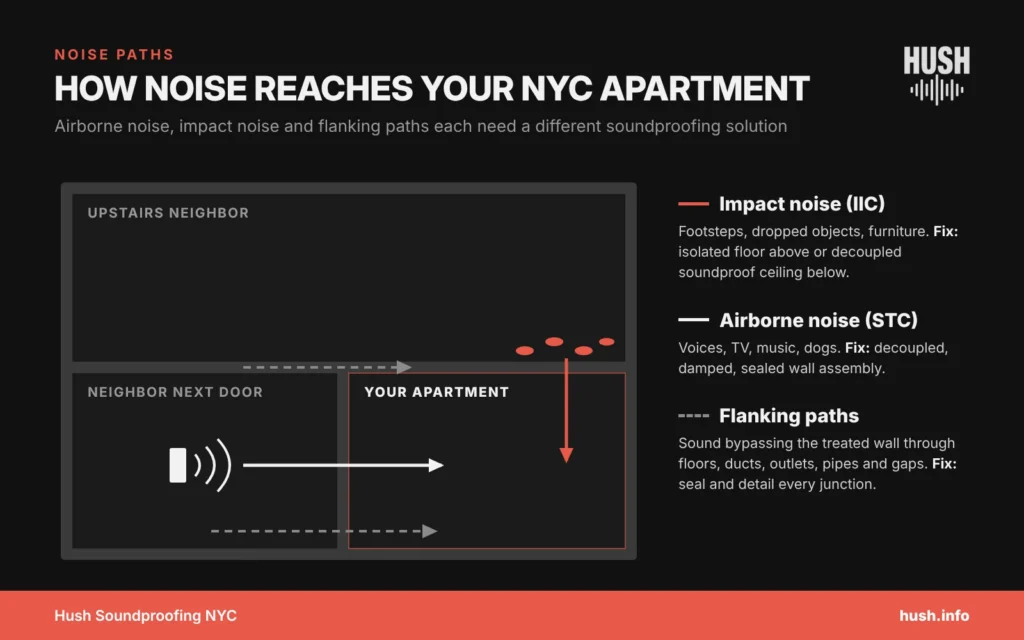
The Three Types of Apartment Noise
Airborne noise
Voices, TV, music, and dogs barking are airborne noise. Sound energy strikes a wall or ceiling, sets the surface vibrating, and then re-radiates on your side. Airborne isolation is measured by STC in the lab and by NNIC / ASTC in the field. In practice, apartment soundproofing in NYC controls it with mass, decoupling, damping, cavity absorption, and airtight sealing. See wall soundproofing for the full assembly method.
Impact noise
Footsteps, dropped objects, furniture dragging, and kids running upstairs are impact noise. The energy is injected directly into the floor-ceiling structure, so adding foam or panels on your side does almost nothing. Impact noise is rated by IIC. However, IIC under-weights low-frequency thuds like heel strikes, so a high-IIC floor can still pass a deep thump. The most effective fix is usually at the source (an isolated floor upstairs), and when that is not possible, a decoupled soundproof ceiling below. Read our guide to upstairs neighbor noise.
Structure-borne vibration
Low-frequency hum from elevators, boilers, pumps, rooftop HVAC, subway rumble, and bass from a bar downstairs travels through the building frame itself. As a result, these problems need vibration isolation and low-frequency design, not generic soundproofing materials. Our mechanical noise control and elevator soundproofing services address them at the source.
Apartment Soundproofing Services
Soundproof the shared party wall
A new decoupled wall plane with added mass, damping, cavity absorption, and acoustical sealant at every perimeter and penetration, engineered by Hush for your building. Typical improvement: from STC 35-45 for an existing partition to STC 55-60+ for the treated assembly. How we soundproof a wall between apartments.
Block footsteps and voices from above
An isolated ceiling hung on sound isolation clips or spring hangers, a managed absorptive cavity, and a damped multi-layer gypsum lid. We also treat recessed lights, sprinkler heads, and HVAC diffusers with putty pads and acoustic enclosures so they do not become leaks. Ceiling soundproofing in NYC.
Stop your noise from reaching the neighbor below
In fact, many co-op and condo alteration agreements require a sound-rated underlayment or floating floor. We design floor assemblies with resilient underlayments and isolated sleepers to meet board IIC targets. We also compare underlayments by ΔIIC (delta IIC), the improvement a product adds over a bare concrete slab. Floor soundproofing.
Seal the hallway
Apartment entry doors leak at the perimeter and the undercut. Leak area matters, because even a small gap can cap a door far below its rated STC. That is why an acoustic perimeter seal and an automatic door bottom, or a full STC-rated door, cut corridor noise, elevator chimes, and cooking odors. Door soundproofing and soundproof doors.
Control echo inside the room
Hard floors and bare walls make apartments reverberant. Acoustic panels in felt, fabric, wood slat, or wood wool lower reverberation time (RT60) and improve speech clarity, especially in home offices and open living spaces. However, panels only treat echo, so apartment soundproofing in NYC still depends on isolation between units.
Apartment Soundproofing by NYC Building Type
- Prewar co-ops (1900-1940): thick plaster on wood or clay tile, but many hidden flanking paths: old radiator risers, abandoned dumbwaiter shafts, and pocket door cavities. So we test before we build.
- Brownstones and townhouses: wood joist floors with low mass make impact noise the main complaint; masonry party walls often perform well except where joists pocket into them.
- Postwar high-rises (1950-1990): concrete slabs perform well for airborne noise, but thin gypsum demising walls on steel studs and shared ductwork often do not.
- New-construction condos: code-minimum STC 50 / IIC 50 assemblies (per IBC Section 1206, which the NYC Building Code is based on) can still be audible in a quiet bedroom. Flanking through curtain wall mullions and continuous slabs is also common. So condo soundproofing has to treat those paths too.
Not sure which applies to your building? In that case, an on-site acoustic report with calibrated Class 1 measurements tells you where the sound is coming from and how much apartment noise reduction is realistic before you spend on construction. It also narrows down which products you need, room by room.
Working With Co-op and Condo Boards
Most Manhattan and Brooklyn co-ops and condos require an alteration agreement, insurance certificates, and approved drawings before soundproofing work begins. So Hush prepares assembly details and product data for the managing agent and architect, schedules work inside the building’s permitted hours, and follows the NYC Noise Code, which limits residential renovation noise to weekday hours. Our installations are also clean, dust-controlled, and typically completed in days, not weeks. When you compare the best condo soundproofing companies, ask who handles the board paperwork and who does the installation.
Our Apartment Soundproofing Process
- Consultation and listening test: we identify the noise type, source, and transmission path. Schedule a consultation.
- Measurement (optional): field STC/IIC testing and frequency analysis documented in an acoustic report.
- Assembly design: we specify decoupling, mass, damping, absorption, and sealing details for each surface, minimizing lost floor space and ceiling height.
- Board submission: drawings, product data, and COI for your managing agent.
- Installation: our crews build the assembly, seal penetrations, and finish to a Level 5 paint-ready surface.
- Verification: a post-construction review, with optional re-testing.
Apartment Soundproofing Across NYC
Hush is based at 298 N 7th St in Williamsburg, Brooklyn and soundproofs apartments in every borough: Manhattan, Brooklyn, Queens, the Bronx, and Staten Island. For offices, restaurants, and other businesses, see commercial soundproofing. For a full overview of our services, visit Hush Soundproofing NYC.
The same methods also cover home soundproofing beyond apartments. For example, a soundproof house or townhouse still starts with finding the path and sealing it. Then we add decoupling, mass and damping where they count.
Apartment Soundproofing FAQ
Can you soundproof an apartment without major construction?
Yes, partly. For example, door seals, acoustic sealant at outlets and baseboards, and acoustic panels can go in within a day. For real reductions in neighbor noise through a wall or ceiling, a new decoupled assembly is required, which typically adds 2 to 4 inches to the wall or ceiling and takes several days.
What is the most effective way to soundproof an apartment wall?
A new wall plane decoupled from the existing structure, with added mass, damping, cavity absorption, and airtight sealing of all perimeters and penetrations. This combines all four principles of sound isolation: decoupling, mass, damping, and absorption.
How do I stop hearing my upstairs neighbor walking?
Footsteps are impact noise. The best fix is an isolated floor upstairs. If that is not possible, a soundproof ceiling hung on isolation clips below, with a damped multi-layer gypsum lid, is the most effective option from your side.
Do I need co-op or condo board approval to soundproof?
Usually yes. Most buildings require an alteration agreement, a certificate of insurance, and drawings. Hush provides assembly details and documentation for the board and managing agent.
How much does apartment soundproofing cost in NYC?
Costs depend on the surface, size, and performance target. Typical Hush projects are $12,000 to $25,000 per room for walls and $18,000 to $36,000 per room for ceilings. See our soundproofing cost guide for a full breakdown.
Will soundproofing make my apartment completely silent?
No assembly makes a room silent, but a well-designed system can reduce transmitted noise by 15 to 20 dBA. We set realistic targets before construction.
Apartment Soundproofing NYC: What to Know Before You Start
Most apartment noise problems in New York come down to three things: party walls that leak sound, floor-ceiling assemblies that pass footsteps, and flanking paths that carry noise around the surfaces you can see. The NYC Department of Environmental Protection’s Residential Noise Control Guidance Sheet suggests at least STC 50 for interior walls, plus floors of IIC 50 for living areas and IIC 60 for bedrooms. Those are useful benchmarks. However, many pre-war and mid-century buildings test well below them in the field, which is why apartment soundproofing in NYC should start with measurement, not materials.
Wondering how to reduce noise in apartment bedrooms? Start by finding the path the noise takes. A soundproof bedroom or soundproof nursery uses the same decoupled wall, ceiling and door assemblies as any other room. However, quiet rooms reveal small leaks, so airtight sealing matters even more when soundproofing rooms for sleep.
Before any construction, check your lease, proprietary lease or condo bylaws. Most co-op and condo boards require an alteration agreement, and all work has to follow the NYC Building Code and Department of Buildings permit rules. For that reason, we prepare board-ready scopes and drawings so approvals move faster.
Apartment Soundproofing NYC FAQs
Can I soundproof a rental apartment in NYC?
Often, yes. However, renters usually can’t open walls without landlord approval, but door seals, window inserts, acoustic panels and some non-invasive wall and ceiling upgrades are possible. So we’ll tell you what’s realistic under your lease before you spend anything.
What STC rating should my apartment walls have?
NYC DEP guidance points to STC 50 or higher for interior walls. However, for home studios, home theaters or light sleepers, we usually design for STC 55 to 60 or more. Keep in mind that STC is a lab rating measured under ASTM E90, so field results are usually lower because of flanking.
Will soundproofing stop bass and footsteps?
Bass and impact noise are the hardest sounds to control. As a result, they usually need decoupling, added mass and damping working together. A decoupled ceiling can cut footstep noise a great deal, although a floating floor in the unit above is the most effective fix when the neighbor agrees.
How long does an apartment soundproofing project take?
Most single-room wall or ceiling projects take a few days of construction once the board approves the scope. We then confirm the exact schedule, dust protection and noise-hour plan in your proposal.
Ready to find out what’s possible in your unit? Book a soundproofing consultation or read our guide to soundproofing a wall between apartments.
Our Clients
Client partners include residential, commercial, and institutional organizations that rely on precise soundproofing and acoustical execution.

SCHEDULE A CONSULTATION
Contact Hush Soundproofing today! Our expert team is ready to assess your space and provide customized solutions to create a peaceful and quiet environment.