
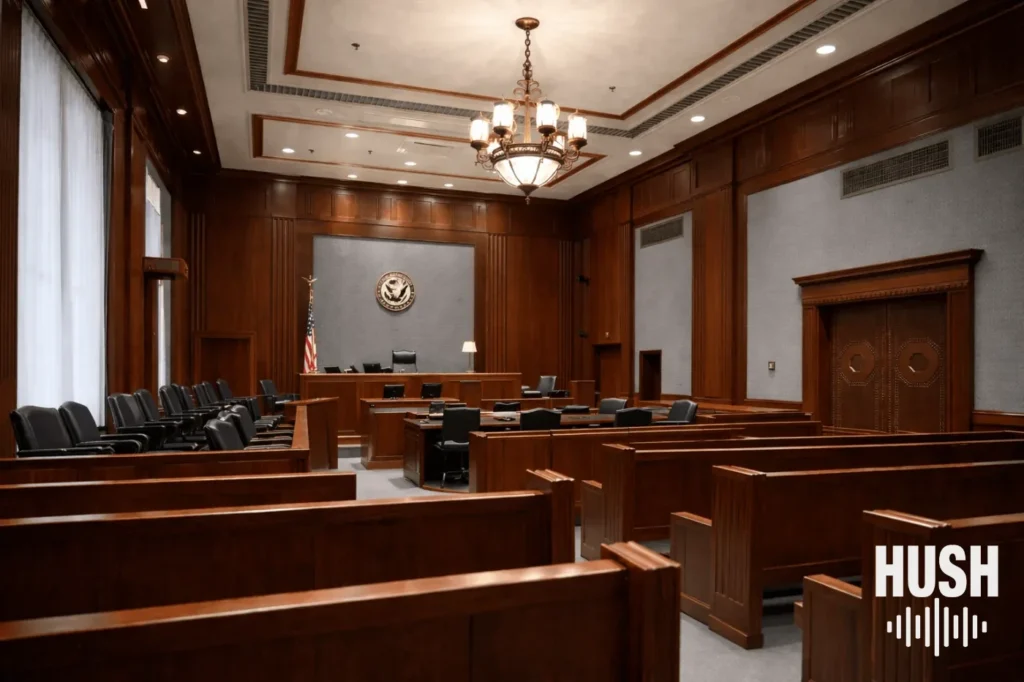
Courtroom Soundproofing
Courtroom Soundproofing
Courtroom soundproofing is about trust and accuracy. Proceedings must be intelligible, private when required, and protected from mechanical and exterior intrusion. In historic courtrooms, the work also has to preserve the architecture. We plan for noise reduction, echo reduction, and high speech intelligibility—without turning the room into a modern box.
What typically goes wrong in courtrooms
- Reverberation: hard plaster, stone, and wood create long decay that blurs speech.
- Background noise: HVAC hiss, rumble, and vibration raise the noise floor. So we set an NC or RC target (Noise Criteria or Room Criteria), which rates HVAC noise band by band.
- Privacy leaks: doors, sidelights, transoms, and shared wall paths.
- Historic constraints: solutions must be hidden and reversible when possible.
Two measurements show how reverberation blurs speech. Reverberation time (RT60) is how long sound takes to fade by 60 dB. The Speech Transmission Index (STI) then rates how well speech is understood. As a result, a long RT60 shows up as a lower STI.
Historic preservation-friendly acoustic control
We use absorption and diffusion in ways that read like architecture. That often means placing materials in ceilings, coffers, wall fields, or behind custom detailing so the room’s character stays intact.
- Hidden absorption: behind grilles, millwork, or controlled wall fields.
- Ceiling control: discreet acoustic ceilings or integrated absorptive zones.
- Reflection management: diffusion where absorption would make the room too dead.
If the issue is echo and clarity inside the room (not transmission), see Acoustic Panels.
Courtroom soundproofing: doors, walls, ceilings, and flanking
Isolation work in courtrooms is usually about sealing + flanking control. That is because one leaky door perimeter can undo an expensive wall scope.
- Soundproof Door (perimeter seals, drop seals, proper closure)
- Wall Soundproofing (adjacent rooms and corridors)
- Ceiling Soundproofing (mechanical rooms above, rooftop units)
Frequently Asked Questions
Can we keep the room “alive” while improving intelligibility? Yes. Courtrooms need clarity rather than dead silence. We control late reflections and noise floor while preserving natural presence.
Further reading:
Courtroom Soundproofing for Clear Testimony and Private Counsel
In a courtroom, every word matters. Judges, jurors and court reporters need to hear testimony clearly, and at the same time attorneys need private space to confer with clients. Unfortunately, many courtrooms are large, tall rooms with hard finishes, so speech echoes and loses clarity. In addition, noise from corridors, holding areas and mechanical systems often leaks in. So courtroom soundproofing addresses both problems together.
First, we improve speech clarity by lowering the reverberation time with panels that suit a formal, dignified interior. Next, we strengthen the walls and doors around attorney conference rooms, jury rooms and judges’ chambers; lab ratings for these assemblies come from tests such as ASTM E90. Finally, we quiet HVAC systems so background noise doesn’t mask soft-spoken witnesses. For broader design principles, the Whole Building Design Guide’s acoustic comfort resource covers speech privacy in public buildings.
Courtroom Soundproofing FAQs
Why are courtrooms so hard to hear in?
Mainly because of their size and hard surfaces. As a result, reflections overlap with the direct voice, and words blur together, especially at the back of the room. Listeners locate a voice by whatever sound arrives first, what acousticians call the precedence effect (or Haas effect). However, the ear still hears strong late reflections as separate echoes.
Can acoustic panels fit a traditional courtroom design?
Yes. For instance, we can use wood-faced, fabric-wrapped or slatted panels that match existing millwork and look like part of the architecture.
How do you protect attorney-client conversations?
Typically, we seal and upgrade conference room walls and doors and add sound masking in nearby waiting areas, so conversations stay confidential.
Sound masking works by raising the background sound slightly. Distant speech then becomes harder to understand, while nearby conversation stays easy.
Can courtroom soundproofing happen while court is in session?
Usually, yes. Specifically, we schedule installation after hours and coordinate closely with court facilities staff.
See conference room soundproofing, acoustic panels and commercial soundproofing.
Our Clients
Client partners include residential, commercial, and institutional organizations that rely on precise soundproofing and acoustical execution.

SCHEDULE A CONSULTATION
Contact Hush Soundproofing today! Our expert team is ready to assess your space and provide customized solutions to create a peaceful and quiet environment.