
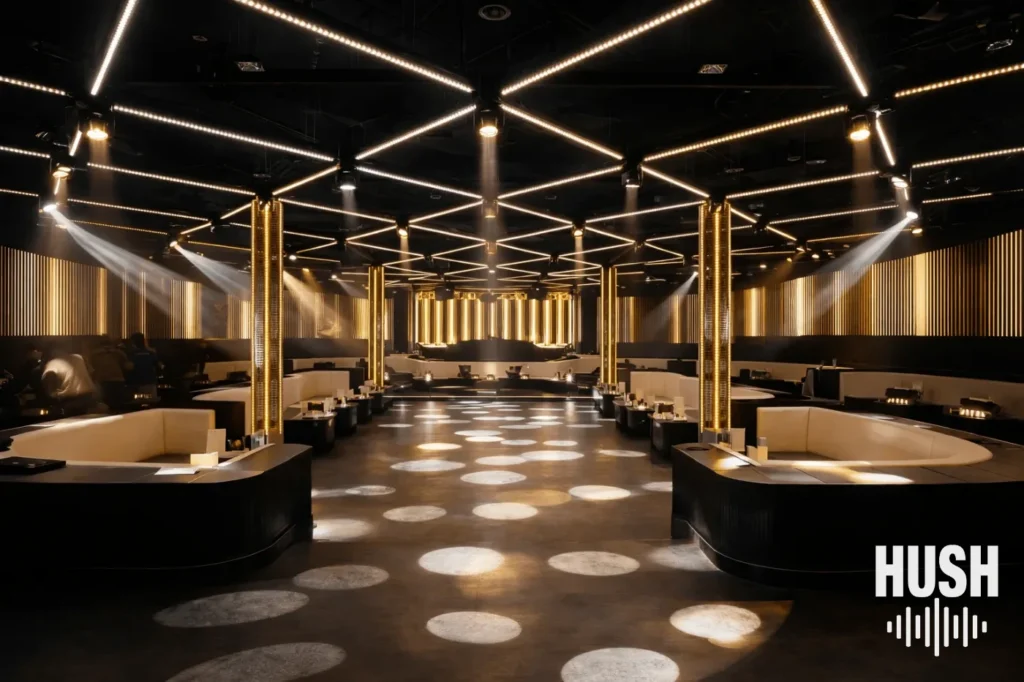
Nightclub Soundproofing
Nightclub Soundproofing
Nightclub soundproofing is fundamentally low-frequency control. Bass couples into structure, travels farther than expected, and triggers complaints even when the club “sounds fine” inside. We design isolation assemblies for noise reduction and sound reduction to neighbors, then manage internal reflections so the space isn’t painfully loud and unintelligible.
Why nightclub noise is different
- Low-frequency energy: vibration travels through slabs, columns, and steel.
- Flanking dominance: sound routes around typical “STC-only” wall builds. STC also starts at 125 Hz, so it says nothing about the deep bass below it.
- Entry leakage: doors and queues become the weak link.
- Mechanical interaction: HVAC can become a transmission duct if untreated.
Isolation strategy: floors, walls, ceilings, and doors
Nightclub soundproofing scopes often require floor isolation (or isolated stage zones) plus coordinated wall and ceiling assemblies. The goal is to break rigid paths and control leakage while keeping the build maintainable.
- Floating floor systems: isolate the energy at the source where possible.
- Decoupled shells: walls and ceilings designed to reduce vibration transfer.
- Door strategy: sealed entries and vestibules to stop the obvious leak path.
Still, a high IIC rating alone is not proof, because IIC under-weights low-frequency impacts. So a floor that scores well can still pass a deep thump. That is why we also check octave-band data at 63 Hz and 125 Hz.
Internal acoustics: control loudness and intelligibility
Nightclubs don’t need “quiet.” Instead, they need control. We use absorption and diffusion to reduce harsh reflections, improve mix translation, and lower the perceived loudness so the room can run with less fatigue.
Treatment options: Acoustic Panels.
Nightclub Soundproofing: Containing Bass in a Dense City
Nightclubs produce the hardest noise there is to contain: loud, sustained, bass-heavy music late at night, often directly below or beside apartments. Low frequencies pass easily through ordinary walls and slabs, and subwoofers sitting on the floor can turn the whole structure into a speaker. Because of that, nightclub soundproofing is almost always about isolating the room as a box within the building.
In practice, that means floating floors or isolated stages, decoupled wall and ceiling assemblies with high mass, sound-lock entries and isolated speaker mounts. In addition, we look at HVAC, which often carries bass to neighbors through shared ductwork. Commercial music in NYC is regulated under the NYC Noise Code, and the NYC Office of Nightlife offers resources for venues and neighbors. Inside the club, staff exposure matters too; OSHA and NIOSH guidance on occupational noise is worth reviewing for long shifts.
Measurement matters too, because A-weighted readings (dBA) under-read bass. As a result, a club can pass a dBA check and still shake the apartment upstairs. So we judge nightclub soundproofing in dBC and octave bands at 63 Hz and 125 Hz.
Nightclub Soundproofing FAQs
Why is bass so hard to block?
Low-frequency sound has long wavelengths and lots of energy, so it moves heavy walls and slabs more easily. Blocking it takes a combination of mass, air space and decoupling, rather than any single product.
Also, mass alone hits diminishing returns. That is because, under the mass law, doubling a wall’s weight adds only about 5–6 dB.
Air space has a catch, too. In a box-in-box room, the two shells and the air gap act like a mass–spring–mass system, so isolation dips at one low resonant frequency. However, deeper, insulated cavities and heavier layers push that resonance lower, below the range that matters.
Can we fix complaints without rebuilding the club?
Sometimes. Isolating subwoofers, adding a sound limiter and treating HVAC paths can make a real difference. For persistent complaints, though, a decoupled ceiling or floating floor is usually needed.
Do nightclubs need an acoustic report?
It’s often wise. A measured report documents your levels and also supports conversations with neighbors, landlords and city agencies.
Will nightclub soundproofing change the sound inside?
It can improve it. Better isolation lets the system run cleanly, and room treatment tightens the bass on the dance floor.
See bar soundproofing, acoustic reports and commercial soundproofing.
Our Clients
Client partners include residential, commercial, and institutional organizations that rely on precise soundproofing and acoustical execution.

SCHEDULE A CONSULTATION
Contact Hush Soundproofing today! Our expert team is ready to assess your space and provide customized solutions to create a peaceful and quiet environment.