
Upstairs Neighbor Noise: How to Stop Footsteps in NYC
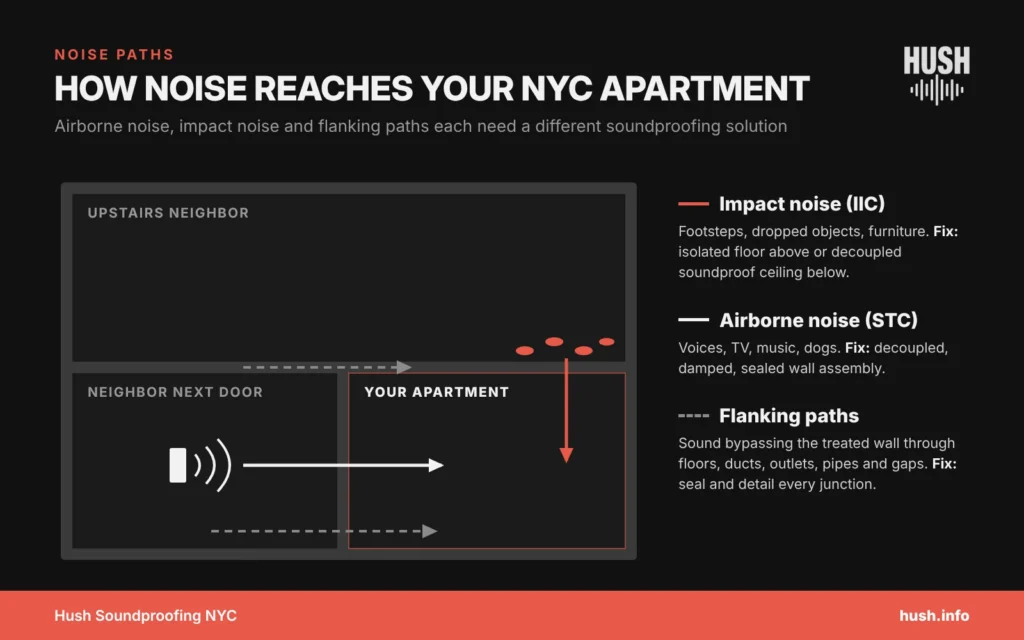
Footsteps, chairs scraping, kids running, and the thud of dropped objects are the most common noise complaint in New York City apartments. This is impact noise, and it behaves completely differently from the voices and TV sound that travel through a wall. In other words, impact energy goes straight into the floor-ceiling structure, travels through joists or the concrete slab, and radiates from your ceiling. That is why foam, acoustic panels, and “soundproof paint” on your ceiling do almost nothing to stop upstairs neighbor noise.
Hush solves upstairs noise with engineered ceiling soundproofing that is mechanically isolated from the structure, combined with damping, mass, cavity absorption, and airtight detailing. Here is how to reduce noise from upstairs neighbors, and what to expect.
Why You Hear Upstairs Neighbor Noise
Low-mass wood joist floors
Brownstones, rowhouses, and many walk-ups in Brooklyn, Harlem, and Queens have wood joist floors with plaster or a single layer of drywall below. They are light, stiff, and resonant, so footfall noise at 63-250 Hz passes through easily. See brownstone soundproofing.
Hard flooring without underlayment
When an upstairs unit replaces carpet with hardwood, tile, or LVP without a resilient acoustic underlayment, the IIC of the floor-ceiling assembly can drop by 15 points or more. In fact, many co-op and condo alteration agreements require a sound-rated underlayment for exactly this reason. Our floor soundproofing page explains IIC targets for buildings.
Concrete slabs and structure-borne sound
Concrete performs well for airborne noise, but heel strikes and dropped objects on a bare slab carry through the structure. As a result, low-frequency thumps are often louder in the room below than people expect.
Rigid connections and flanking
Ceilings fastened directly to joists, recessed lights cut into the ceiling, and sprinkler pipes or ducts that pass between floors all create paths that bypass any treatment. Flanking through walls that are continuous between floors is also common in older NYC buildings. So when soundproofing apartment ceilings, we detail each of these paths, not just the drywall.
The Most Effective Fix: An Isolated Soundproof Ceiling
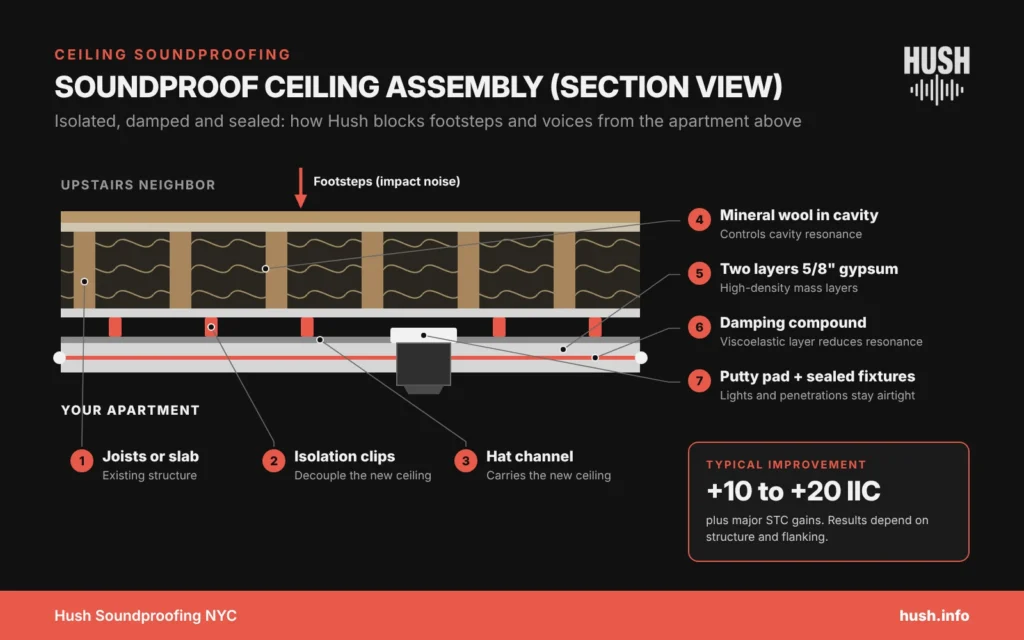
When you cannot control the floor above, the best solution is a new ceiling plane that does not touch the structure. So Hush builds it in layers:
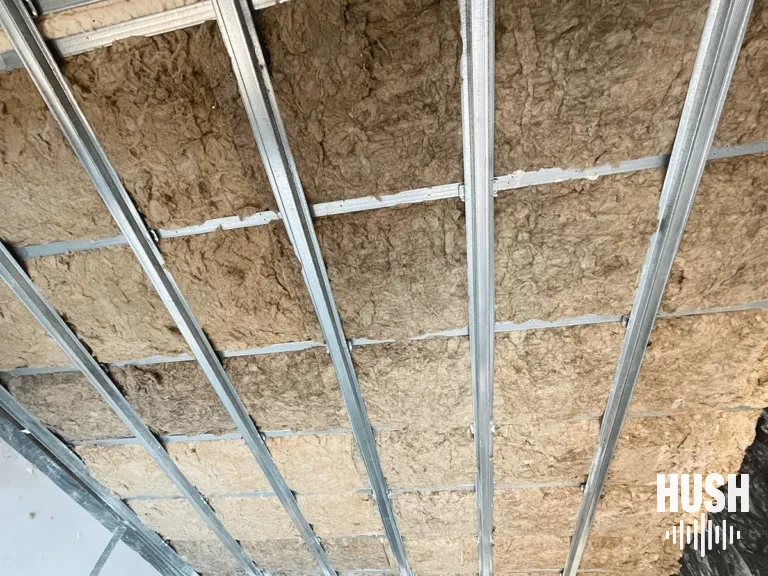
- Isolation clips or spring hangers attached to the joists or slab, so vibration is not transmitted into the new ceiling.
- Hat channel carried by the clips to support the new gypsum lid.
- Mineral wool in the cavity to control resonance and improve low-frequency performance.
- Two layers of 5/8″ gypsum with viscoelastic damping compound between them to add mass and convert vibration into heat.
- Perimeter isolation and acoustical sealant so the ceiling does not touch the walls.
- Treated penetrations: surface-mounted or sealed light fixtures, putty pads, and isolated sprinkler and HVAC details.
Typical improvement is 10 to 20 IIC points plus substantial STC gains, depending on the existing structure and flanking. The ceiling typically drops 2 to 4 inches. Read the full ceiling soundproofing NYC method, or compare ratings in STC and IIC explained.
Other Options for Upstairs Neighbor Noise
Ask about the floor upstairs
An acoustic underlayment or floating floor in the unit above is the most effective fix for impact noise. Underlayments are compared by ΔIIC (delta IIC), the improvement they add over a bare concrete slab. If your building’s alteration agreement requires one, the managing agent may be able to enforce it. An acoustic report with field IIC testing documents the problem objectively.
Rugs and pads upstairs
Thick rugs with dense felt-rubber pads help with heel strikes and are often the first step a neighbor will agree to. However, they do little for low-frequency thuds.
Panels, foam and paint on your ceiling
Acoustic panels reduce echo inside your room. However, they do not block impact noise coming through the structure. Mass loaded vinyl or extra drywall screwed directly to the joists is also rigidly coupled and adds only a few points.
Also hearing your neighbor through the walls? See how to soundproof a wall between apartments and our full apartment soundproofing guide. Pricing is covered in soundproofing cost NYC.
Upstairs Neighbor Noise FAQ
How do I stop hearing my upstairs neighbor walking?
Footsteps are impact noise. The most effective fix is an acoustic underlayment or floating floor upstairs. From your side, a decoupled soundproof ceiling on isolation clips with damped double-layer gypsum is the most effective option.
Will acoustic panels on my ceiling block upstairs noise?
No. Acoustic panels absorb sound inside your room and reduce echo, but they do not stop sound transmitted through the floor-ceiling structure.
How much ceiling height will I lose?
A typical Hush isolated ceiling adds 2 to 4 inches below the existing ceiling, depending on the clip system, cavity depth, and fixtures.
How much does it cost to soundproof a ceiling in NYC?
Hush ceiling soundproofing projects typically cost $18,000 to $36,000 per room (150 sf and up), including isolation hardware, insulation, damped gypsum, sealing, and Level 5 finishing.
What is IIC?
Impact Insulation Class (IIC) rates how well a floor-ceiling assembly reduces impact sound such as footsteps. Higher numbers are better. Building codes based on IBC Section 1206 require IIC 50 between dwelling units in new construction.
Can I make my upstairs neighbor install soundproofing?
It depends on your building rules. Many co-op and condo alteration agreements require carpeting or sound-rated underlayment. An acoustic report with measured IIC values gives the board objective evidence.
Upstairs Neighbor Noise: Your Options in a NYC Apartment
Footsteps, dropped objects and furniture dragging overhead are some of the most common complaints we hear from New Yorkers. Upstairs neighbor noise is mostly impact noise. In other words, it starts as vibration in the floor above, travels through the joists or slab, and comes out of your ceiling as sound. That’s why earplugs, white noise and acoustic foam rarely solve it.
So if you want to drown out noise from upstairs neighbors, white noise can mask some airborne sound. However, it does little for heel strikes and thuds, because those travel through the structure.
The NYC Department of Environmental Protection’s Residential Noise Control Guidance Sheet suggests an Impact Insulation Class (IIC) of at least 50 for floors in living areas and 60 for bedrooms. However, many older buildings fall short of that. Fortunately, there are two ways to close the gap: treat the floor above, which works best, or build a decoupled ceiling below, which you control yourself. Impact ratings come from lab tests such as ASTM E492, and we measure in the field before and after so you can see the change.
Field results have their own name: AIIC (Apparent IIC, ASTM E1007). They usually come in a few points below lab IIC because of flanking and workmanship. Also, IIC under-weights low-frequency thuds, so a floor with a good IIC can still pass a deep heel strike.
Upstairs Neighbor Noise FAQs
Can I stop upstairs neighbor noise without touching their apartment?
Yes. A decoupled ceiling on isolation clips, with mineral wool and damped drywall, can cut footstep noise significantly. It won’t be as effective as a floating floor upstairs, but it’s entirely within your control.
Do co-op and condo rules require carpet upstairs?
Many NYC proprietary leases and house rules include an “80 percent carpet” clause or similar. So it’s worth checking your building’s rules and talking to management before or alongside construction.
Should I file a 311 complaint for upstairs neighbor noise?
Normal living noise usually isn’t a code violation, so a 311 noise complaint rarely fixes footstep problems. However, loud music or late-night parties are different. For everyday impact noise, construction is the lasting fix.
How much ceiling height will I lose?
Most of our ceiling systems drop the ceiling by roughly 3 to 5 inches, depending on the clips and layers used. Then we confirm the exact depth during your consultation.
Learn more about ceiling soundproofing and IIC ratings, or book a consultation.
Our Clients
Client partners include residential, commercial, and institutional organizations that rely on precise soundproofing and acoustical execution.

SCHEDULE A CONSULTATION
Contact Hush Soundproofing today! Our expert team is ready to assess your space and provide customized solutions to create a peaceful and quiet environment.