
STC and IIC Ratings Explained
STC and IIC ratings are the two numbers that define how well a wall, floor, or ceiling blocks sound. If you are comparing soundproofing proposals, reading a co-op alteration agreement, or deciding whether a wall upgrade is worth it, understanding these ratings will save you money. This guide explains STC (Sound Transmission Class), IIC (Impact Insulation Class), their field equivalents, and what the numbers mean in a New York City apartment.
What Is STC (Sound Transmission Class)?
STC is a single-number rating of how well a building assembly reduces airborne sound such as voices, TV, and music. It is calculated from transmission loss measured across 16 one-third-octave bands from 125 Hz to 4,000 Hz in a laboratory (ASTM E90) and classified using ASTM E413. That standard fits a reference contour to the measured curve with a rule called the sum of deficiencies. The curve may fall below the contour by up to 32 dB in total and 8 dB in any band. The STC is then the contour’s value at 500 Hz. Learn more in the Sound Transmission Class reference.
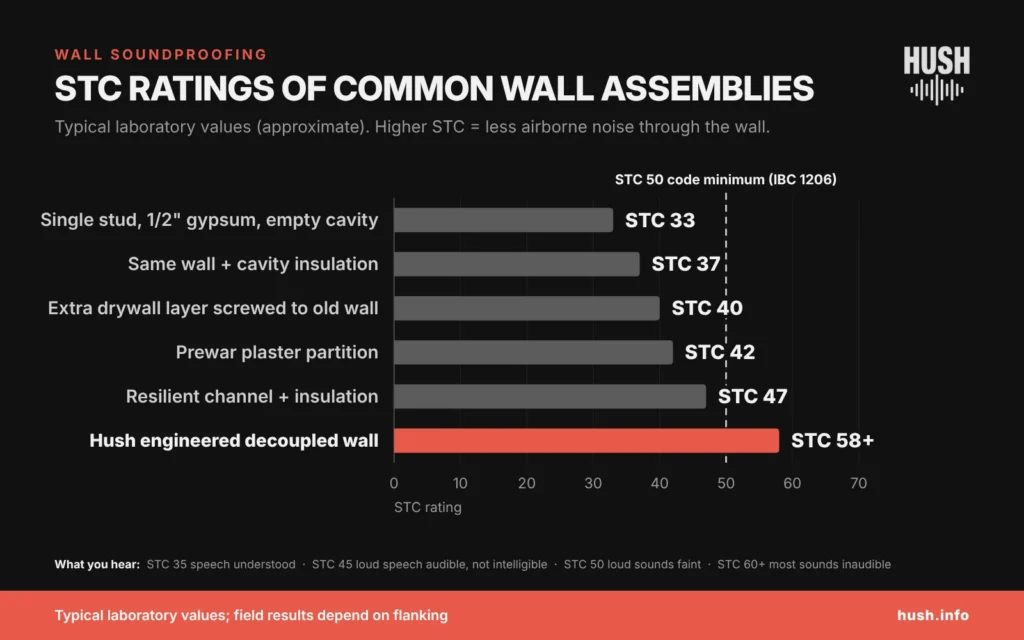
| STC | What you hear through the wall |
|---|---|
| 25-30 | Normal speech is easily understood |
| 35 | Loud speech is understood |
| 40-45 | Loud speech is audible but not intelligible |
| 50 | Loud sounds are faint; code minimum between units |
| 55-60 | Most household sound is inaudible; music bass may be faint |
| 60+ | Excellent isolation; suitable for bedrooms beside living rooms and home studios |
What Is IIC (Impact Insulation Class)?
IIC rates how well a floor-ceiling assembly reduces impact sound such as footsteps, dropped objects, and moving furniture. A standard tapping machine strikes the floor above, then a meter measures sound levels in the room below (ASTM E492, classified with ASTM E989). As with STC, higher IIC ratings are better. See the Impact Insulation Class reference for the test method.
- IIC 30-40: bare concrete or hardwood on joists with no underlayment; footsteps clearly heard.
- IIC 50: code minimum between dwelling units in new construction.
- IIC 55-60+: the target many co-op and condo boards set for renovations with hard flooring.
However, underlayment products use a different number. ΔIIC (delta IIC, ASTM E2179) is the improvement a floor covering and underlayment add over a bare concrete slab. So a product’s ΔIIC is not the IIC of your finished floor. Also, IIC under-weights low-frequency thuds, like heel strikes and dropped weights. As a result, a high-IIC floor can still pass a deep thump. If that sounds familiar, see our guide to upstairs neighbor noise.
Lab Ratings vs Field Ratings
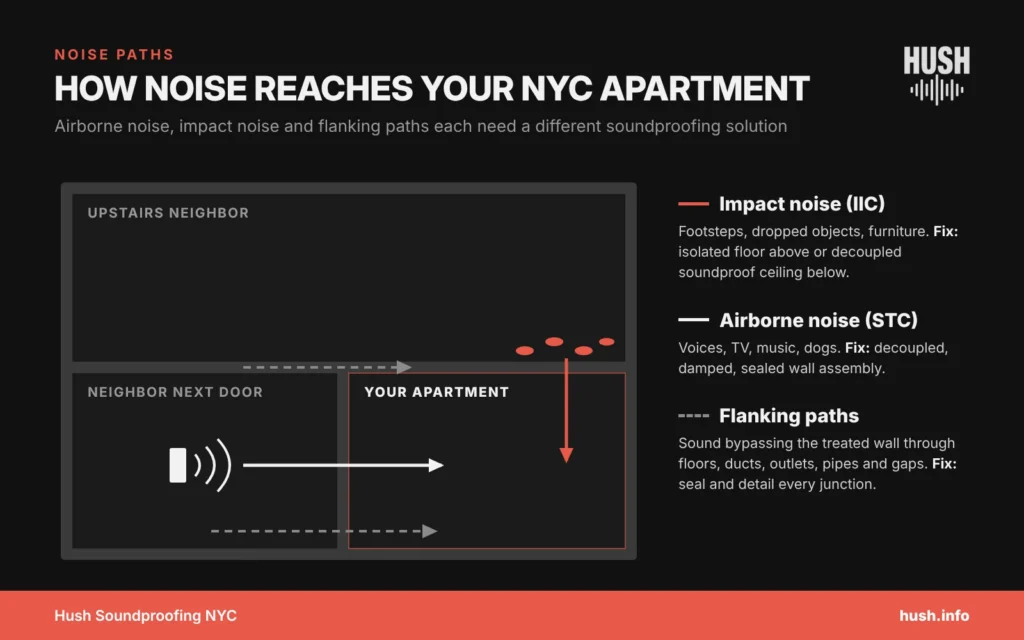
STC and IIC are laboratory ratings for a tested assembly. In a real building, sound also travels through flanking paths, so field results are usually lower. Flanking means sound that bypasses the tested partition through connected structure, ducts, outlets or ceiling plenums. Field measurements use ASTC or NNIC for airborne sound and AIIC or NISR for impact sound. Wondering about NYC apartment requirements? Sound insulation between units falls under Section 1207 (Sound Transmission) of the 2022 NYC Building Code. Codes based on IBC Section 1206 require STC 50 / IIC 50 between dwelling units, or 45 when field-tested. A Hush acoustic report measures field ratings with calibrated Class 1 instrumentation.
So what happens during a field test? First, a dodecahedron loudspeaker, which radiates sound evenly in all directions, fills the source room with noise. For impact tests, a standard tapping machine strikes the floor above instead. Then a Class 1 sound level meter (IEC 61672-1), checked with a field calibrator, measures each one-third-octave band. Airborne field results follow ASTM E336, while impact results follow ASTM E1007. On international specs, you will see ISO equivalents, such as R’w and L’nT,w, measured under ISO 16283.
How to Raise STC and IIC
- Decoupling: isolation clips, hat channel, staggered or double studs, spring hangers.
- Mass: additional layers of 5/8″ gypsum or other dense boards.
- Damping: viscoelastic compound between rigid layers. It also eases the dip where a panel’s bending waves match the speed of sound in air. Acousticians call it Cremer’s coincidence effect, after Lothar Cremer, who explained it in 1942.
- Absorption: mineral wool in cavities.
- Sealing: airtight perimeters and penetrations.
- Resilient floors: acoustic underlayments and floating floors for IIC.
Mass alone has limits, though. Under the mass law, doubling a single layer’s weight adds only about 5–6 dB. In real rooms, sound arrives from all angles, so acousticians use the field-incidence mass law. It puts transmission loss at TL ≈ 20 log(f·m) − 47 dB, with f in Hz and m in kg/m². That is why decoupling and damping do most of the work in raising STC and IIC ratings. Also, don’t skip sealing. Leak area caps performance, so a small unsealed gap can hold an assembly far below its rated STC. In practice, acoustical sealant and putty pads behind outlets close those leaks.
See these principles applied in wall soundproofing, ceiling soundproofing, and floor soundproofing, or see example wall assemblies with estimated STC ranges on STC Ratings. Ready to improve your space? Book a consultation or read soundproofing cost NYC.
STC and IIC FAQ
What is a good STC rating for an apartment wall?
STC 50 is the code minimum between dwelling units in new construction (IBC §1206 and NYC Building Code §1207) and a sensible target for renovations. For real privacy in a NYC apartment, aim for STC 55-60 or higher, which makes most household sound inaudible.
What is a good IIC rating?
IIC 50 is the code minimum. Many co-op and condo boards require IIC 55-60 for renovations with hard flooring.
Why does my new wall test lower in the field than in the lab?
Field tests include flanking paths through floors, ceilings, ducts, and outlets. That is why sealing and flanking control are as important as the wall assembly itself.
Does STC measure bass?
STC is calculated from 125 Hz to 4,000 Hz, so it does not capture very low bass well. For music and home theaters, we also review performance below 125 Hz.
Using STC and IIC Ratings to Compare Real Options
STC and IIC ratings are the two numbers most often used to describe how well a wall, floor or ceiling blocks sound. STC (Sound Transmission Class) covers airborne sound such as voices and TV, and labs measure it under ASTM E90. IIC (Impact Insulation Class) covers footsteps and dropped objects, measured in the lab under ASTM E492 and in the field under ASTM E1007. Higher numbers are better for both.
For New York apartments, the NYC DEP Residential Noise Control Guidance Sheet suggests at least STC 50 for interior walls, STC 60 for exterior walls, floors of IIC 50 for living areas and IIC 60 for bedrooms. However, a lab rating is only the starting point. Flanking paths, gaps and workmanship usually make field results lower, which is why we test before and after the work. The classic NIST study NBS Report 10316 remains a helpful background read on how these ratings apply to housing.
STC and IIC Ratings FAQs
What is a good STC rating for an apartment wall?
STC 50 is the code minimum between dwelling units in new construction (IBC §1206 and NYC Building Code §1207) and a sensible target for renovations. At STC 55 to 60 and above, normal speech becomes essentially inaudible and loud TV is greatly reduced. For music rooms, we design higher still.
What is a good IIC rating for a floor?
IIC 50 is the common minimum, and IIC 60 or higher is a better target over bedrooms. Many luxury condos aim for the mid-60s or above.
Why does my lab-rated product perform worse at home?
Lab tests isolate one assembly. In a real building, sound also travels through side walls, floors, outlets and ceiling cavities. As a result, field ratings (often written ASTC, formerly called FSTC, or AIIC) are usually several points lower.
Does STC tell me how well a wall blocks bass?
Not fully. STC is weighted toward speech frequencies, so two walls with the same STC can perform very differently on bass. For music and mechanical noise, therefore, we look at the full frequency data.
Also, for windows and façades, look at OITC instead of STC. OITC (Outdoor–Indoor Transmission Class, ASTM E1332) weights low frequencies like traffic and trains. So it describes protection from street noise better. In other words, STC and IIC ratings are not the whole story for a street-facing apartment. For more, see our page on street and subway noise.
Next, see how these ratings apply to wall soundproofing and floor soundproofing, or order an acoustic report with field measurements.
Our Clients
Client partners include residential, commercial, and institutional organizations that rely on precise soundproofing and acoustical execution.

SCHEDULE A CONSULTATION
Contact Hush Soundproofing today! Our expert team is ready to assess your space and provide customized solutions to create a peaceful and quiet environment.