
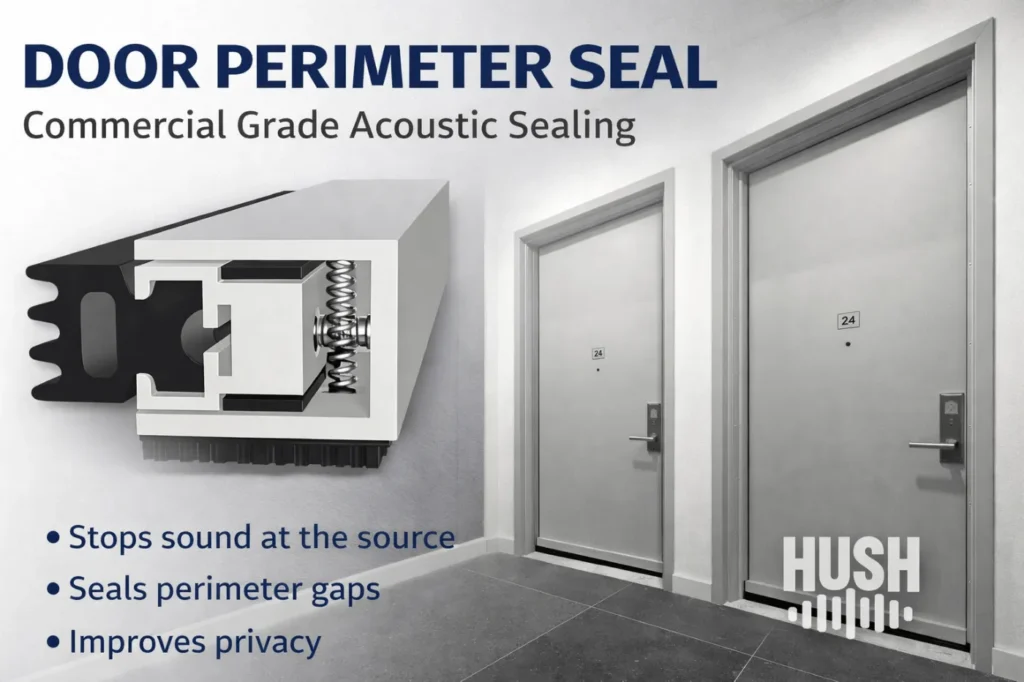
Door Perimeter Seal
Why a Door Perimeter Seal Matters
A door perimeter seal is the simplest way to reduce sound leakage around a door frame. In NYC, hallway voices and lobby activity usually enter at the jamb and head gaps first. However, seals only work when the door closes with consistent compression, so we treat the seal line and the closing behavior as one system.
Start here
What a perimeter seal actually does
Perimeter gasketing targets airborne leakage. Therefore, it’s ideal for speech privacy and general corridor noise reduction. In addition, it helps stabilize the room’s noise floor by reducing the constant bleed that makes spaces feel exposed.
- Jamb + head gaps: closes the most common leak path around the frame.
- Latch-side compression: improves the part of the opening that usually leaks first.
- Consistency: reduces the “quiet only when I push the door” problem.
Our installed Acoustic Door Gasket Package
Most doors need perimeter seals and an under-door solution. For that reason, our standard scope is the installed Seal Package: $1,440 per door (door perimeter seal + automatic door bottom). We verify alignment, latch engagement, and closing force, then we tune the seal so it compresses without making the door difficult to operate.
What we check on site
Before we install anything, we confirm the opening will hold compression. For example, a loose hinge side or a drifting latch can reopen gaps over time.
- Frame alignment: hinge-side and latch-side gap consistency.
- Hardware behavior: latch pull-in and closer/closure force.
- Threshold conditions: floor variation that affects seal continuity.
When you may need more than seals
If the door leaf is hollow-core, warped, or lightweight, the leaf itself can transmit sound even after sealing. In that case, we recommend a full door upgrade and coordinate adjacent conditions so flanking (sound that sneaks around the door through walls, ceilings or ducts) doesn’t take over.
Not sure what your leaf is made of? Our soundproof wooden doors page compares solid core and hollow core doors.
Related pages: Wall Soundproofing and Ceiling Soundproofing.
Authority links
Why a Door Perimeter Seal Matters More Than the Door
Sound behaves a lot like air: wherever air can pass, sound can too. That’s why the thin gaps around a door frame often let through more noise than the door itself. A door perimeter seal closes those gaps along the head and both jambs with continuous acoustic gaskets that compress when the door shuts. Paired with an automatic door bottom, it seals the door on all four sides.
Soundproofing a door frame also means sealing behind the trim. The joint between the frame and the wall is often hollow or cracked, so sound leaks straight past the gaskets. In practice, we close that joint with acoustical sealant before the casing goes back on. That matters because leak area caps performance. Even a small open gap can hold a door far below its rated STC, as our guide to STC and IIC ratings explains.
The NYC DEP Residential Noise Control Guidance Sheet specifically recommends rubber or vinyl gasketing around doors as one of the most effective noise fixes for homes. In offices and commercial spaces, sealed doors are also key to speech privacy, a point the Whole Building Design Guide makes in its acoustic comfort guidance. Our installers adjust each door perimeter seal so the door still latches easily while the gasket stays fully compressed.
Door Perimeter Seal FAQs
What’s the difference between weatherstripping and an acoustic door seal?
Weatherstripping is designed to stop drafts and is usually soft foam or thin vinyl. An acoustic perimeter seal uses denser, more durable gaskets in a rigid carrier, so it stays compressed and keeps its performance for years.
What about a soundproof door kit from a hardware store? Many pair foam strips with a basic sweep. They help a little. However, foam compresses unevenly and wears out. A true soundproof door seal uses dense gaskets in a rigid carrier instead. So a good acoustic door seal kit also includes a drop bottom for the undercut.
Can a perimeter seal be added to my existing door?
Usually, yes, as long as the frame is solid and the door hangs straight. If the door rubs or the gaps are uneven, we adjust the hinges first.
Will a door perimeter seal make my door hard to close?
Not when it’s set up correctly. We tune the stop position and strike so the door closes with normal effort.
Is a perimeter seal enough on its own?
It’s a big improvement. For the best results, though, combine it with a bottom seal and, on hollow doors, a heavier slab.
Read more about door soundproofing or browse our soundproof doors.
Our Clients
Client partners include residential, commercial, and institutional organizations that rely on precise soundproofing and acoustical execution.

SCHEDULE A CONSULTATION
Contact Hush Soundproofing today! Our expert team is ready to assess your space and provide customized solutions to create a peaceful and quiet environment.