
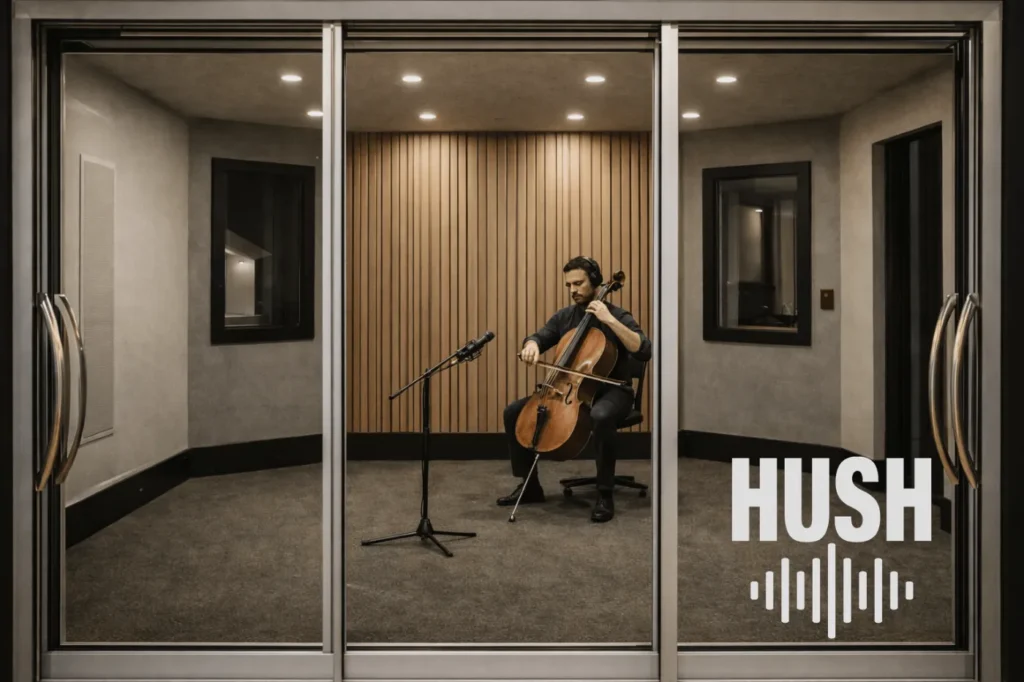
Soundproof Sliding Glass Doors
Soundproof Sliding Glass Doors
Acoustic sliding glass doors can support isolation and sight lines, but they have one problem: sealing a moving interface is hard. Therefore, “soundproof sliding glass” is less about the glass alone and more about the track geometry, compression strategy, and how the door lands and locks.
What we design around
First, we confirm the performance target and the room use. Next, we design the sealing strategy so the panel closes the same way every time. In addition, we coordinate the frame and adjacent construction so flanking (sound that travels around the door through walls, ceilings or ducts) doesn’t bypass the opening.
- Sealing lines: jamb, head, and sill interfaces that stay tight under movement.
- Locking/closure: hardware that pulls the panel into compression, not just “closed.”
- Glass build: selected for mass behavior and the frequency range that matters.
Common failure points (and what we prevent)
- Rattle: vibration in the frame or hardware that reads as “buzzing” at volume.
- Air gaps: small discontinuities at the jamb or sill that leak sound immediately.
- Inconsistent landing: the panel stops short of full compression and never truly seals.
Where Acoustic sliding glass makes sense
Studio sliding glass doors are common in media rooms, and modern offices where visibility and clean detailing matter. However, if the project is purely about maximum isolation, a hinged door system is often the more efficient choice. Therefore, we recommend sliding glass only when the layout or design intent justifies the added complexity.
Compare options: Soundproof Studio Doors and Soundproof Glass Doors.
Fire-rated considerations
Many corridor openings are fire-rated. Studio sliding glass door solutions are not automatically appropriate for rated conditions, so we confirm early whether the opening must maintain a rating before we scope the door. That avoids spending money in the wrong direction.
Authority links
If you need defensible scope clarity, start with Acoustic Report.
What Makes Soundproof Sliding Glass Doors Different
Sliding doors are great for saving space, but they’re notoriously hard to seal. A standard slider has to clear its track, so it usually leaves gaps along the top, bottom and meeting edges. Those gaps are why ordinary sliding doors let so much noise through, even when the glass itself is decent.
Soundproof sliding glass doors close that gap. They combine laminated acoustic glazing with a frame that presses the panel tightly against continuous seals when it closes, along with brush or compression seals at the meeting rails. We use them for home offices, bedroom dividers, conference rooms and pocket-door openings where a swinging door won’t fit. As a benchmark, the NYC DEP Residential Noise Control Guidance Sheet suggests around STC 50 for doors and windows in homes, and lab ratings come from tests such as ASTM E90.
For a soundproof balcony door facing the street, look past STC. OITC (Outdoor–Indoor Transmission Class, ASTM E1332) weights low frequencies like traffic and trains. As a result, it describes street-facing glass better than STC does. Unequal pane thicknesses with an air gap also help, because the panes don’t share the same coincidence dip. That dip is the frequency where the glass bends in step with sound, so isolation drops. For more on traffic and rumble, see our page on street and subway noise.
Soundproof Sliding Glass Doors FAQs
Are sliding doors less soundproof than swinging doors?
Usually, yes, because they’re harder to seal. However, a purpose-built acoustic slider with compression seals can come surprisingly close to a good swinging door.
The same rule applies to soundproof sliding doors of any kind: the seals decide the result. Accordion doors are the hardest case, because every fold adds another joint to seal. So we rarely recommend them where isolation matters. Soundproof French doors fare better, although the meeting edge between the two leaves still needs careful gasketing.
Can I soundproof my existing sliding door?
Adding brush seals and an inner track gasket can help a little. For a noticeable improvement, though, replacing the panel and frame with an acoustic system is the reliable route.
Do soundproof sliding glass doors work as pocket doors?
Yes, with the right hardware. Pocket installations need extra care, since the wall pocket itself can become a sound path, so we detail it as part of the assembly.
Will an acoustic slider still feel light to open?
Good acoustic sliders use heavy-duty rollers, so even with thick laminated glass they glide smoothly.
Compare soundproof glass doors and all our soundproof doors, or book a consultation.
Our Clients
Client partners include residential, commercial, and institutional organizations that rely on precise soundproofing and acoustical execution.

SCHEDULE A CONSULTATION
Contact Hush Soundproofing today! Our expert team is ready to assess your space and provide customized solutions to create a peaceful and quiet environment.