
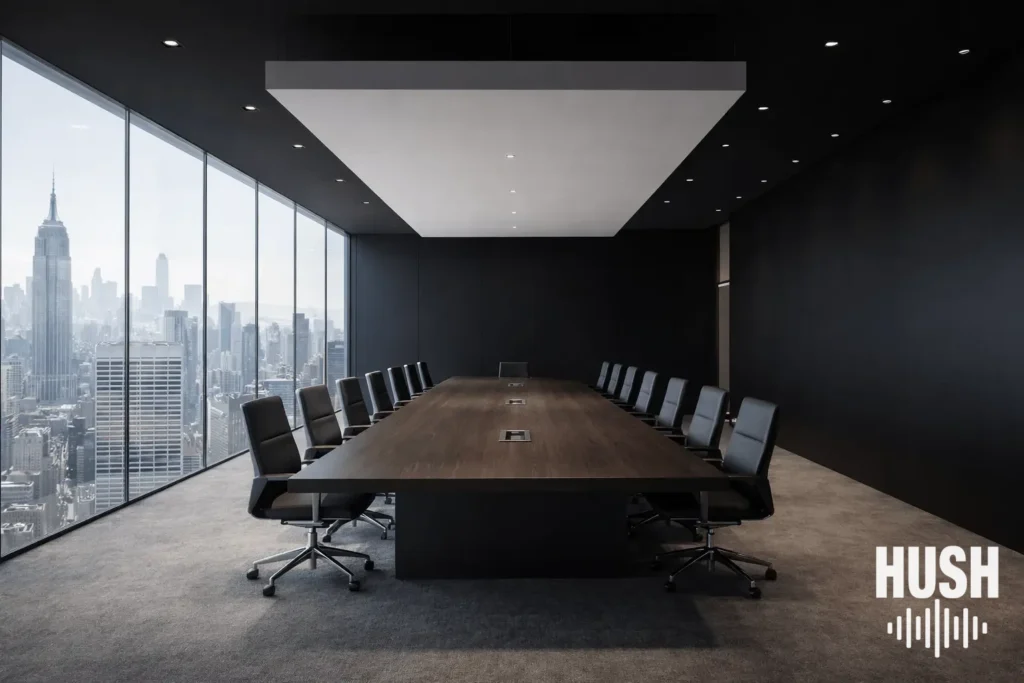
Fabric Acoustic Panels
Fabric Acoustic Panels
Fabric wrapped acoustic panels are the workhorse of echo control. They absorb broadly across speech frequencies, so meetings sound clearer and the room stops feeling “bright.” In addition, the fabric face lets you dial in the aesthetic without compromising function. If the real issue is sound transfer between rooms, treat isolation first with wall soundproofing, then finish with absorption.
Best applications for fabric panels
Fabric panels perform when speech is the priority and reflections are the problem. Therefore, they’re ideal for:
- Conference rooms (speech clarity, less fatigue)
- Glass-heavy offices (echo control without redesign)
- Therapy rooms and private practices (better intelligibility and comfort)
- Restaurants and lounges (less “roar” at peak occupancy)
- Studios that need controlled reflection (paired with bass control)
For office-specific strategy, reference office soundproofing. For absorption fundamentals, read sound absorbing material.
Specs, options, and install approach
Core material, thickness, and air gap drive performance. As a result, the same “panel” can perform very differently depending on how it’s built and mounted.
- Core: engineered absorptive cores (specified to match performance goals and site constraints).
- Fabric: durable architectural textiles, color-matched to interiors.
- Mounting: concealed Z-clips and clean edge detailing to keep the finish intentional.
- Planning: we treat reflection zones first, then balance the room to avoid over-deadening.
Why does the air gap matter? Porous cores like fiberglass and mineral wool absorb best when their depth approaches a quarter of the sound’s wavelength. Bass wavelengths are long, so a thin panel barely touches them. However, spacing fabric acoustic panels off the wall with a small air gap adds depth without a thicker core. As a result, the same panel reaches lower than one glued flat.
If you’re weighing treatment vs isolation, start with how to soundproof a room so you don’t buy the wrong solution.
Frequently Asked Questions
Will fabric panels block neighbor noise? No. Instead, they reduce reflections inside the room. Blocking transfer requires sound isolation assemblies.
Do panels have to cover every wall? No. First-reflection coverage is the fastest win. For flutter echo (rapid repeats between parallel hard walls), treating just one of the two facing walls usually breaks it up. Then, add where the room still “rings.”
Related acoustic panel types:
- Felt Acoustic Panels
- Wood Slat Acoustic Panels
- Wood Fiber Acoustic Panels
- Studio Acoustic Panels
- Custom Acoustic Panels
References:
Choosing Fabric Acoustic Panels for Offices and Homes
Fabric acoustic panels are the workhorse of room acoustics. Inside, a rigid core of fiberglass or mineral wool absorbs sound, and outside, an acoustically transparent fabric lets sound reach that core while giving you a clean, finished look. Because the fabric comes in hundreds of colors and textures, fabric acoustic wall panels fit almost any interior, from conference rooms and open offices to home theaters and nurseries.
When comparing fabric acoustic panels, look first at the tested Noise Reduction Coefficient, which labs measure under ASTM C423. The NYC DEP Residential Noise Control Guidance Sheet suggests an NRC of 0.7 or higher. Next, check the core density and thickness, since thicker panels absorb more low-frequency sound. Finally, make sure the fabric is truly acoustically transparent; for instance, a heavy upholstery fabric can block sound from reaching the core.
Two panels with the same NRC can still perform differently. That is because NRC averages just four bands (250, 500, 1,000 and 2,000 Hz) and rounds to the nearest 0.05. So also ask for the Sound Absorption Average (SAA). It comes from the same ASTM C423 test but averages 12 one-third-octave bands, so it is more precise.
Fabric Acoustic Panels FAQs
Can I pick any fabric for an acoustic panel?
Not quite. Acoustic panel fabric needs to let air and sound pass through easily. We supply tested acoustic fabrics, and we can also check a customer-chosen fabric before production.
How do you clean fabric acoustic panels?
Usually, light vacuuming with a brush attachment is enough. Some fabrics also allow gentle spot cleaning.
Do fabric panels work for speech privacy in offices?
They improve clarity and reduce how far sound carries within a room. However, privacy between rooms also needs sealed walls and doors.
Are fabric acoustic panels fire-safe?
We specify panels and fabrics with the fire ratings that commercial and residential buildings require.
Compare felt, wood slat and custom panels, or see all acoustic panels.
Our Clients
Client partners include residential, commercial, and institutional organizations that rely on precise soundproofing and acoustical execution.

SCHEDULE A CONSULTATION
Contact Hush Soundproofing today! Our expert team is ready to assess your space and provide customized solutions to create a peaceful and quiet environment.