
Why does condo elevator noise get worse at 2 a.m.? Mostly because everything else has stopped, so the elevator becomes the only sound in the bedroom. If your apartment shares a wall with the shaft or sits under the machine room, you know the list already. The car thumps as it passes, whines as it slows, and somewhere down the line a door clacks.
The good news is that condo elevator noise is usually traceable. It comes from a few specific parts, and the NYC Building Code says more about it than most owners expect.
Where condo elevator noise comes from
Elevators make noise in three places, and each one travels differently.
The machine room or machine space
In older buildings, the hoist machine, brake and controller usually sit in a machine room above the top floor. Newer machine-room-less designs put the machine inside the hoistway, typically near the top. Either way, most of what reaches you is structure-borne. Vibration from the machine goes into the beams and slab. Then it radiates from your ceiling or wall as a hum, a whine or a brake click. Electronic drives can also add a steady tone, which tends to annoy people more than broadband noise. The code treats pure tones more strictly too, as you will see below.
The hoistway
As the car travels, guide shoes or rollers run along steel rails. Worn rollers, misaligned rails and rough rail joints produce a thump or rumble each time the car passes a certain floor. In a tight shaft, a fast car can also push air past the landing doors with a rush or a whistle. For background on how vibration moves through a building, see our post on structure-borne noise and vibration.
The doors
Door operators on the car, and the hall doors at each landing, clatter or squeal when they drift out of adjustment. Bedrooms next to the elevator lobby hear this one most. Fortunately, it is often the cheapest fix of the three.
What the NYC Building Code says about condo elevator noise
Start with the walls. The code requires STC 50 in lab testing for any wall or floor between an apartment and an elevator shaft. It also covers mechanical spaces and service areas, and a field test must reach 45 (2022 NYC Building Code §1207).
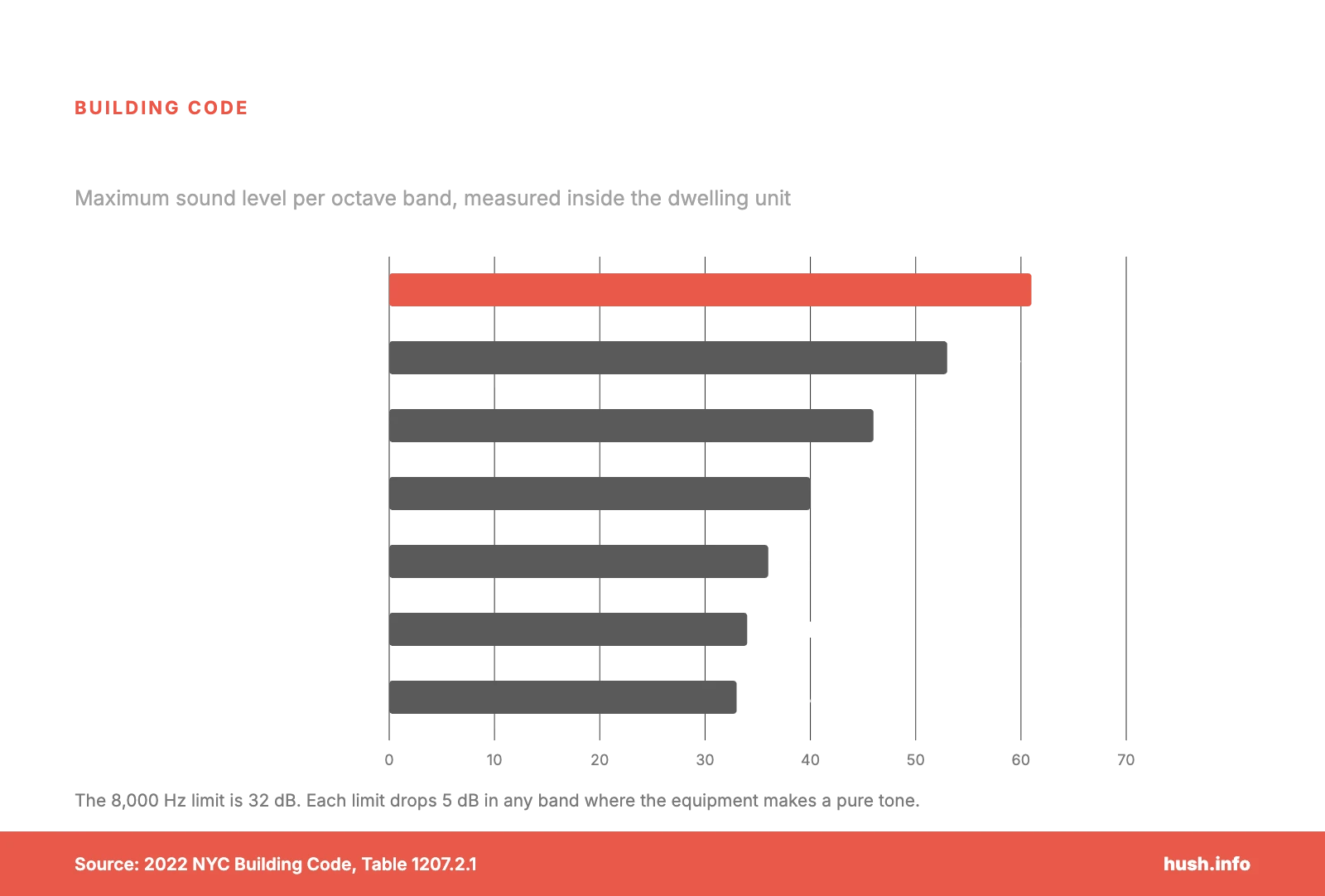
The code also limits what a machine room can push into your home. Elevator machine rooms and machinery spaces with more than 75 rated horsepower of equipment cannot sit beside, above or below an apartment. The exception is equipment certified to stay under octave-band limits measured inside the apartment. Those limits drop by 5 dB in any band where the equipment produces a pure tone.
Chapter 30 adds a simpler rule for multiple dwellings. Elevator machines and motor generators on a roof, or on any floor not on grade, must sit on vibration isolator pads. Those pads must be at least 1/2 inch thick (2022 NYC Building Code §3005.7). However, rubber pads can harden or flatten with age. So “the pads are there” and “the pads still work” are two different questions.
How to trace condo elevator noise before anyone spends money
- Keep a short log. Note the time, which car, and what the sound is: thump, whine, click, clatter or rush. A pattern tied to one car, one floor or one direction narrows things quickly.
- Tell the managing agent in writing. In co-ops and condos alike, the elevator is a building system. As a result, the fix at the source runs through the board and its elevator maintenance contractor.
- Ask for a ride-along. A mechanic who hears the noise in your apartment and then rides the car can often match it to a specific part. The usual suspects are rollers, door operators and rail joints.
- Measure at night. Octave-band readings in the apartment, with the elevator running and then idle, separate low-frequency vibration from a tone. They also give the board numbers to compare with the code table. An acoustic report puts all of that in a form the board’s engineer can act on.
Fixes at the source, and fixes in your apartment
For condo elevator noise, source fixes come first, because they help every apartment on the line. Typical items include:
- new rollers or guide shoes, aligned rails and smoothed rail joints
- adjusted door operators and hall door closers
- fresh isolation pads under the machine, and isolation for drives and controllers
- noise and vibration limits written into any modernization contract
Our elevator soundproofing work usually starts with that list. Newer buildings are not exempt either, which is part of why brand-new luxury condos can still be loud.
Inside the apartment, the options are narrower but still useful. An independent wall in front of the shaft wall takes the edge off. It should not touch the shaft wall, and it needs insulation and heavy board. Under a machine room, an isolated ceiling does the same job overhead. The shaft is a fire-rated enclosure, so new work goes in front of it, never into it. It also needs board approval. Still, room-side work does little for a deep rumble coming through the slab. That one has to be solved at the source.
FAQ
Is the board responsible for condo elevator noise?
The elevator is a building system, so the source is in the board’s hands. Writing in Habitat Magazine, a co-op attorney argued that building-system noise is within the co-op’s control. Courts have ruled against co-ops over it, too. They do defer to reasonable board decisions. That deference has limits, though, when a less disruptive fix is reasonably priced (Habitat Magazine, Noise Complaints). Condo boards run common elements in a similar way, but check your bylaws.
Will an elevator modernization make it quieter?
It can, but only if someone asks. New drives and machines are often quieter. Then again, a modernization can introduce a new tone or move equipment closer to apartments. Put measurable limits in the contract, and test before and after.
If the elevator is keeping you up, book a consultation. We will listen at night and find the path. Then we will tell you plainly whether the fix belongs to the building or to you.