
At 5:45 a.m. in a white-brick postwar on the Upper East Side, a bedroom ceiling starts to thump. Treadmill noise in an apartment travels in ways most home-gym owners never expect. The person below hears every stride before their alarm goes off.
The runner upstairs usually has no idea. On their side, the machine sounds like a hum and some soft footfalls. Downstairs, it sounds like someone tapping a drum. Most arguments start in that gap. So it helps to know what is actually happening in the floor.
Why treadmill noise in an apartment is a different problem
Most apartment noise is airborne: voices, TV, music. Walls and ceilings handle that reasonably well. A treadmill, a spin bike or a set of dumbbells is different, because the energy goes straight into the structure. The slab or joists carry it, and the ceiling below turns it back into sound.
Floor ratings do not capture this well. New York City requires IIC 50 in the lab, or 45 in the field, for floors between new apartments (NYC Building Code, Section 1207). That rating comes from a standard tapping machine. However, the test standard itself admits the machine does not simulate the weight of a human walker. It adds that the booms of real footsteps don’t show up in the single-number rating (ASTM E492-22). In other words, a floor can meet code and still pass a runner’s stride straight through.
Four myths about home gym noise
Myth: a thick rubber mat solves it
A mat helps with the click of the belt and the rattle of the frame. Those are higher-pitched sounds. The thud of a running stride is low and heavy, and a thin layer of rubber barely changes it. So a mat is a fine first step for treadmill noise in an apartment, but it is not a fix.
Myth: concrete buildings don’t have this problem
Concrete is heavy, which helps a lot with voices. It is also stiff, so it carries vibration efficiently. As a result, the complaint may come from the apartment beside the one below, not just the one directly underneath.
Myth: a bike is silent
The flywheel on a modern spin bike is quiet. Still, standing climbs rock the frame, and clip-in shoes click on and off. Bikes are usually a smaller problem than treadmills, although they are rarely a zero.
Myth: the neighbor can fix it with acoustic panels
Panels absorb sound inside a room. They do not stop sound coming through the ceiling. The National Bureau of Standards, now NIST, made the same point in a homeowner’s guide decades ago. Acoustical tile on your own ceiling, it noted, will not block noise from the unit above (NBS, Quieting: A Home Owner’s Practical Guide to Noise Control).
What actually reduces treadmill noise in an apartment
The same NBS guide gives the rule we still work by. Stop vibration as close to its source as possible, with resilient mounts between machine and floor. For home gyms, that means treating the machine and the spot it stands on, not the room below.
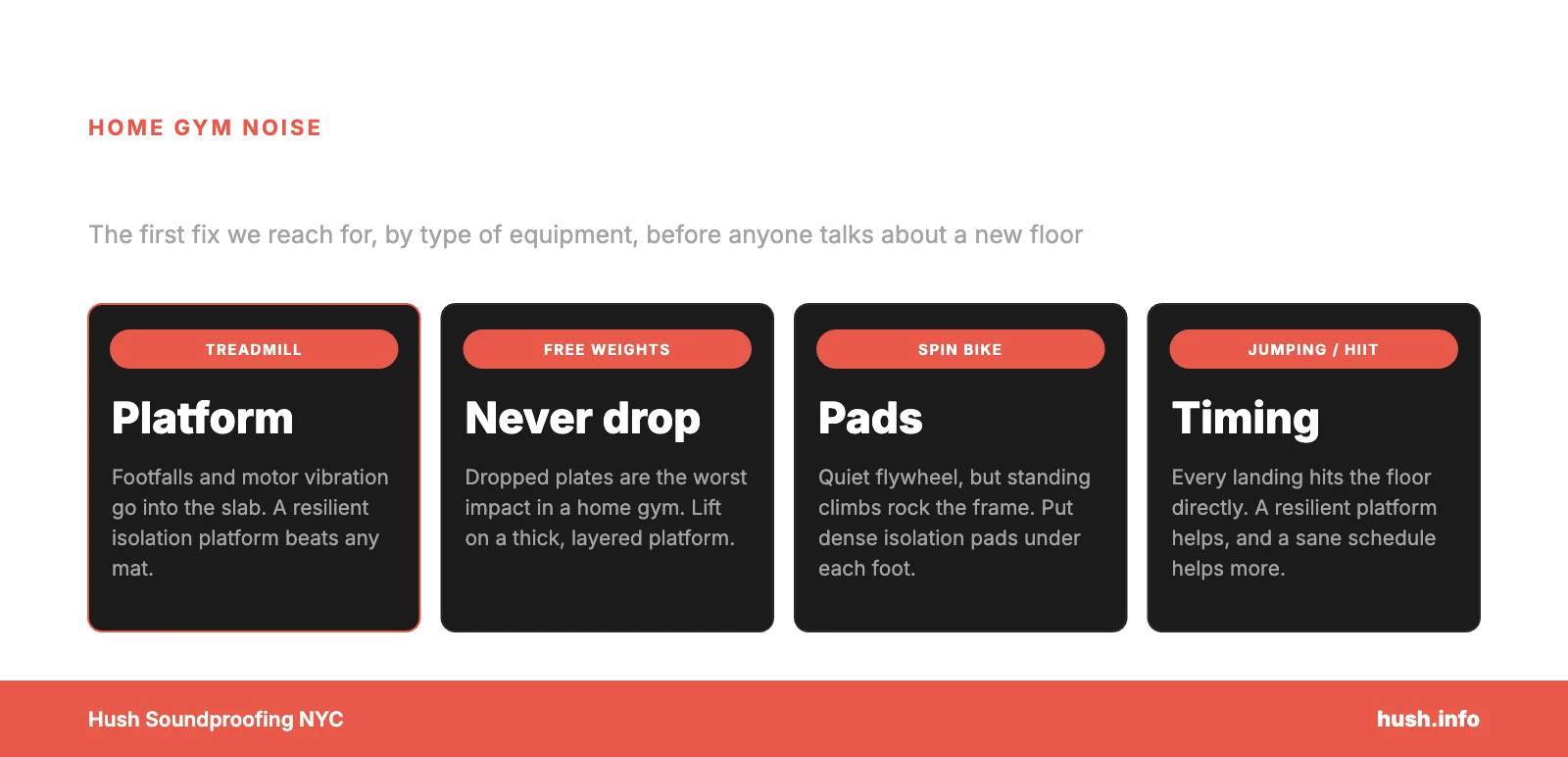
- Treadmills: an isolation platform does far more than any mat. That means a heavy, rigid deck on resilient mounts tuned for the load. Placement matters too. Floors are usually stiffer near columns and bearing walls than at mid-span.
- Free weights: a thick layered platform under the lifting area. Then a house rule of your own: set weights down, never drop them.
- Spin bikes and rowers: dense isolation pads under each foot, plus a mat to catch the small stuff.
- Jumping, HIIT and jump rope: these land directly on the floor. A resilient platform helps, but timing helps more.
Treadmill noise in a co-op apartment: rules and timing
Before buying anything heavy, read your building’s house rules and alteration agreement. Many co-ops and condos have rules on floor coverings. Some boards also want to review a large machine or a dedicated gym room. Putting in new flooring too? Our post on underlayment and carpet rules in co-ops covers what boards usually ask for.
Timing is the cheapest fix there is. A 6 a.m. run lands very differently from a 6 p.m. run. So a short talk with the neighbor about schedules often buys more goodwill than any product. If you are the one downstairs, our guide to upstairs neighbor noise covers what you can fix from your side.
When the answer is a floating floor
For a serious home gym, isolating each machine eventually stops being practical. At that point, the better answer is a floating floor across the whole room. That means a heavy layer on resilient supports, kept clear of the walls at the edges. It is the same approach we use in commercial fitness spaces, scaled for a spare bedroom. See how we handle gym soundproofing and floor soundproofing in occupied buildings.
If treadmill noise in your apartment has already turned into a board complaint, it is worth measuring before you spend. Book a consultation, and we will tell you whether a platform will do or the room needs a floor.