
How loud is a piano, really? Louder than most owners guess, which is why piano practice in an apartment so often ends up on a co-op board’s agenda. Normal practice runs about 60 to 70 dB, and fortissimo can reach 84 to 103 dB. Those figures come from audiologist Marshall Chasin, via the National Hearing Conservation Association (NHCA decibel chart).
That is a lot of sound to park against a shared wall in a prewar co-op. Still, most piano complaints can end without anyone giving up the instrument. The order matters, though, so this is a walkthrough rather than a shopping list.
What the neighbors actually hear
Piano practice in an apartment reaches the neighbors by two routes. The first is airborne. Sound leaves the soundboard, hits the wall or ceiling and comes through on the other side. An upright pushed against a party wall is the classic case, because its soundboard faces straight into that wall.
The second route is structural. The legs and pedals pass vibration into the floor, and the bass notes carry furthest. It is the same kind of problem we see with treadmills and home gyms, only more musical. Digital pianos are not immune either. Headphones remove the music, but a common pattern we see is the neighbor below still hearing a steady knock of keys and pedals.
Piano practice in a co-op apartment: the rules come first
Before you change anything, read the house rules and your proprietary lease. House rules often set hours for instruments, and some limit lessons. Those documents, more than the decibels, tend to decide how a dispute ends.
Courts have also tended to protect regular piano practice in an apartment. A column by counsel for Local 802, the New York musicians’ union, collects cases in which judges tolerated daily practice. In one, a co-op had limited playing to an hour and a half a day, with nothing after 8 p.m. The court found that rule arbitrary and unreasonable (Local 802, Allegro). However, the column dates from 2004 and is not legal advice, so ask counsel about your own building’s documents.
Habitat Magazine makes the practical point. When a player keeps reasonable hours and follows the house rules, there may be no tidy solution at all. Instead, it suggests compromise: set days and hours, mediation, or splitting the cost of noise-reducing work (Habitat Magazine). In other words, the quieter the piano gets, the easier every conversation becomes.
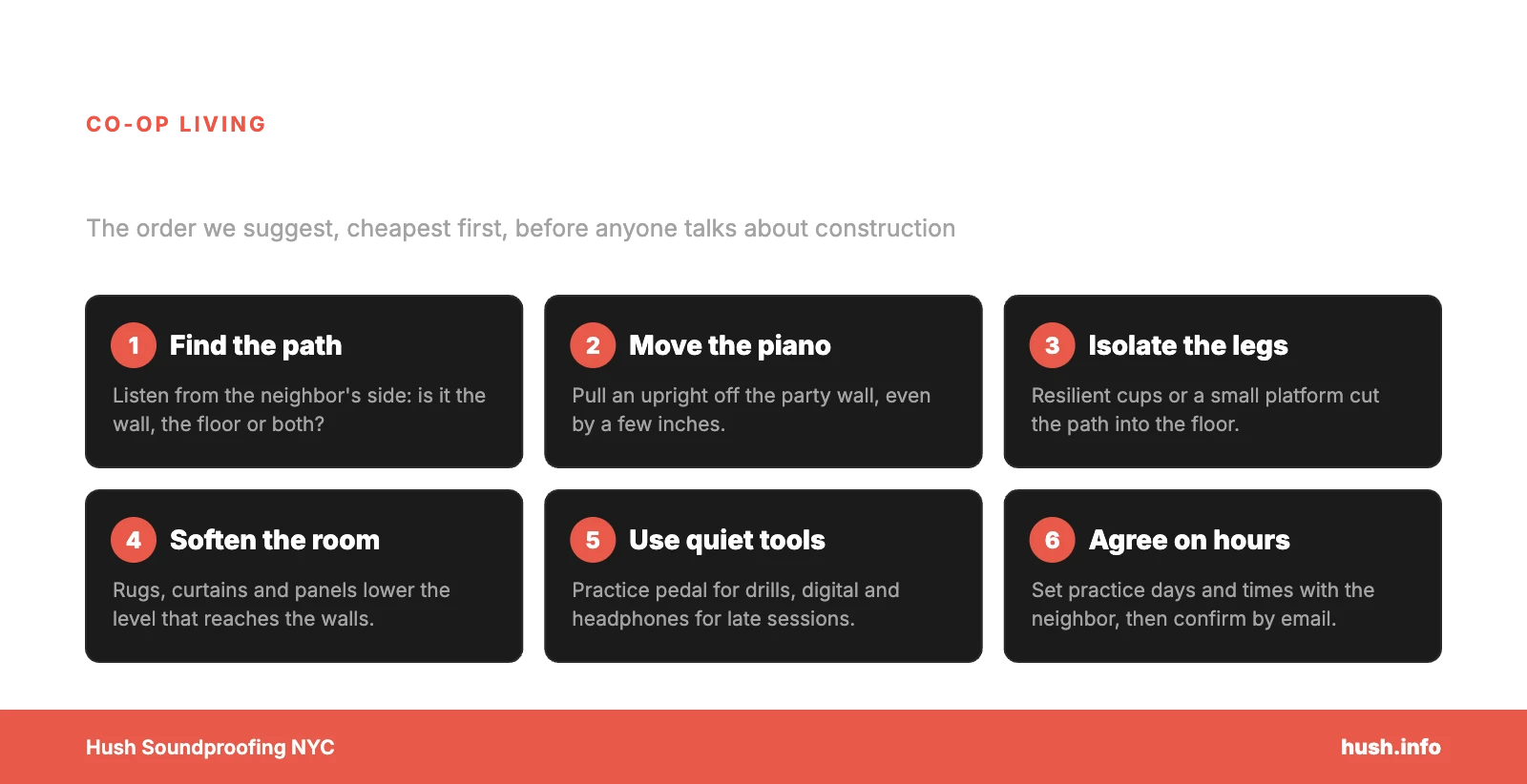
Six steps to quieter piano practice in an apartment
Work through these in order, because piano practice in an apartment rarely needs all six. Each one is cheaper than the next, and the first few often settle things on their own.
- Find the path. Ask the neighbor if you can listen from their side while someone plays. Bass through the floor points to the legs. Mid and high notes through the wall point to placement.
- Move the piano. Pull an upright off the party wall and onto an interior wall if you can. Even a few inches of air behind it helps. Also check what sits below, since layouts usually stack from floor to floor.
- Isolate it from the floor. Resilient isolation cups or a small platform under the legs cut the structural path. A dense rug with a thick pad helps too, but the cups do most of the work.
- Soften the room. Rugs, heavy curtains, full bookshelves and a few absorptive panels lower the level that builds up in your room. As a result, less sound reaches the walls.
- Use the quiet tools. If your upright has a practice pedal or mute, use it for scales and drills. For late sessions, switch to a digital piano with headphones, set on its own isolation pad.
- Agree on hours, in writing. Finally, sit down with the neighbor and agree on practice days and times, then confirm it by email. It costs nothing, and it gives the board something concrete if a complaint comes in later.
When piano practice needs construction
Some piano practice in an apartment goes past what furniture can fix. A professional who practices for hours, a teacher with students, or a grand over someone’s bedroom usually calls for real construction. That can mean a decoupled wall on the shared side, a floating floor under the piano area, or a full practice room.
Our guides to soundproofing a wall between apartments and studio soundproofing cover the options. In a co-op, all of it runs through the alteration agreement, so plan for board review and a few weeks of paperwork. If you want a second opinion before that conversation, book a consultation and we will tell you which steps your situation actually needs.
Piano practice FAQ
Does a digital piano solve the problem?
Mostly. Headphones take care of the airborne sound. Key and pedal thumps still travel through the floor, though, so put the stand on an isolation pad.
Can a co-op limit piano practice in my apartment?
That depends on your proprietary lease and house rules, so it is a question for counsel. In our experience, buildings usually regulate hours rather than ban instruments outright.
Will acoustic panels stop my neighbor hearing me?
No. Panels absorb sound inside your room, which helps a little with the overall level. They do not block what passes through the wall or floor. For that, you need isolation.