
Two hundred dollars settles half of the acoustic consultant or contractor question. Any home improvement job above that amount on a New York City residential building needs a licensed contractor (NYC DCWP, Hiring a Home Improvement Contractor). The other half is harder. Owners have to judge consultants on credentials, test methods and track record, and that is where most of them get stuck.
Here is how we would decide, if we were on your side of the table.
Acoustic consultant or contractor: what each one does
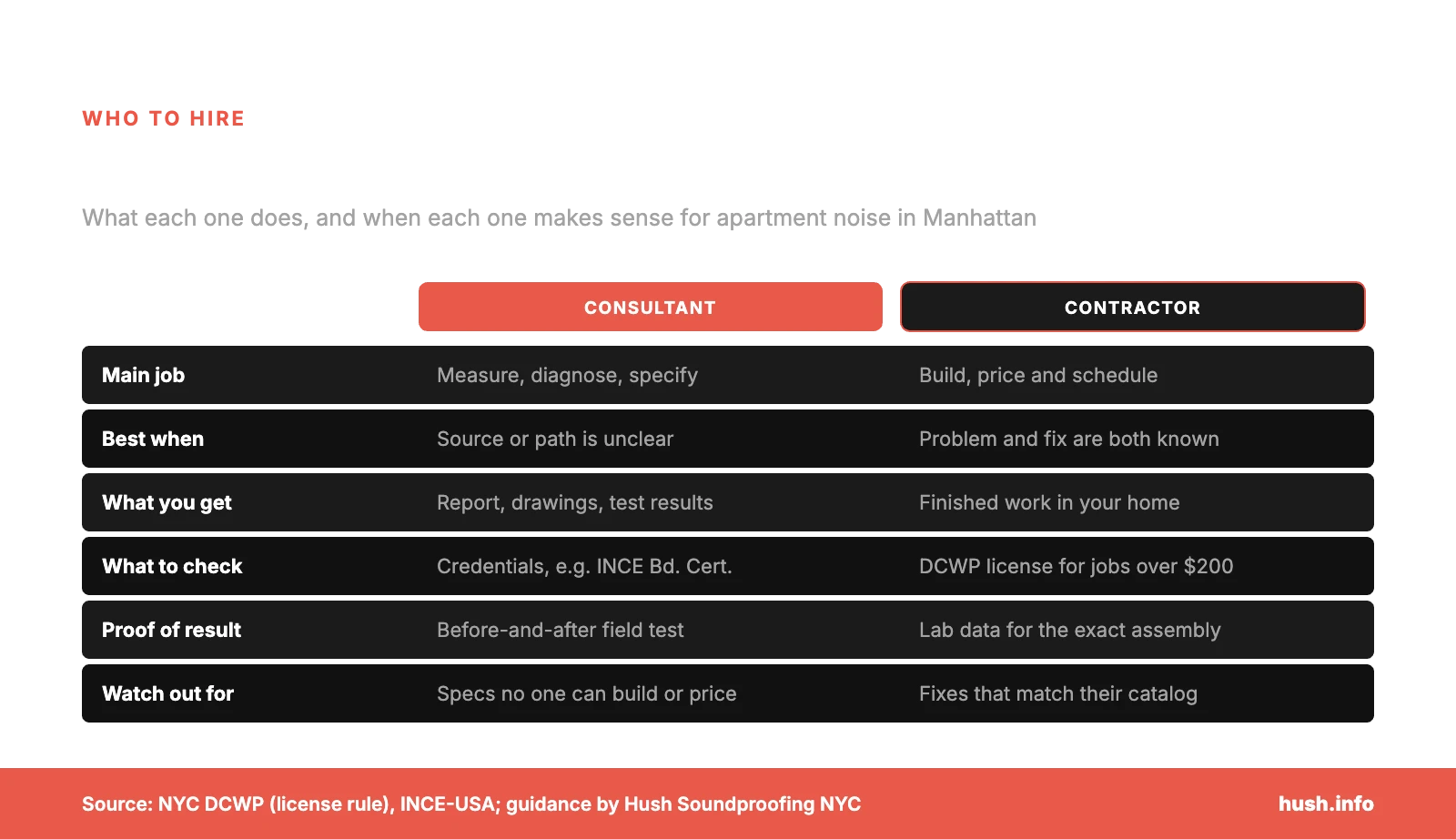
An acoustic consultant measures, diagnoses and specifies. They find the source and the path, set a target, draw the fix and test the result. A good one also tells you when not to build anything. They do not, however, swing a hammer.
A soundproofing contractor builds. The good ones know tested assemblies, sealing details and how Manhattan buildings actually work: freight elevator bookings, work hours, insurance certificates and the managing agent’s paperwork. Still, a contractor sees the problem through what they install, so the proposed fix tends to match their catalog.
Hire an acoustic consultant first when the problem is unclear
In the acoustic consultant or contractor decision, a consultant earns the fee when guessing would be expensive. In our experience, that usually means one of these situations:
- You do not know the source or the path. Low hum, thumps with no obvious cause, mechanical or elevator noise, and anything structure-borne.
- There is a dispute. A neighbor, a board or a sponsor is involved, and numbers will matter more than opinions.
- The board wants a report or a field test. Some alteration agreements require one before or after the work.
- A mistake means opening finished work. Full guts, media rooms and music rooms are too costly to redo.
- A building system is involved. When pumps, ducts or the elevator are the source, a measurement helps show the board that the fix is theirs. Our post on elevator noise in condos and co-ops walks through one example.
Field tests are where a consultant earns trust. ASTM E336, for example, measures airborne sound isolation between two rooms in a real building, including flanking paths around the wall itself (ASTM E336). As a result, a before-and-after test shows what the work actually achieved, not what a brochure promised. Our acoustical consultant service centers on that kind of measurement.
When a soundproofing contractor is enough
Sometimes the acoustic consultant or contractor choice is easy, because the diagnosis is obvious. Hallway noise through an entry door with daylight under it is a door problem. TV noise through a thin party wall, with no mystery path, is a wall problem. Likewise, a floor underlayment your board has already specified is an installation job, as we explain in our post on hardwood floors and underlayment in co-ops.
In those cases, hire a careful contractor and ask for lab data on the exact assembly they plan to build. If they cannot produce it, that tells you something.
The middle ground: one firm for both
We do both, so here is the honest version. Design-build has real advantages. The person who measured the problem also stands behind the result, and nothing gets lost between a consultant’s drawing and a crew on site. The risk is obvious, though. A firm that sells construction has a reason to recommend construction.
So keep any design-build firm, including us, to three rules. First, the diagnosis comes before the price. Second, put the scope in writing, with a target number. Then test the result. Sometimes the right answer is a door seal, or a fix the building has to pay for. A firm worth hiring will say so.
If you are weighing an acoustic consultant or contractor and a design-build firm is also bidding, ask it to price the diagnosis separately. That way you can buy the measurement alone and still shop the construction.
Acoustic consultant or contractor: what to check before you sign
- Contractor license. Check the Home Improvement Contractor license through 311 or the DCWP website. DCWP also says to get a written contract signed by both sides, and to pay no more than 25 percent of the total up front.
- Permits. If the job needs a Department of Buildings permit, a New York State registered design professional, meaning a licensed engineer or architect, files the plans (NYC DOB, Obtaining a Permit).
- Consultant credentials. Ask which test standards they use and whether they test after the work. One recognized credential is INCE board certification. It calls for professional references and an eight-hour exam, or INCE’s own course track instead, and INCE-USA compares it to PE registration (INCE-USA Board Certification).
- Building paperwork. Make sure whoever builds can meet the insurance and scheduling rules in your alteration agreement.
What your board will want to see
Most boards we work with do not much mind whether you chose an acoustic consultant or contractor. They care about what you submit. That usually means drawings, product data and tested assemblies. In a noise complaint, they also want a measured number instead of competing opinions. Our guide to alteration agreement soundproofing rules covers the paperwork side, and an acoustic report covers the evidence side.
Still not sure which you need? Book a consultation. We will tell you whether the next step is a measurement, a build, or nothing at all.