

Cast iron is quiet and PVC is loud. That is the one rule most people know about plumbing drain noise, and it is true enough to be misleading. Owners hear upstairs toilets through cast iron stacks in some very expensive Manhattan towers. The pipe matters, but how it is held, sealed and enclosed matters just as much.
Here are the myths we run into most often, and what is actually happening behind the wall.
Myth 1: a cast iron stack can’t be the problem
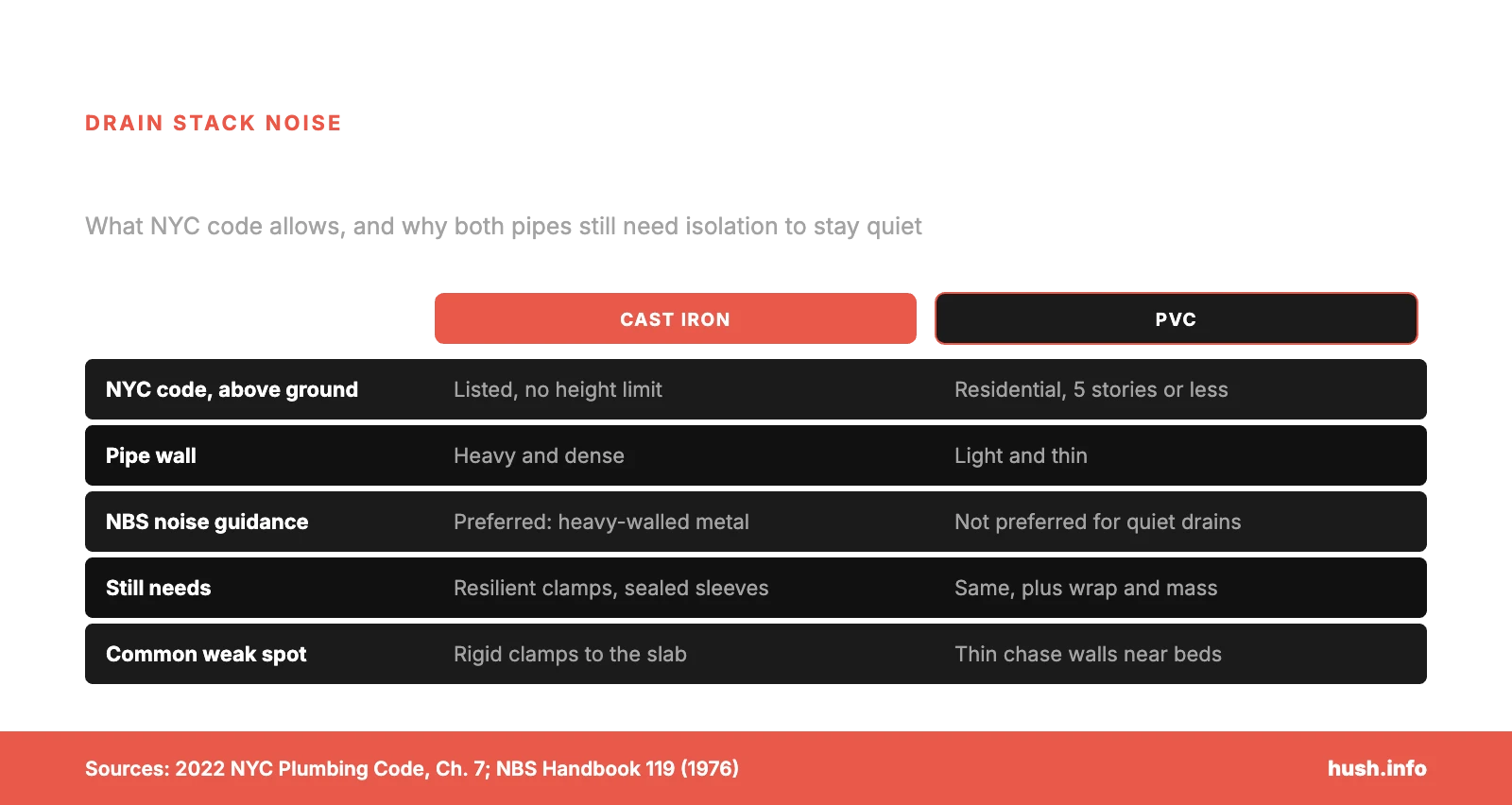
Mass does help. A 1976 federal noise handbook recommended heavy-walled pipe, such as ceramic or metal, rather than plastic for drain lines (NBS Handbook 119, Quieting). However, the same handbook gives a whole chapter to plumbing noise, and much of it is about how pipes are mounted. Falling water in horizontal runs vibrates both the piping and the building structure. A rigid clamp bolted to the slab then passes that vibration straight into the floor.
So a cast iron stack can still produce plenty of plumbing drain noise. The usual culprits are hard clamps with no resilient insert, pipes touching studs or the slab edge, and open gaps where the stack passes through the floor.
Myth 2: the developer saved money with PVC
In a Manhattan high-rise, probably not. The 2022 NYC Plumbing Code says plastic piping and fittings shall not be used, with an exception for residential buildings five stories or less in height (2022 NYC Plumbing Code, Chapter 7). The same limit appears as a footnote to the code’s table of above-ground drain and vent pipe. So in a tower, expect a metal stack, which in our experience usually means cast iron.
Plastic does show up in townhouses and low-rise buildings, where the code allows it. In a brownstone renovation with PVC drains running past a bedroom, plumbing drain noise becomes a design issue. Isolate, wrap and enclose those runs before the drywall goes up.
Myth 3: pipe wrap fixes plumbing drain noise
Wrapping a drain in a dense, flexible lagging can cut the airborne part of the sound, the whoosh you hear through a thin chase wall. Still, it does little for vibration traveling through a rigid clamp into the structure. The NBS handbook’s advice is to isolate exposed piping with bands or sleeves of rubber, neoprene or glass fiber at all points of support. It also says to seal every opening around pipe penetrations through walls and floors with a non-setting caulk.
In practice, the jobs happen in order. Isolate first, then wrap, then build the chase with enough mass and an absorptive cavity. Our chase and wall assemblies follow the same sequence.
Myth 4: the whole stack is the problem
Usually a few specific spots cause most plumbing drain noise. Horizontal runs deserve the most attention, because that is where falling water hits pipe. A horizontal offset in the ceiling over a bedroom, where the line jogs around a beam or a new layout, is a classic source. Fixtures matter too. The NBS handbook recommends setting tubs, toilets and shower stalls on resilient underlayments of cork, rubber or neoprene.
Supply pipes make their own noise. The thud when a dishwasher or washing machine valve snaps shut is water hammer, which NBS ties to the sudden interruption of flow by a quick-closing valve. That calls for a plumber’s shock absorber, not an acoustic fix. For offsets above bedrooms, our ceiling soundproofing approach isolates the ceiling from the pipe and the slab.
Myth 5: the building code limits plumbing drain noise
Not directly. Section 1207 of the NYC Building Code requires walls and floors between apartments to reach STC 50 in lab tests. It also says penetrations for piping must be sealed, lined, insulated or otherwise treated to keep that rating (2022 NYC Building Code, Chapter 12). That protects the assembly. Yet the sound section sets no decibel limit for a drain, so a flush can be loud in the bedroom next to the chase and still comply with that section.
That gap is why buyers and boards should treat drains as part of any new-construction noise review. A brand-new condo can meet every code line and still put a stack behind the headboard.
How we track down plumbing drain noise
- Run a flush test. One person runs fixtures upstairs on a schedule while another listens and records below. The timing shows which fixture, and which unit, is responsible.
- Find the path. Next, decide whether the sound is airborne through a chase wall or structure-borne through a clamp or slab. A small inspection opening usually answers that.
- Fix the contact points. Resilient clamps, sleeves at penetrations and sealed gaps come before anything else.
- Then add mass. Rebuild the chase or ceiling with isolated layers where an airborne path remains.
Most of this is mechanical noise work in miniature. If you can hear a neighbor’s shower from bed, book a consultation and we will start with the flush test.