

New construction is not the same thing as quiet construction. Luxury condo noise catches buyers off guard because the rest of the apartment performs so well. The windows seal tight and the HVAC barely registers. Then the neighbor upstairs crosses a stone floor in hard shoes at 6am, and you can follow every step.
That rarely means the developer cut corners. More often the building meets code, and the code describes a minimum. Below are the four assumptions we hear most from new condo owners in Manhattan, and what is actually going on behind each one.
Myth: New Construction Means a High Sound Standard
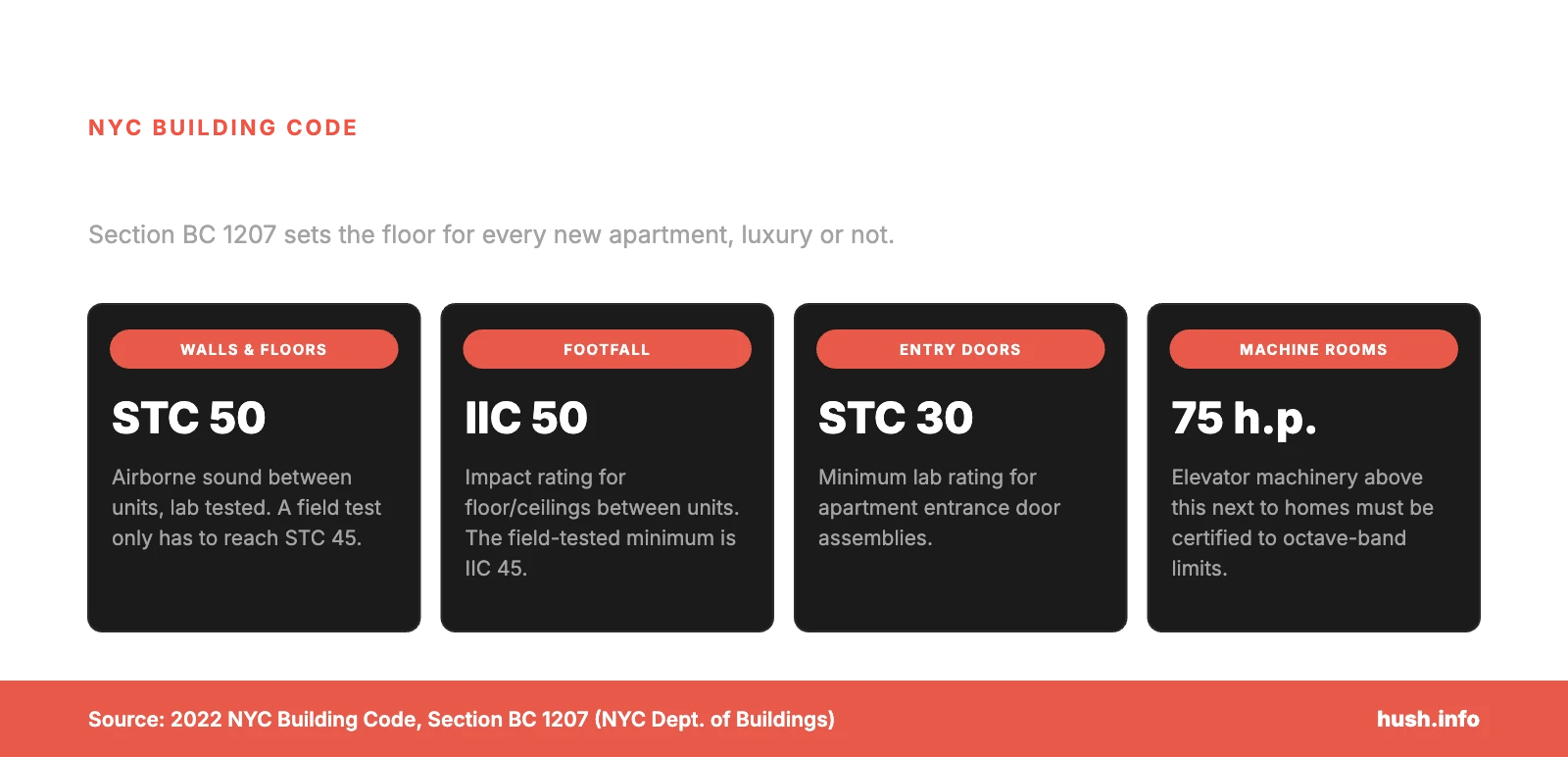
The sound rules for a glass tower on Billionaires’ Row are the same ones that apply to a six-story rental uptown. Section BC 1207 of the 2022 NYC Building Code sets the bar. Walls and floor/ceilings between apartments need STC 50 in a lab, or STC 45 if field tested. Floor/ceilings also need an impact rating of IIC 50 in the lab, or IIC 45 in finished construction. Entrance doors need STC 30 (2022 NYC Building Code, Chapter 12).
None of those numbers scale with the price per square foot. So “exceeds code” in a sales brochure can mean a lot or very little. Ask what the assemblies are, and whether anyone tested them in finished apartments. Our guide to STC and IIC ratings explains what the numbers mean in practice.
There is a New York paperwork angle, too. For a newly built condo, the sponsor’s offering plan has to describe unit finishes, including the type of flooring, walls and ceiling (13 NYCRR 20.7). It is not an acoustic report. Still, it tells you what sits under your feet and between you and the neighbors.
Myth: Concrete Towers Don’t Carry Footsteps
Concrete slabs are good at stopping voices. Footsteps are a different kind of luxury condo noise. A heel strike puts energy straight into the structure, and the slab carries it to the ceiling below. Wide-plank oak and large-format stone look great in a listing. On a thin underlayment, however, they pass that energy right through. We covered the details in our post on underlayment rules for hardwood and stone floors.
Then there is flanking. The National Research Council of Canada describes it as transmission between two rooms by paths other than the separating wall or floor (NRC Canada, soundPATHS). In glass condos, a common pattern we see is sound slipping around a well-built demising wall. It finds the slab edge at the curtain wall, a continuous mullion, or a pair of back-to-back outlets. The code itself allows for some of this, since its field minimums sit five points below the lab numbers.
Myth: Better Windows Cure Luxury Condo Noise
High-performance glazing does its job. On a high floor above the West Side Highway, traffic can fade to almost nothing. The catch is that street noise was also covering sounds inside the building. Once it is gone, you start noticing everything else.
A neighbor’s TV through the wall was always there, and so was the elevator cab passing your bedroom. They just had nothing to hide behind. That is why so much luxury condo noise turns out to be ordinary building sound in an unusually quiet room. This is the part nobody likes to hear. In a very quiet apartment, small leaks matter more, so interior details have to beat code, not just meet it.
Myth: All Luxury Condo Noise Comes From Neighbors
Plenty of it comes from the building. Elevators, trash chutes, booster pumps and drain stacks run day and night. Amenity floors add more, since a gym or a pool equipment room can sit right beside or below residential units.
The code does address the biggest machines. For example, elevator machine rooms with more than 75 rated horsepower of equipment cannot sit next to apartments unless that equipment is certified to stay under octave-band limits measured inside the unit. Vibration that travels through pipe hangers and elevator rails is harder to spot, and it never shows up during a sales gallery visit. Our mechanical noise work starts by pinning down which machine, and which path, is responsible.
Very tall buildings add one more source: movement. When the condo board at 432 Park Avenue sued the sponsors in 2021, its list of alleged defects included “intolerable” noise caused by building sway (Habitat Magazine). That is an extreme case. Even so, it is fair to ask how any supertall sounds in high wind.
What to Do About Luxury Condo Noise
Before you sign, a few steps go a long way:
- Read the description of property. Check flooring, demising walls and ceilings in the offering plan’s unit finishes.
- Ask for field test data. Results from finished units tell you more than lab ratings on paper.
- Visit at the wrong times. Early morning and evening are when neighbors are home and equipment cycles.
- Look at what surrounds the unit. An amenity floor, a mechanical room or the elevator core changes the picture.
- Bring a meter. A pre-purchase acoustic inspection measures before you are committed.
If you already own, start a simple log of what you hear, when, and in which room. Next, identify the path. Footfall, airborne sound and structure-borne vibration need different fixes, and guessing wrong gets expensive. Field testing to the methods the code names, such as ASTM E1007 for impact, also shows whether an assembly meets the minimum. That matters if the conversation is with the sponsor or the board.
After that, apartment soundproofing in a new condo is usually about details: a decoupled ceiling, sealed penetrations, isolated equipment or better underlayment upstairs. Most luxury condo noise has a specific, findable path. New buildings can be quiet. They just are not quiet by default. If you are weighing a purchase or living with a problem now, book a soundproofing consultation and we will tell you what we hear and what it would take to fix.