
Just before 6 a.m. the boiler fires, and the radiator under your bedroom window answers with three hard bangs, a hiss and a rattle that climbs the riser. Steam radiator banging is the sound of a prewar New York winter. It is also one of the few noise problems where soundproofing is the wrong first call.
The bang is water and steam meeting in the wrong place, so it is a heating problem with a heating fix. Many people call us only after a thicker rug or a radiator cover failed. Here is how to read the noise, and who fixes which part.
Why steam radiators bang in the first place
In New York City, roughly 80 percent of residential buildings are heated by steam (Urban Green Council, Demystifying Steam). Steam rises to the radiator, gives up its heat and condenses into water that has to drain back by gravity.
The trouble starts when the water cannot get out. A U.S. Department of Energy guide on balancing steam systems says back-pitched mains create low spots where water collects. It adds that these often cause water hammer, especially at the start of a heating cycle (DOE Building America Solution Center). Urban Green Council describes water hammer simply as loud banging that results from water meeting steam. A 1976 federal noise handbook put it plainly: hammering in steam pipes and radiators may come from water trapped in the lines (NBS Handbook 119, Quieting).
Read the sound: what steam radiator banging tells you
Different noises point to different parts of the system. So before anyone opens a wall, listen for when the sound happens and where it seems to start.
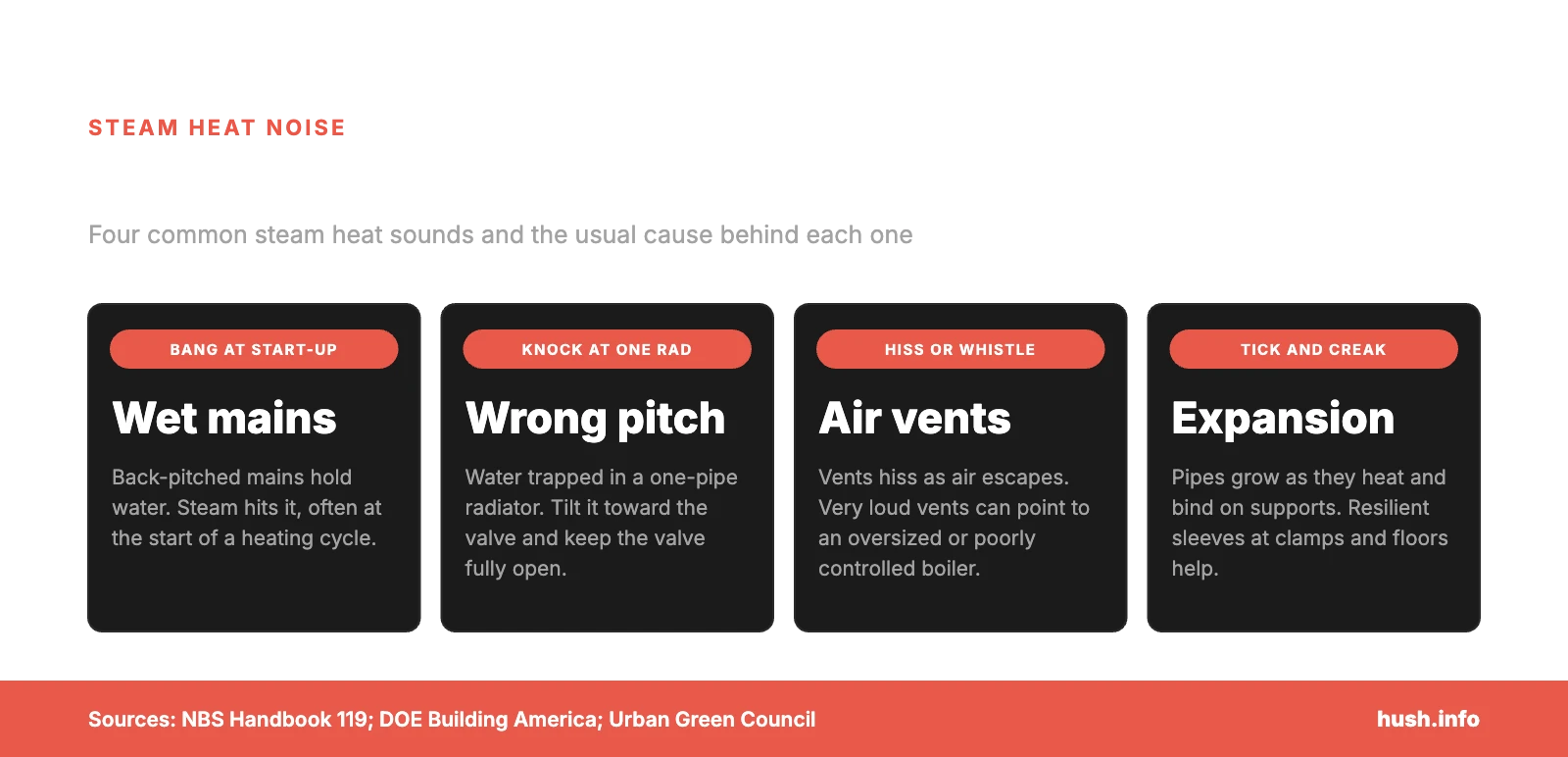
- A few loud bangs as the heat comes up. This usually means water pooled in a main or riser, which makes it a building issue.
- Knocking at one radiator. A one-pipe radiator drains its condensate back down the same pipe that feeds it steam. If it tilts the wrong way, water sits inside and steam hits it.
- Hissing or whistling. Steam pushes air out through vents, and the NBS handbook notes those vents can whistle and hiss every time steam circulates. The DOE guide adds that vents can be intolerably loud when the boiler is too large or poorly controlled.
- Ticking and creaking as pipes warm up. Pipes expand and contract with every cycle. Where a pipe binds against a support or a tight floor opening, the NBS handbook says that movement produces a staccato of creaks and snaps.
What you can check in your own apartment
Some steam radiator banging starts inside the apartment, and a few checks cost nothing. First, look at the valve. On a one-pipe system it should be fully open or fully closed. Urban Green Council notes that a partially closed one-pipe valve often causes water hammer, so these radiators are effectively on or off. Turning the knob halfway to cool a hot bedroom can make the noise worse.
Next, check the pitch. Set a level on top of a one-pipe radiator. The valve end should sit slightly lower, so water can run back out. The NBS handbook suggests wedges under the legs at the end opposite the inlet to increase the drainage angle. A new floor under one end can throw it off.
Then write it down: the time, the radiator and the type of sound. Give that log to the super or managing agent. A pattern such as banging only at the first firing of the morning helps the heating contractor find the low spot faster.
Building-wide fixes for steam radiator banging
If the bang comes from the mains or risers, the fix belongs to the building. The DOE guide says to correct back-pitched mains first. Then it calls for very-high-capacity air vents at the ends of the mains and the tops of the risers.
Habitat Magazine profiled a Manhattan co-op that shows how this plays out. The eight-unit building had a two-pipe system built without steam traps, plus a one-pipe-style air vent on every radiator. The fix was a trap at each radiator, a central vent near the boiler, and boiler pressure lowered in stages to below 3 psi. Afterward, residents heard only the sound of water flowing (Habitat Magazine, 2024).
For boards, the lesson is that piecemeal renovations can break a steam system. In that building, some contractors had added traps while others cut or sealed the second pipe. So ask the heating contractor to confirm the system type before any radiator is moved or replaced. Our guide to alteration agreement rules covers how boards put requirements like that in writing.
Where soundproofing actually helps
Soundproofing cannot stop steam radiator banging at the source, because a heavier wall does nothing about water in a pipe. However, once the heating side is sorted, some noise can remain, and that part is ours.
Risers pass through every floor, so they carry vibration from apartment to apartment. The NBS handbook recommends heat-resistant resilient sleeves at pipe clamps, supports and wall or floor penetrations, which also stops pipes rubbing as they expand. We treat a riser like any other structure-borne noise path. Isolate the contact points, seal the openings, then add mass to the enclosure if hiss still comes through. When the noise starts in the boiler room, our boiler soundproofing work begins at the equipment itself.
Steam radiator banging FAQ
Should I close the valve partway to quiet the radiator?
No. A half-closed one-pipe valve tends to cause water hammer, so keep it fully open or fully closed. If the room runs hot, ask the building about thermostatic radiator valves, which Urban Green Council lists as a one-pipe measure.
Is steam radiator banging only a noise problem?
No. The DOE guide warns that hammer can destroy main-line vents. Urban Green Council also ties wet steam to noisy pipes, spitting air vents and wasted fuel. That gives a board a maintenance reason to act, not just a comfort reason.
Will acoustic panels or a radiator cover help?
Not with the bang. Panels absorb sound reflecting inside a room, and a cover is a box around the radiator. Neither one touches the water in the pipe. Fix the pitch, venting and pressure first, then deal with what is left.
If the heating contractor has fixed the steam radiator banging and you still hear pipes through the floor, book a soundproofing consultation. We will trace the path before anyone opens a ceiling.