
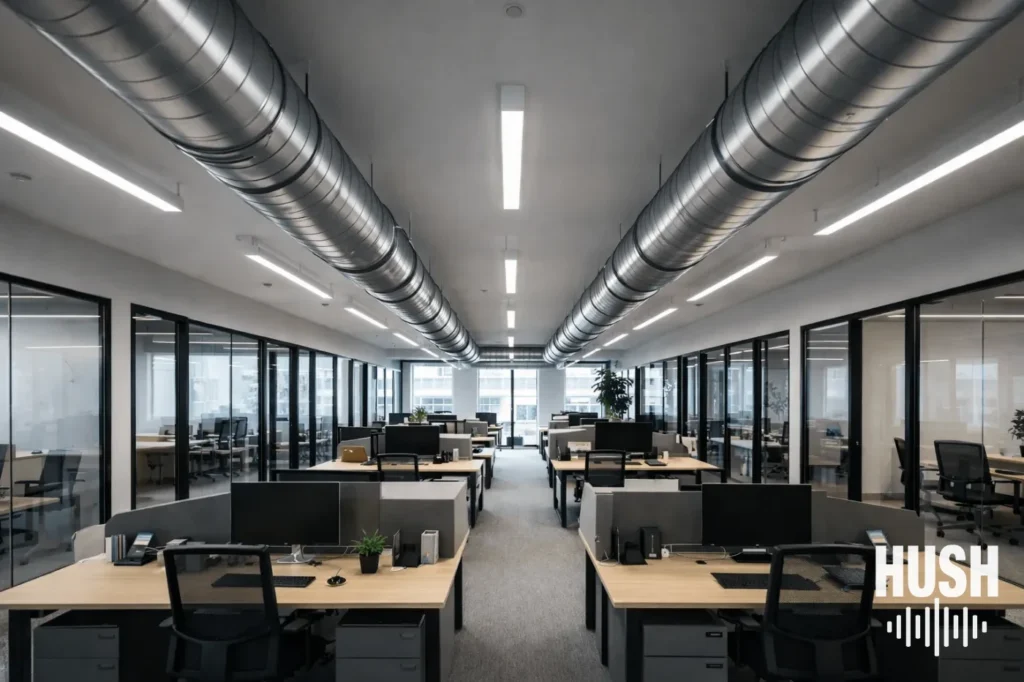
Office sound masking is the one acoustic fix that works by adding sound instead of removing it. Small speakers play a low, steady signal tuned to the frequencies of speech. As a result, the call two desks over stops being words and fades into the background.
Done well, nobody notices it. Done badly, it turns into a hiss people blame for headaches, or a line item that fixes nothing. What follows is how we decide whether masking belongs in a Manhattan office, and what has to be true for it to work.
What Office Sound Masking Actually Does
Speech privacy comes down to signal versus background. If a colleague’s voice sits well above the room’s background level, you catch every word. Raise the background a little, in the right frequencies, and the same voice gets hard to follow. In fact, GSA’s workplace acoustics guide argues that many modern open offices are too quiet for comfort, because nothing covers speech (GSA, Sound Matters).
Masking is also not the same as white noise. The same GSA guide describes masking as sound matched to the spectrum of human speech, so that normal conversation becomes unintelligible to casual listeners. That shaping is why a good system sounds like soft airflow rather than static.
Results can be measured, too. ASTM E1130 rates open-plan speech privacy with the Articulation Index, a scale from 0 to 1 that predicts how intelligible speech will be (ASTM E1130). Masking is one of the variables that moves that number.
When Office Sound Masking Works
Masking earns its keep in a few specific situations:
- Open plan with a decent ceiling. Desk-to-desk speech is the classic use. The room already absorbs sound, so masking only has to cover what is left.
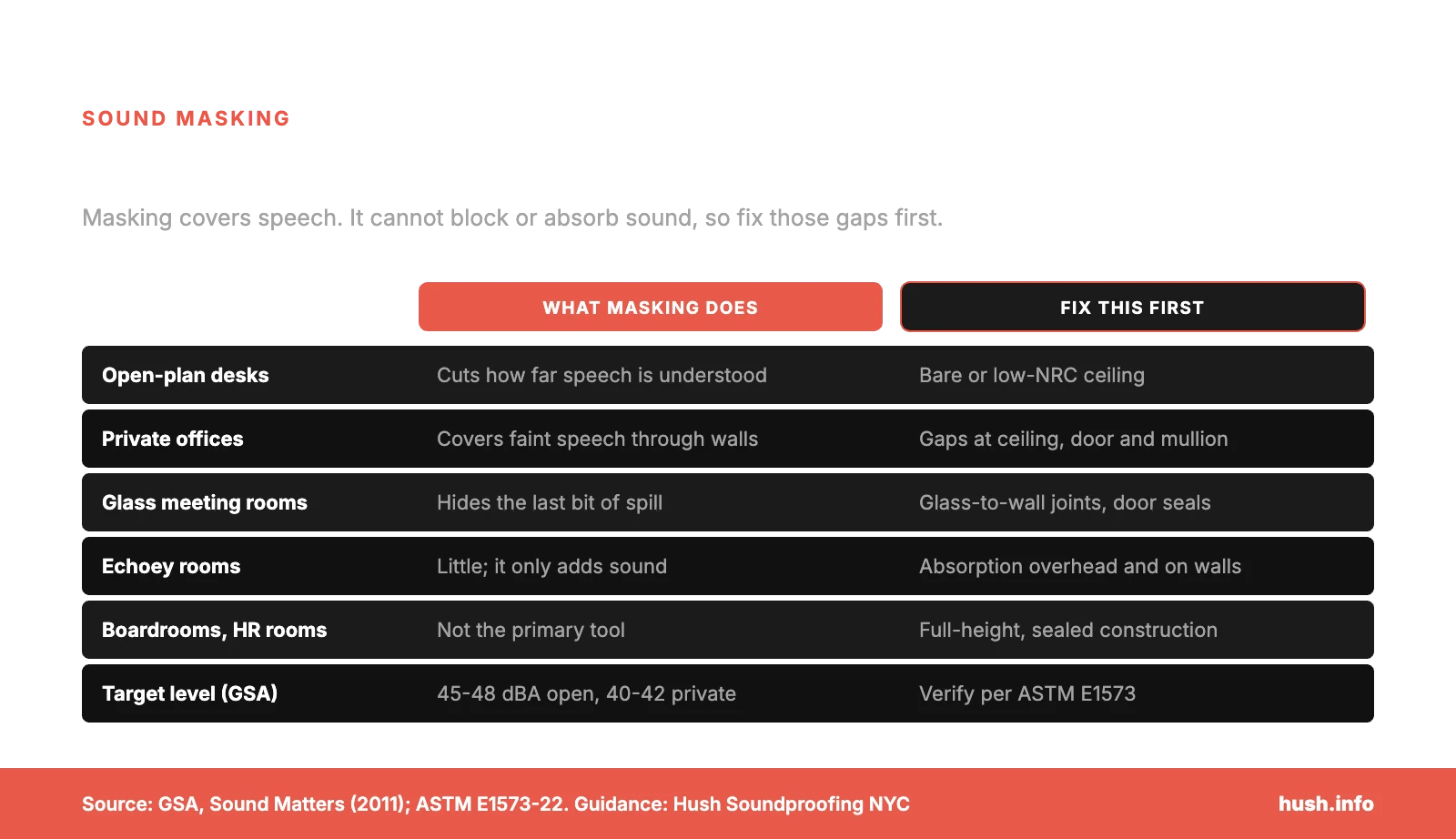
- Private offices with ordinary walls. A modest background helps cover speech that leaks through a standard partition. GSA’s guide suggests 40 to 42 dBA for private offices that need normal privacy.
- Corridors and reception areas. Masking outside offices and meeting rooms keeps passersby from catching fragments.
- Very quiet buildings. New Class A towers in Midtown and Hudson Yards often have quiet HVAC, which leaves almost no natural background.
When It Falls Short
Office sound masking cannot block or absorb anything. So it fails in predictable places:
- Rooms that echo. Hard ceilings and floors make speech carry and ring. Adding sound to a reverberant room just makes it louder, so it needs ceiling clouds or acoustic panels first.
- Leaky construction. Partitions that stop at the ceiling tile, undercut doors and gaps where glass meets the wall need fixing first. Our post on glass-front conference rooms covers the usual leaks.
- Confidential rooms. GSA’s guide does not treat masking as the typical answer for confidential enclosed rooms, and it rules masking out for secure ones. For HR, legal and deal rooms, construction does the work, as we explained in our piece on speech privacy for law and finance offices.
- Turning it up to rescue a bad space. Above the level a design calls for, masking stops being background and becomes the complaint.
Setting Levels People Won’t Notice
With office sound masking, level is everything. GSA’s guide suggests 45 to 48 dBA for open-plan areas, tuned by zone, and lower levels in private offices. Those are modest numbers on purpose. Then come the details that separate a good install from a hissing one:
- Zones. Open areas, private offices and corridors each need their own level.
- Spectrum, not just volume. The shape across frequencies matters as much as the overall dBA.
- Verification. ASTM E1573 covers measuring masking in A-weighted and one-third-octave levels, and it expects level and spectrum to stay within tolerance across the treated area (ASTM E1573-22).
- A gradual start. We prefer to bring levels up over a couple of weeks so the change never feels sudden.
Exposed-ceiling offices in Flatiron and Chelsea lofts add a wrinkle. With no ceiling tile to hide behind, emitters sit in plain view, so placement and tuning take more care.
Why Masking Comes Third
The GSA guide frames office acoustics as the ABCs: Absorb, Block, Cover. Electronic masking is the cover, and the guide treats it as the third step, after absorption and blocking. Research points the same way. Bradley’s study of conventional open-plan offices found that ceiling absorption, panel height and workstation size mattered most. It also concluded that acceptable speech privacy is out of reach unless every design parameter sits near its optimum (Bradley, Canadian Acoustics, 2003).
In other words, office sound masking is a finishing tool. It works when the ceiling absorbs, the partitions are sealed and the HVAC is quiet. That is why our office soundproofing scopes usually start overhead and finish with masking.
Office Sound Masking FAQ
Is office sound masking just white noise?
No. Masking is shaped to the speech spectrum. That is why it sounds smoother and less hissy than plain white noise.
Will employees hear it?
At first, some will. Set at a modest level and brought up gradually, it usually fades into the background. If people still talk about the masking after a month, the level or the spectrum needs another look.
Can masking fix a conference room that leaks?
Only the last bit of it. Masking in the corridor can cover faint spill, but gaps at the ceiling, door and glass have to be sealed first. Otherwise you are covering a hole with noise.
If you are planning a fit-out or living with a loud floor now, schedule a consultation. Sometimes the honest answer is that masking should wait until the ceiling and walls are sorted.