

“It’s a landmark, so we can’t touch the windows.” That line comes up a lot in landmark window soundproofing. It is also mostly wrong. The real fix usually goes on the room side of the window, where the Landmarks Preservation Commission has far less to say. The trick is making it quiet and invisible from the street at the same time.
Here are four myths we hear in brownstones and prewar co-ops, and what actually works.
Myth 1: a landmark means no window soundproofing
The LPC’s own permit guidebook lists interior storm windows among the ordinary maintenance and retrofitting work that needs no permit. The condition is that nothing shows from the street. Clear-glazed interior storm windows need no LPC permit if they have no visible mullions, muntins or wide frames (LPC Permit Guidebook).
Two caveats apply, though. An interior landmark or your co-op’s alteration agreement can add rules of its own. And when a case is unclear, the guidebook points you to the LPC directly, so ask before you build.
Myth 2: the outside is the easy place to add glass
Exterior storm windows look like the simple route. In a landmark, they are not. They require a permit. They also have to fit tightly, sit as far back from the wall plane as possible and match the window’s finish. Full replacement is possible too. LPC staff can approve new primary-facade windows that match the historic configuration, operation, details, materials and finish. The rules loosen at secondary facades, especially ones the street cannot see.
Still, replacement means drawings, review and time. By contrast, landmark window soundproofing with a clean interior insert needs none of that.
Myth 3: thicker glass in the old sash will fix it
Single glass runs out of road quickly. Research from the National Research Council Canada found that single-glazing STC barely rises as glass gets thicker (NRC, CBD-240). A stiffness effect called coincidence is to blame.
Meanwhile, the old sash is often the bigger leak. Even a well-weatherstripped window that opens usually rates 3 to 5 STC points below a sealed one, per the same digest. A loose double-hung with tired weatherstripping leaks more than that. So for landmark window soundproofing, heavier glass in a leaky sash buys you very little.
Myth 4: double glazing is double glazing
In landmark window soundproofing, two panes only help if there is real space between them. In a typical factory-sealed unit the gap is small, and the panes and trapped air behave like a spring. The NRC digest puts that resonance between 200 and 400 Hz, where city traffic has plenty of energy. As a result, a thin sealed unit can rate only slightly better than single glass, or even worse.
The fix is distance. The NRC rule of thumb is simple: each doubling of the air space adds about 3 STC points. That is why secondary glazing suits prewar buildings so well. Thick masonry walls leave a deep reveal. An interior insert can sit well behind the old sash, in its own frame. For very high isolation, the digest also favors separate frames, so sound cannot cross through a shared one. Finally, it recommends glass layers with a thickness ratio of about 2, so their weak frequencies do not coincide.
What good landmark window soundproofing looks like
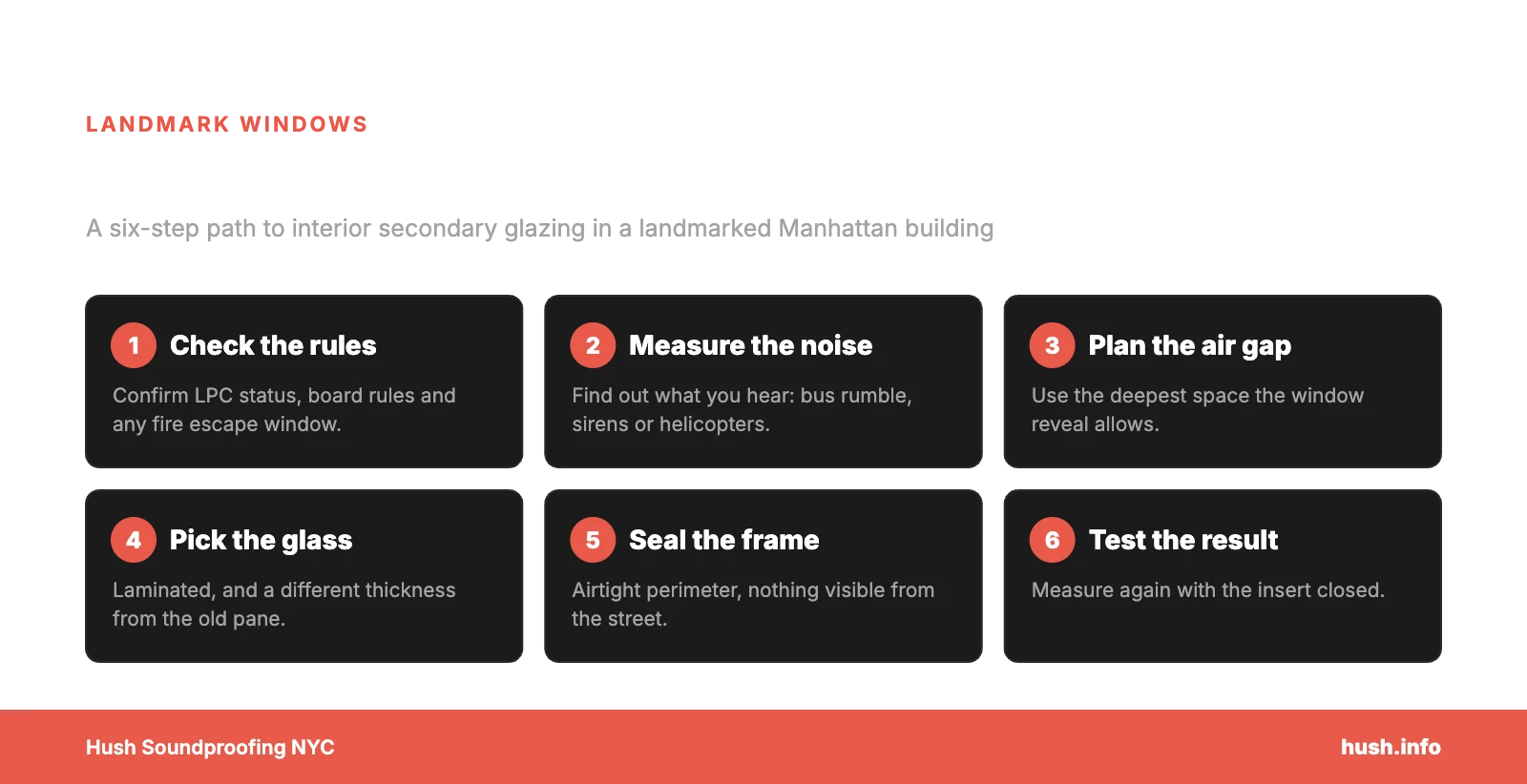
- A deep, sealed air space. Use the deepest gap the reveal allows, and seal the insert’s frame to the opening all the way around.
- Laminated glass on the room side. The interlayer adds damping. Per the NRC digest, that benefit depends on temperature and can drop sharply in the cold. An inner pane stays warm, which helps.
- A different thickness from the old glass. Matching panes share the same weak spot.
- Absorptive reveals, as a bonus. Per the NRC, lining the reveal between panes raises STC only slightly. Still, gains of up to 10 dB can show up at high frequencies.
- Nothing visible from the street. No muntins, no wide frames in view, and a finish that disappears behind the sash.
- Easy opening where it matters. FDNY says to keep the fire escape window clear of obstructions (FDNY, Apartment Building Fire Safety). It also allows only approved gates there, ones that open without a key. Hold any insert on that window to the same standard.
For most of our landmark window soundproofing work, that list matters more than the brand of insert. A well-sealed, deep, laminated insert beats an expensive one installed tight against the old glass.
Before you order landmark window soundproofing
Measure first. Bus rumble, sirens and helicopter thump call for different priorities. A short reading tells you which one you are fighting. Our post on helicopter noise in NYC covers one of the toughest sources. Then check the paperwork. In a co-op or condo, an insert usually still goes through the alteration agreement even when the LPC needs nothing.
Planning a bigger townhouse project? Read our guide to soundproofing a Manhattan townhouse conversion. Our brownstone soundproofing page covers the walls and floors. To get the windows right the first time, book a consultation. We will measure before we recommend anything.