

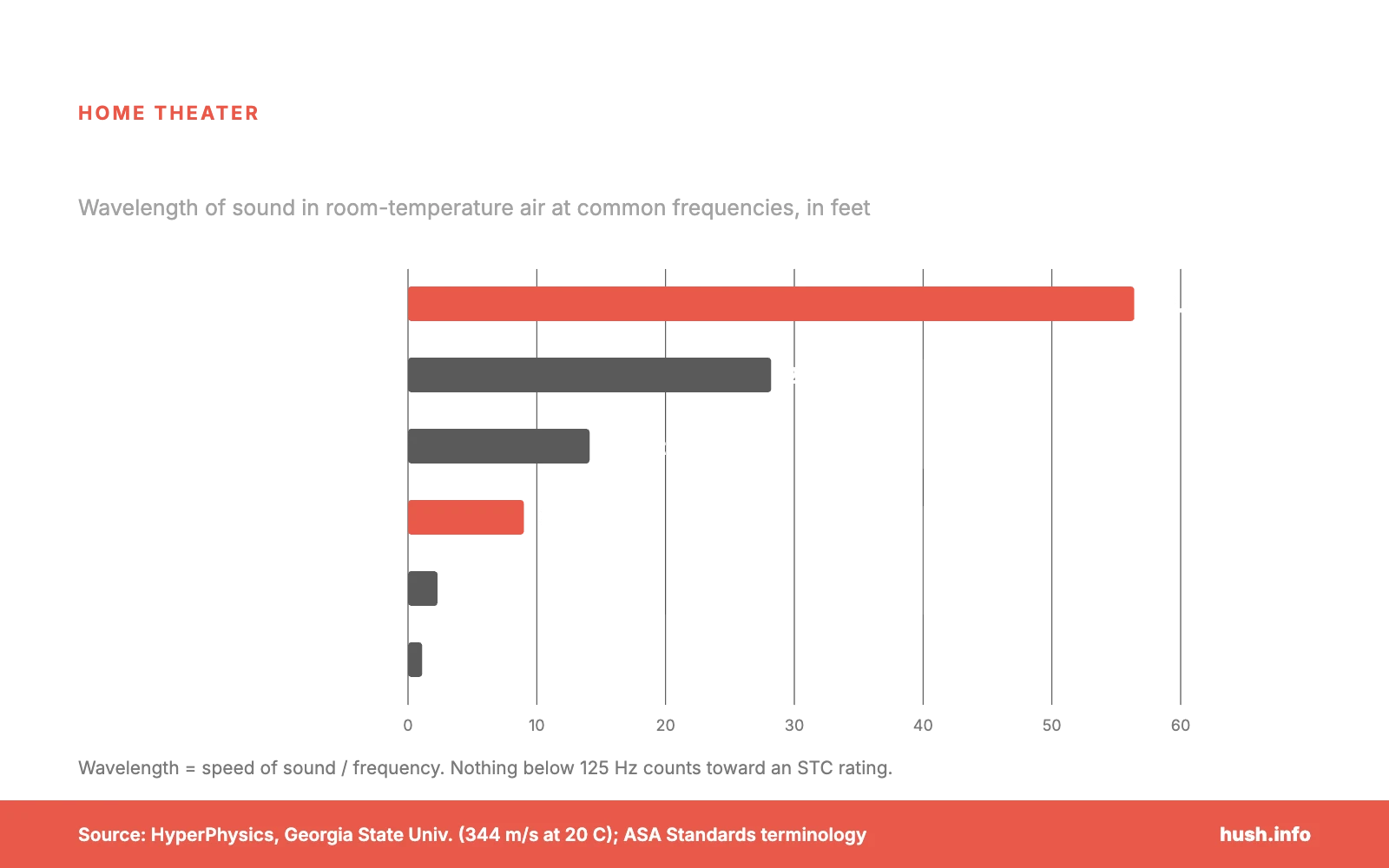
A 20 Hz bass note has a wavelength of about 56 feet. That is longer than most Manhattan living rooms, and it is the main reason home theater acoustics in an apartment are harder than they look. The sound you want to feel is also the sound your neighbors will hear.
A good media room has to do two separate jobs. It has to keep sound in, and it has to sound good inside. Those jobs use different tools, and mixing them up is the most expensive mistake we see.
Two Jobs in Home Theater Acoustics
Isolation is about mass, airtightness and decoupling. It decides how much of the movie reaches the apartment next door. Room acoustics is about absorption, diffusion and speaker placement. It decides whether dialogue is clear and the bass is even from the couch.
The two overlap less than people expect. For example, fabric panels on every wall can make a room sound wonderful, yet they do very little for the neighbor. Panels absorb reflections inside the room. Stopping bass from leaving takes construction.
Why Bass Is the Hard Part of Home Theater Acoustics
Most wall ratings ignore the problem. STC is fitted across 16 one-third-octave bands from 125 Hz to 4000 Hz (ASA Standards terminology). Nothing below 125 Hz counts, which is exactly where a subwoofer does its work. ASTM goes further and says the STC method is not appropriate for sources like music systems, which need a detailed analysis in frequency bands instead (ASTM E413-22).
Physics adds a second penalty. For a single-layer wall, transmission loss rises about 6 dB each time you double either the mass or the frequency (NRC Canadian Building Digest 239). So every octave you go down costs about 6 dB, and doubling the drywall only buys about 6 dB back. That is why a wall that stops voices cold can still let a movie’s explosions through.
Size is the last piece. Sound travels about 344 meters per second in room-temperature air (HyperPhysics, Georgia State University), and wavelength is that speed divided by frequency. So an 80 Hz note is roughly 14 feet long. Waves that size pass right through thin absorbers, which is why bass control takes depth and not just fabric.
Building the Room Inside the Room
For home theater acoustics, serious isolation in a Manhattan apartment usually means a room within a room. In practice, that looks like this:
- Decoupled walls. A new stud wall that does not touch the party wall, or resilient mounting, with damped double layers of gypsum.
- An isolated ceiling. Spring or rubber hangers carry the new ceiling, so the slab above is not driven directly. Our ceiling soundproofing work in co-ops often starts here.
- A floating floor, where the structure allows. It helps the unit below, but it adds weight and height, so an engineer has to review it.
- Nothing hard-mounted to shared walls. Screens, speakers and subwoofers should not bolt to a party wall.
In-wall and in-ceiling speakers deserve a warning. Each one cuts a hole in the assembly you just paid to build. If you want them, plan enclosed back boxes and treat each opening as part of the isolation design.
Doors, Air and the Other Weak Spots
A great wall with a hollow-core door is a hollow-core room, and home theater acoustics fail fastest at the door. Use a solid door with full perimeter seals and an automatic door bottom. Better yet, use two doors with a small vestibule if the plan allows.
Then there is air. A sealed room needs ventilation, and a straight duct is a speaking tube to the next room. Lined duct runs, flexible connections and silencers keep supply and return from undoing the walls; our page on HVAC duct soundproofing explains the options. Ductless mini-split heads are simpler, but pick a quiet model and seal the line set penetration.
Inside the Room: Treatment That Helps
Once sound stays in, make it sound right. Start with absorption at the first reflection points on the side walls and ceiling. Then treat the rear wall so it does not slap sound back at the listening position. Bass needs thick absorbers or tuned traps, usually in corners.
Parallel walls also create standing waves at frequencies set by the room’s dimensions. As a result, bass can boom in one seat and vanish in the next. Keep the main seat away from the exact middle of the room and off the back wall. After that, measure and adjust the subwoofer position before buying more treatment.
Co-op and Condo Approvals
A media room is an alteration, and most boards treat home theater acoustics work that way. Expect drawings, a review by the board’s architect or engineer, and limits on work hours and freight elevator use. A floating floor or a heavy wall build-up may also need structural sign-off. Our post on alteration agreements and soundproofing walks through the approval side. If you are still deciding who should design the room, read acoustic consultant or soundproofing contractor first.
Home Theater Acoustics FAQ
Will acoustic panels keep the movie from reaching my neighbors?
Only slightly. Panels control reflections inside the room. Keeping sound in takes mass, sealing and decoupling.
Can I just turn the subwoofer down?
It helps. So does setting a sensible crossover and putting the sub on an isolation platform away from shared walls. Still, if late-night movies are the goal, construction is the real fix.
Is a dedicated room necessary for good home theater acoustics?
No, but it helps a lot. A media wall in an open living room can sound great. Isolating it from the neighbors is much harder, because there is no door to close and far more surface to treat.
Planning a media room in a co-op or condo? Home theater acoustics are far easier to get right on paper than after the drywall is up. Book a consultation before the drawings go to the board, while changes are still cheap.