
Mechanical Noise Reduction
Mechanical Noise Control
Mechanical noise is rarely “just loud.” In New York City buildings, it’s usually a combination of airborne sound, structure-borne vibration, and duct-borne transmission. That’s why quick fixes fail. As a result, the solution is almost always a system: isolate the equipment, control vibration paths, then add the right mass, damping, and detailing where the building needs it.
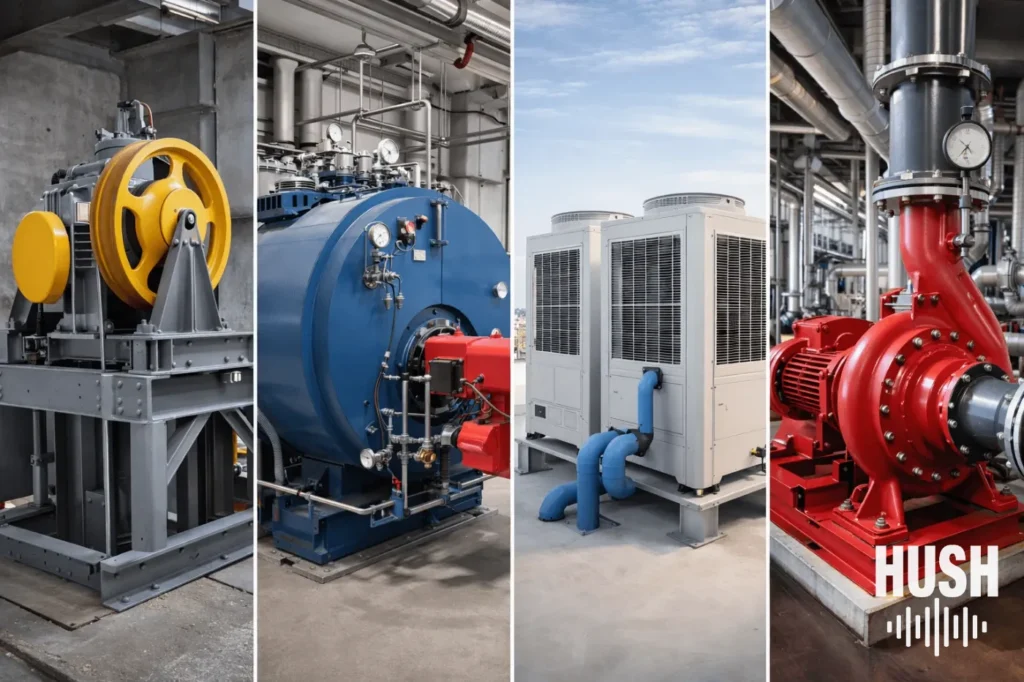
In short, Hush handles mechanical noise in apartments, offices, hotels, and mixed-use buildings—elevators, boiler rooms, pumps, chillers, and HVAC systems. Specifically, we approach the problem the same way every time: identify the source, map the transmission path, then build an assembly that performs under real conditions.
Mechanical noise types we solve
Mechanical noise control works best when we name the problem correctly. Therefore, we separate the issue into categories before recommending any scope:
- Structure-borne vibration: the building carries vibration, then re-radiates it through walls, ceilings, and floors.
- Tonal noise: whine, hum, or cycling tones from motors, VFDs, bearings, and rotating equipment. A steady tone annoys people more than broadband noise at the same level.
- Low-frequency energy: the “pressure” feeling—harder to block, easier to misdiagnose.
- Duct-borne noise: fan noise, rumble, cross-talk, and breakout through ductwork.
- Flanking paths: sound that travels via structure, penetrations, shafts, and shared framing.
For example, if the noise feels like it is coming “through the structure,” start with ceiling soundproofing and wall soundproofing fundamentals. In fact, mechanical noise is often a flanking problem.
Our process: control the source, then control the path
Mechanical noise is not solved by stacking products. First we diagnose, then we isolate, then we build the correct envelope. In practice, that looks like:
- Step 1: Site evaluation + measurement (sound levels, vibration behavior, and the dominant transmission path).
- Step 2: Equipment isolation strategy (correct isolators, inertia bases where required, and no rigid short-circuits).
- Step 3: Connection control (flex connectors, pipe isolation hangers, and penetration detailing).
- Step 4: Assembly upgrades (mass + damping + airtightness in walls/ceilings/floors where the building re-radiates noise).
- Step 5: Verification (confirm the result in the space that mattered: the bedroom, the office, the guest room, the conference room).
Vibration isolation uses springs, neoprene pads or isolation hangers to carry the machine. Isolator selection comes down to static deflection, that is, how far a spring or pad compresses under the machine’s weight. More deflection gives a lower natural frequency. When that frequency sits well below the equipment’s running speed, transmissibility (the share of vibration that gets through) drops sharply. An inertia base, a heavy concrete base under a pump or fan, also lowers the center of gravity.
Neoprene pads come with a catch: rubber is nearly incompressible, with a Poisson’s ratio close to 0.5. In fact, its bulk modulus is several orders of magnitude larger than its shear modulus. So a pad must bulge to isolate, and a higher shape factor (loaded area ÷ free-to-bulge area) makes it stiffer. Boxed in, grouted in, over-tightened or overloaded, a pad acts nearly rigid and passes vibration straight through: rigid transfer.
Similarly, when you want a single scope that’s buildable and accountable, use soundproofing consultation as the entry point.
High-temperature machines + piping: damping and foil-faced insulation that holds up
Boilers, steam piping, hot water loops, and some mechanical rooms run hot enough that typical “sound blanket” thinking breaks down. For instance, we design high-temperature noise control systems using heat-appropriate insulation and mechanical detailing.
- Foil-faced insulation jackets: used to manage temperature while supporting clean, durable finishes on pipes and equipment.
- Damping layers: constrained-layer or viscoelastic damping where vibration is causing panel “ring” and sympathetic buzz.
- Mass barriers + jacketing: added where airborne breakout is driving complaints, then detailed so seams stay continuous.
- Isolation of pipe supports: because rigid hangers can transmit vibration into slabs, walls, and risers.
Likewise, if insulation inside cavities is part of the fix, see soundproofing insulation for how we approach resonance control.
Mechanical Noise pages
Choose the system you’re dealing with:
- Elevator Soundproofing
- Boiler Soundproofing
- Pump Soundproofing
- Chiller Soundproofing
- HVAC Unit Soundproofing
- HVAC Duct Soundproofing
Frequently Asked Questions
Do acoustic panels fix mechanical noise? No. After all, mechanical noise is typically vibration and transmission through structure and openings. In other words, panels reduce echo inside a room, not vibration coming through a building.
Why does the noise sound worse at night? At night, the building is quieter, so tonal and low-frequency mechanical noise becomes more noticeable. In addition, some systems cycle more aggressively overnight.
Related soundproofing systems:
- Wall Soundproofing
- Ceiling Soundproofing
- Floor Soundproofing
- Soundproof Door Systems
- Acoustical Consultant NYC
Further reading:
Mechanical Noise in NYC: Where It Comes From and How We Trace It
Mechanical noise is any sound produced by a building’s equipment: elevators, boilers, pumps, chillers, rooftop units, fans and even transformers. In dense New York buildings, that equipment often sits just a floor or a wall away from bedrooms and offices. As a result, mechanical noise is one of the most persistent complaints we investigate. It also tends to be tonal and low-pitched, so it’s more noticeable at night and harder to ignore.
Our process starts with diagnosis. Specifically, we measure sound and vibration, compare levels when equipment cycles on and off, and trace the path from source to room. Only then do we recommend a noise abatement plan: isolation, enclosures, silencers or room upgrades. The NYC DEP Residential Noise Control Guidance Sheet stresses the same point, noting that HVAC noise can be difficult to control unless you identify its true cause. Equipment noise also falls under the NYC Noise Code. In other words, it’s the city’s noise ordinance, and building owners and equipment operators must follow it. When the source is outside the building, such as nearby subway lines, the FTA’s Transit Noise and Vibration Impact Assessment Manual offers useful context.
We also log dBC alongside dBA. A-weighting follows human hearing and under-reads bass, so a 63 Hz hum can look minor in dBA. However, C-weighting and octave-band data, such as the 63 Hz and 125 Hz bands, show that energy clearly. We then set HVAC targets with NC or RC curves, which rate a room’s background noise by octave band.
Mechanical Noise FAQs
How do I know if a noise is mechanical?
Typically, mechanical noise follows a schedule. For example, it starts and stops with equipment cycles, it’s steady or tonal, and it’s often worse at night or on hot and cold days.
Can mechanical noise be fixed from inside my apartment?
Sometimes. A decoupled wall or ceiling can help a lot. However, fixing the equipment at the source is usually more effective, so we look at both options.
Who is responsible for building mechanical noise?
In most cases, the building owner or the equipment owner. Our acoustic reports document the problem clearly for those conversations.
What does a mechanical noise assessment include?
Generally, on-site measurements, a source and path analysis and clear recommendations, with optional before-and-after verification.
See elevator, boiler, pump and HVAC unit soundproofing, or order an acoustic report.
Our Clients
Client partners include residential, commercial, and institutional organizations that rely on precise soundproofing and acoustical execution.

SCHEDULE A CONSULTATION
Contact Hush Soundproofing today! Our expert team is ready to assess your space and provide customized solutions to create a peaceful and quiet environment.